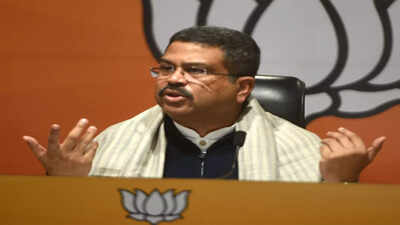
NEW DELHI: Dharmendra Pradhan, who stepped down as Union education minister on Saturday after a five-year tenure, leaves behind an education system more standardised, digitally connected and centrally regulated than the one he inherited — but also questions over examination credibility, institutional autonomy, data privacy and the Centre’s capacity to implement reforms on such a large scale.Pradhan, the longest-serving education minister in Prime Minister Narendra Modi’s cabinet, held the portfolio from July 7, 2021, to July 25, 2026. Until 2024, he was also minister for skill development and entrepreneurship.His tenure was less about announcing a new education policy — the National Education Policy had been approved in 2020 — and more about constructing the machinery required to put it into operation.
CJP Jantar Mantar Protest Updates
The defining theme was standardisation and portability: common entrance examinations, transferable academic credits, permanent student identification numbers, comparable assessment standards and an attempted umbrella regulator for higher education.The Common University Entrance Test, introduced in 2022, sought to replace differing Class XII board cut-offs with a common admission platform for central universities. It also dramatically expanded the role of the National Testing Agency, whose functioning and credibility later became one of the biggest challenges of Pradhan’s tenure.The National Credit Framework, Academic Bank of Credits and four-year undergraduate programmes were designed to allow students to accumulate and transfer credits, pursue multidisciplinary courses and enter or leave programmes without losing their academic record.APAAR, envisaged as a permanent academic identity for every student, sought to link school, university and skill qualifications through DigiLocker and the credit bank. While intended to ease mobility, it triggered concerns over consent and protection of children’s data.In school education, the ministry released curriculum frameworks for the foundational stage and school education, operationalising the NEP’s 5+3+3+4 structure. PM SHRI was launched to upgrade more than 14,500 existing government schools as models of NEP implementation, while PARAKH was established to develop common assessment standards and bring greater comparability among school boards.Other big-ticket measures included the Anusandhan National Research Foundation, One Nation One Subscription for access to research journals, PM-USHA funding for state universities, permission for foreign universities to open campuses in India and the establishment of IIT campuses abroad.Pradhan also pushed Indian-language textbooks, multidisciplinary education, vocational integration and apprenticeship programmes, drawing on the overlap between his education and skill-development portfolios.The proposed replacement of UGC, AICTE and NCTE with an umbrella regulatory architecture remained unfinished. Implementation also met resistance from some states over language, curriculum and centrally sponsored schemes.Ultimately, the sharpest contradiction of the Pradhan years lay in national testing. Common examinations were meant to deliver fairness and uniformity, but paper leaks, cancellations and administrative failures raised doubts about whether centralisation had moved faster than institutional capacity.