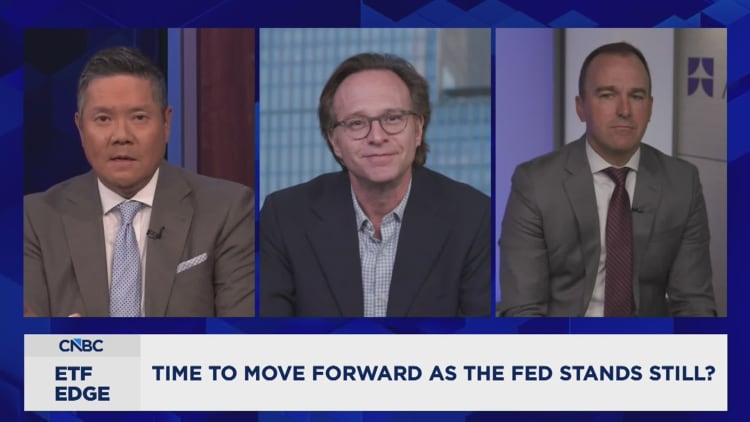

If there was one safe bet over the course of 2026, it was that treasury yields would rise alongside a move up in oil futures contracts. Over the past month, that ended, and according to Jeffrey Rosenberg, senior portfolio manager of the Systematic Alternatives ETF (IALT) at BlackRock, the world’s largest asset manager, the breakdown in that trade has big implications for the market.
“Oil and treasury yields had this amazing correlation and in October it just stopped,” Rosenberg said on the most recent CNBC “ETF Edge.”
The relationship between oil and bond yields was featured in Federal Reserve Chair Kevin Warsh’s FOMC press conference on Wednesday, with Warsh noting how oil futures have continued to rise, a factor the central bank must consider in its fight against inflation. But Rosenberg said what Warsh didn’t talk about was “the most important takeaway.”
“Treasuries and oil had an 80% correlation this year,” Rosenberg said, which is “outsize” relative to normal correlations. “We’ve basically been trading off oil for good reason.” “

Oil futures contract one-month performance.
What happened? Rosenberg says you can sum it up by looking to the deflated AI trade. As the market moved away from that oil-treasuries trading correlation in October, “It told us something important,” he said. “In the market’s mind, the geopolitical risk is secondary to AI risk,” he said.
Over the past month — which became most painfully clear in Friday’s Nasdaq market wipeout and, earlier the week, Google’s biggest single-day decline in its history, wiping out half a trillion dollars in value — the AI trade experienced a retracement. Bond yields went lower, Rosenberg says, because the market is equating weakness in the AI trade as a broader weakness in the U.S. economy. And he said, last week’s GDP report backed up that thinking. “AI is everything, everywhere, all the time,” he said. Both the growth for the economy on the investment side and the wealth effect on the consumption side are all AI, he said.
“Q3 GDP was a blowout [number] and all AI-related,” Rosenberg said on the “ETF Edge” podcast extended conversation. He pointed to equipment investment increases and consumption well above expectations and both fueled by the AI wealth effect, which with the latter is even more notable given that real incomes have been coming down in the U.S.
Business investment of 12.7% in Q3 was the biggest increase outside the pandemic since 2011, led by a 37% rise in information processing equipment. Industrial equipment investment rose nearly 25%, which while not a straight AI trade, does partially reflect spending on data centers.
Magnificent Seven ETF performance over the past month.
Warsh did not agree in his assessment of the economy at the FOMC press conference. “It is convenient to say that the strength of the economy is all about this new technology wave. In fact, if we look at the data, really including data from the last meeting until this, the capex story is not just robust, not just strong, but it is broadening. And so if you wanted to tell the story somehow that this is strength we’re seeing only in narrow pockets, that’s a much harder story to tell now than it would have been several quarters ago,” he said.
But Rosenberg says that’s not a conclusion that the October market came to and it all adds up to a situation in which he says any “wobble” in the AI trade is going to be seen as a wobble in the growth outlook for the U.S., and as disinflationary. And in a disinflationary environment, there is “only one thing that hedges,” he said, and that is “the thing everyone wants to hate. … the long end of the treasury curve.”
“That’s the really important lesson from last month of market performance,” he said.
U.S. 10-year treasury yield performance over the past month.
Despite this view, Rosenberg is cautious about suggesting that this dynamic makes bonds a safe bet. “The simple answer is it’s not a return to normal, where normal was bonds hedging stocks,” he said.
That is because of the conflicting forces on bonds. Oil price increases and the persistent level of inflation above target are not going away as challenges to fixed-income assets and the “efficacy,” Rosenberg said, of fixed income as a hedge.
“There’s too much inflation and that limits the ability of the Fed to provide accommodation, and we haven’t gotten away from that,” he said. “But what we’ve learned in the last month is if it’s big enough, if the AI trend turns against the macroeconomy and inflationary trends, it can bring about a wholesale change in that direction that’s disinflationary and bonds may react like they did in October,” he said.
Still, he says investors should not bet the trade will be one-directional or come without a potential cost. Investors need to weigh the potential diversification benefit from bonds based on the October action versus a scenario in which AI does not unravel the economy. And the longer the AI boom persists, coupled with the broader fiscal challenges in the U.S., “bonds will be challenged,” he said.
How to trade the AI hyperscaler debt boom
The AI trade itself is a very big piece of the bond market, and that showed up over the past week in a major way between both the Google earnings decline and Microsoft coming back into the public bond market. “It was a surprise to the markets. It hadn’t been back in close to a decade,” Rosenberg said.
As the capex needs of the tech giants begin to overwhelm their free cash flow more regularly, the public bond markets are coming to terms with an expected flood of issuance. “When the bonds markets, the public bond markets, look at where it is all coming from … it’s a huge marginal issuer, and its increasingly all coming again and again,” he said.
The hyperscalers are reaching the limits of the financing that bank loan and private credit markets can offer and while Rosenberg stressed that a $40 trillion to $60 trillion global bond market can absorb an expected $4 trillion in AI debt over the next four years, “the market is not unlimited in capacity.”
That demand will lead to lower prices and higher spreads, though Microsoft’s deal attracted huge investor interest and was oversubscribed.
Rosenberg said it’s a good thing that more of the hyperscale debt is being pushed into the public bond market because it means there will be more transparency in the form of bond prices and CDS spreads. While spreads on Microsoft credit default swaps are currently trading near a five-year high, roughly 55, they are still a world away from Oracle CDS spreads, by comparison, which are closer to 300. That presents another trading opportunity for investors who may not want to buy bonds outright given the inflationary environment and fiscal challenges in the U.S., but may still be looking for ways to hedge bets on the AI boom.
“That old tool from the Great Financial Crisis,” he said. “Short it. You can trade two ways in [public] credit markets and you can’t do that in bank loans and private credit. But once they start going in public markets, you can do that.”
Rosenberg said a 12% down day in Google is “not even on the chart” historically. “So it’s moving into a different zip code, if you will, of market pricing and market volatility and market indigestion. It’s not the end of the world, it’s just a different world of the AI buildout,” he said, with the greater transparency in the public bond market giving investors more ability to trade “the emotional swings between fear and greed,” he said.
What the CDS market is telling investors with the large-cap hyperscaler names, according to Rosenberg, is not that the prospect of default is high, but that as all the companies try to access more debt financing, the capacity of the banks and financial intermediaries to find counter-parties for the risk is becoming more limited.
“Think about financial markets and these big investment booms. They don’t move in one direction. They ratchet up, reset.” But with the AI boom, it’s only been “the positive part,” Rosenberg said. “It’s still an incredibly positive story, but you get a little of the balance with the AI pessimism.”
Sign up for our weekly newsletter that goes beyond the livestream, offering a closer look at the trends and figures shaping the ETF market.