

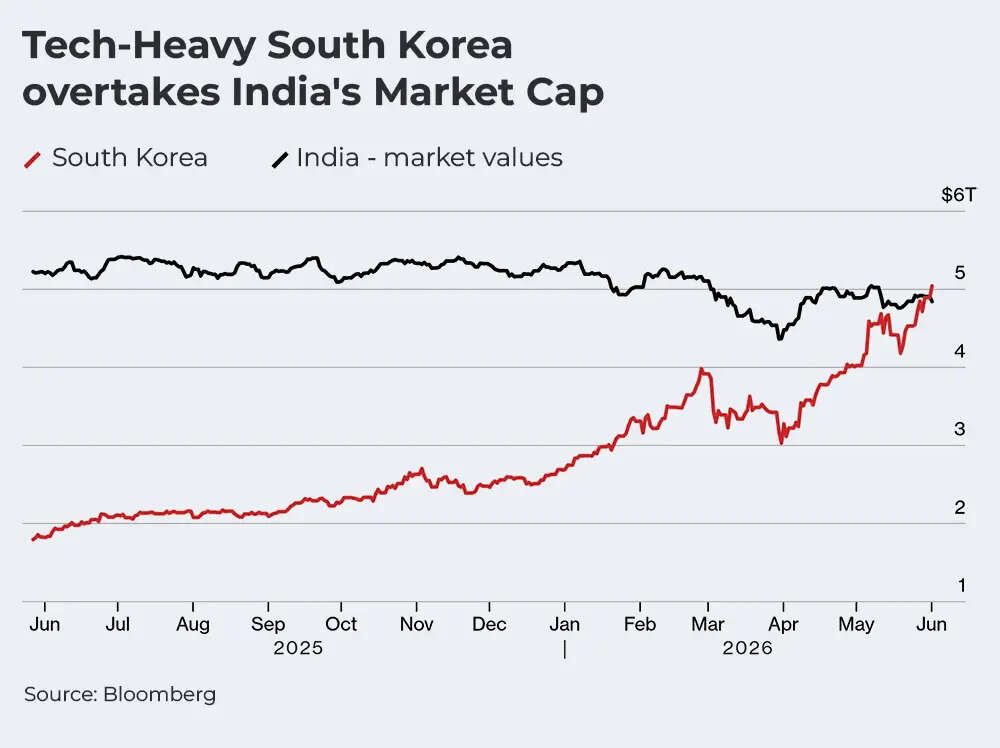
In a span of just over a week, the Indian stock market has gone from being the world’s fifth largest to the seventh largest by market capitalization. First overtaken by Taiwan last week, India has now dropped below South Korea as artificial intelligence-driven rallies in these stock markets propel them to fresh highs. But the fall to seventh rank is not just about the rallies in South Korea and Taiwan. It is also about the record exodus of foreign capital from Indian stock markets in the last few quarters.At a time of global economic turmoil, why are some global markets like the US, Taiwan and South Korea rallying? Why has the Indian stock market slipped from record highs, giving negative returns over the last few quarters?
Why have Taiwan & South Korea stock markets rallied?
The rally in both Taiwan and South Korea has been led by the global semiconductor push. In Taiwan, Taiwan Semiconductor Manufacturing Company (TSMC) has been a big beneficiary of the AI wave. In South Korea, Samsung Electronics and SK Hynix have led the gains.
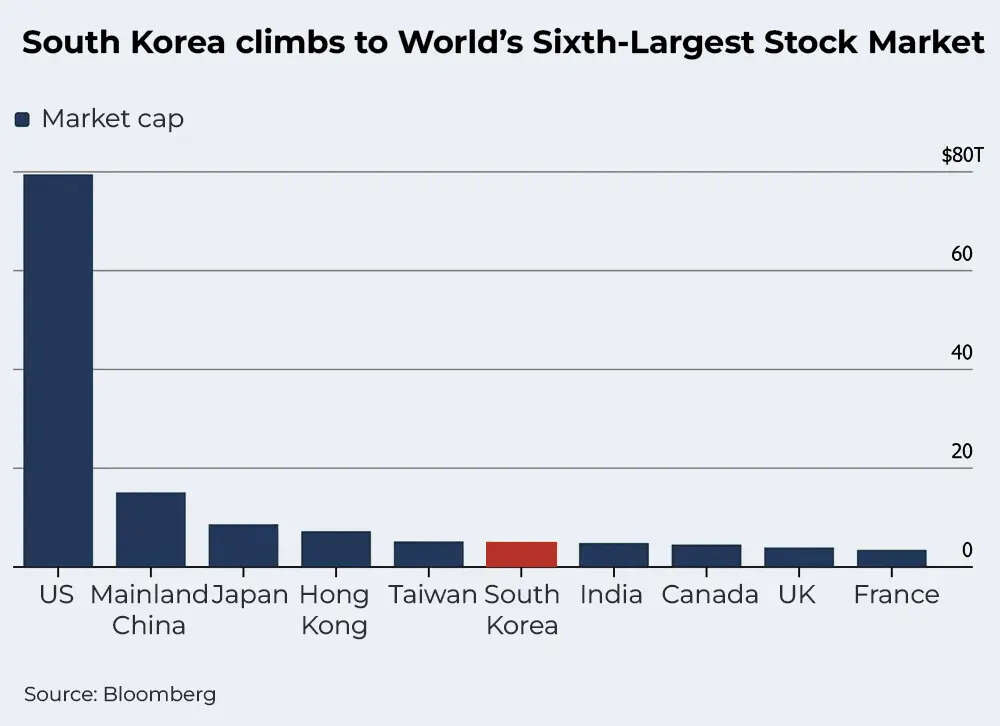
It is also noteworthy to see the skewed nature of the market cap rise in Taiwan.TSMC, which has seen a record 50% rally now makes up over 40% of the market cap of Taiwan stock market.South Korea’s market capitalisation has jumped to $5 trillion after an 86% rise this year, with Samsung and SK Hynix emerging as key beneficiaries of the AI memory-chip boom. India’s market capitalization has slipped to $4.8 trillion.
India’s stock market fall in numbers
Let’s understand the fall of Indian stock markets with some numbers:
- BSE
Sensex hit a lifetime intra-day high of 86,159.02 on December 1, 2025 after a very volatile year for the most part. Since then the market is down over 13%, with the fall exacerbated due to the US-Iran conflict since the start of March 2026. - So, while stock markets in the US, Japan, South Korea, and Taiwan are hitting lifetime highs, Indian stock markets, once the favourite of foreign investors among the emerging markets basket, have seen a drop of not just a few percentage points but a double-digit drop.
- IT sector stocks have been rallying the world over, with chipmakers seeing strong growth. In India, major IT sector stocks are down over 20%.
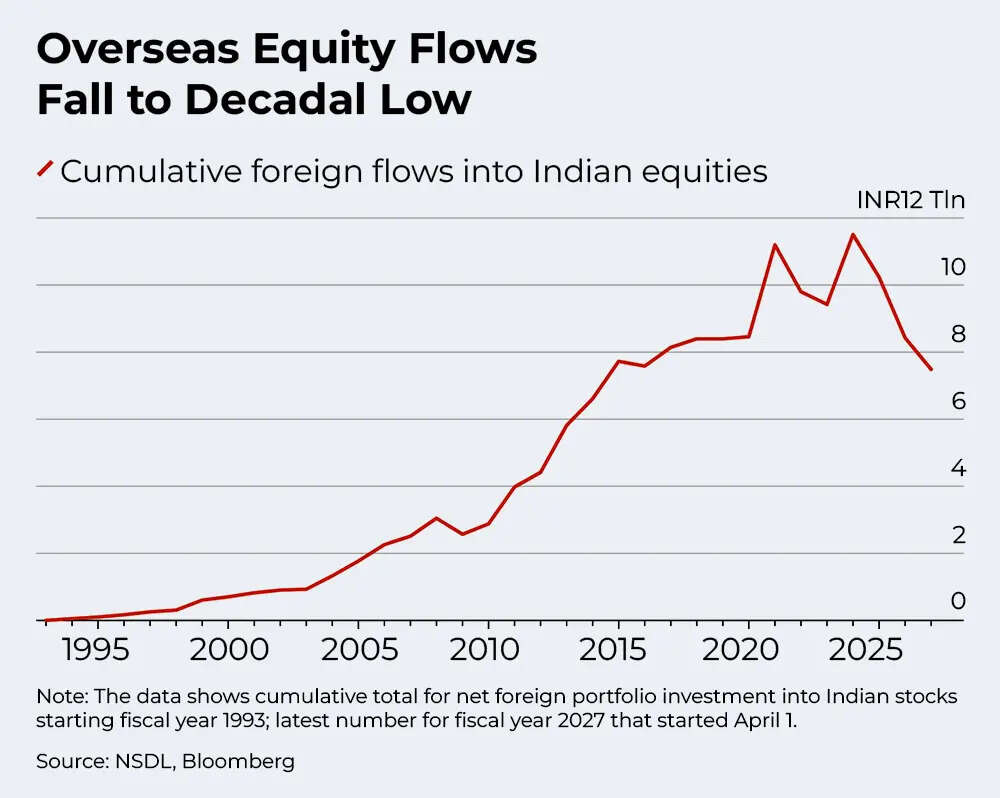
- Foreign portfolio investors have been net sellers in equities in most months this year. In May alone foreign investors were net sellers, withdrawing Rs 32,963 crore from equities.
- In 2026 so far, the total outflow by foreign portfolio investors from the equity market has hit around Rs 2.3 lakh crore. This is much more than the Rs 1.7 lakh crore selloff seen in the entire of 2025, as per NSDL data.
- In fact, the cumulative value of foreign portfolio holdings in Indian shares has dropped to its lowest level since 2016, according to NSDL data.
Why have Indian stock markets fallen so much?
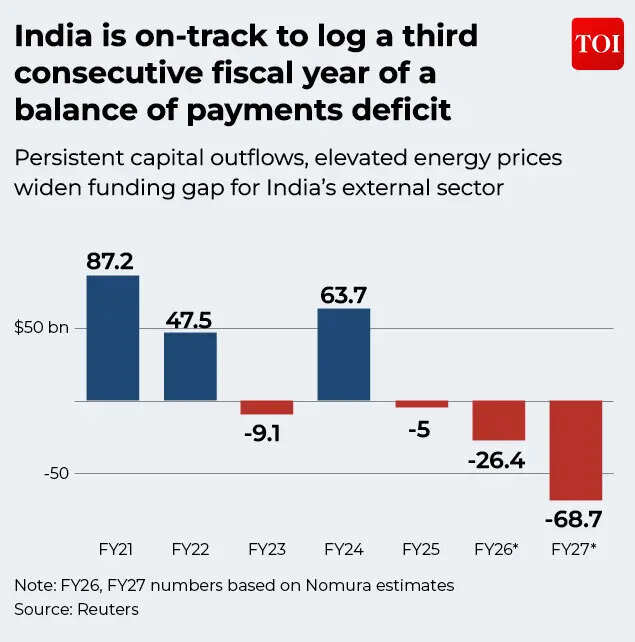
Several reasons have contributed to the decline in Sensex and Nifty in the last year-and-a-half. For one, some investors were of the view that the markets are overvalued having rallied at break-neck speed in 2024. There are also concerns on taxation of capital gains. A large part of the stock market rally globally has been driven by the artificial intelligence boom. Market experts are of the view that India has missed that bus for now. The US stock market, South Korea, and Taiwan on the other hand have benefitted from this surge in stock prices of technology stocks, in effect eclipsing the impact of global economic turmoil.For example, Nvidia in the US, which is the world’s most valuable company with a market cap of over $5 trillion, has rallied over 63% in the last one year! In India, an opposite case scenario unfolded. Indian IT majors TCS, Infosys and others saw their stocks decline as fears of artificial intelligence-led workflow disruptions threatened the working model of this sector. Infosys is down over 22% year-to-date, and TCS has plunged over 24%With the imposition of 50% tariffs on India in the second half of 2025, foreign investors fled the market, causing the rupee to depreciate and become the worst performing Asian currency.As things began to stabilize in February, with the announcement of the US-India trade deal and reduction in tariffs from 50% to 18%, FPIs turned net buyers. However, with the US-Iran conflict war breaking out, the selling spree resumed.Investors world over are rushing to safer haven assets like the US dollar, leading to sharp sell-offs. Rising crude oil prices resulting in a ballooning crude import bill and hence a strain on foreign exchange reserves is also adding to the external sector pressures. While analysts are confident of India’s domestic growth story, the inflationary impact of rising petrol and diesel prices is keeping investors on the edge. There are also concerns that
What’s the outlook?
Analysts expect quarterly earnings to pick up going forward, and while the US-Iran conflict will continue to determine market direction in the near-term some positive signs are also visible.VK Vijayakumar, Chief Investment Strategist, Geojit Investments Limited is of the view that a sustained rally in Indian stock markets would require resolution of the US-Iran conflict. He also points out that the rallies in South Korea and Taiwan stock markets are largely led by a few companies, hence raising doubts about their sustainability. “A rally in the Indian market would require resolution to the West Asia crisis and decline in Brent crude price to around $85 level. This will help in earnings recovery in H2 FY27,” he says.“South Korean Kospi is up 99% YTD and Taiwan’s Taiex is up 55 % YTD while Nifty is down 10.9% YTD. For the last more than a year, these two markets have been doing exceptionally well driven by the huge demand for semiconductor chips and memory chips whose demand has exploded due to the massive AI investments being done by the AI majors,” Vijayakumar tells TOI.Taiwan’s TSMC is now close to 45 % of Taiwan’s market cap and Samsung and SK Hynix account for 50% of South Korea’s market cap. “These are unprecedented mind boggling numbers. In brief, the AI trade and the domination which Taiwan and South Korea have in semiconductor and memory chips have enabled their markets to boom. The risk is that this boom may not last long. There is a view that there is a bubble in AI stocks,” he cautions. Tanvi Kanchan, Associate Director, Anand Rathi Share and Stock Brokers Limited feels that the shift is almost entirely an AI story.“The surge highlights intense AI-driven optimism that is triggering a global rally in tech shares, disproportionately benefiting manufacturing hubs like Taiwan and South Korea. India, by contrast, has been grappling with surging energy costs, slowing corporate earnings growth, and a lack of companies directly linked to the AI buildout,” she explains. Global funds sold nearly $24 billion of Indian equities as they chased the AI boom in Taiwan and Korea. India’s weight in the MSCI EM index also fell sharply from around 19% to 12%.After domestic equities underperformed emerging markets by nearly 25% and global equities by around 15% in 2025, as India Inc’s earnings growth collapsed from 20% plus CAGR to just 5-6%, Tanvi Kanchan notes.
“We believe India’s outperformance now rests on two key factors: a cooling of the global AI frenzy, and a meaningful pickup in earnings growth,” she tells TOI.The analyst is of the view that the earnings downgrade cycle appears to have bottomed. After five consecutive quarters of depressed earnings, consensus now expects a pick-up, MSCI India earnings growth estimates stand at 13% for CY25 and 16% for CY26. The macro scaffolding is also firmer: India’s FY26 delivered a rare Goldilocks combination, GDP growth well above 7% alongside headline inflation at just 2.1%, the lowest in decades, precisely the combination that long-term capital looks for.“On valuations, the prolonged consolidation has done its work, Large-cap valuations have dipped below their 10-year premium to global and emerging markets, while the Nifty and mid-caps now trade near their long-term average P/E, creating the kind of entry point that tends to reward patient capital. Fundamentally, for India, the structural thesis of financialization of savings, demographic dividend, policy-driven capex, and a deepening equity culture remains intact,” she concludes.(Disclaimer: Recommendations and views on the stock market, other asset classes or personal finance management tips given by experts are their own. These opinions do not represent the views of The Times of India.)