

HOUSTON — During a late night at home in May 2021, Hy Luu, a 29-year-old engineering consultant, was researching how to obtain more capital to invest in shares of Tesla.
That’s when he discovered margin investing: the act of borrowing money from a broker to buy securities such as stocks, while using existing investments as collateral. Borrowing would give him more buying power, and he could pay it back as the stock appreciated. The main risk would be a margin call, or having to deposit more money into the account, if its value fell.
It was all too good to be true, Luu thought.
Luu washes dishes at the home he shares with his mother. Luu said proceeds from refinancing the house helped him reduce his margin balance and avoid being forced to sell Tesla shares after the stock fell.
Daoud Qamar for CNBC
Luu — who lives with his mother, Kim Nguyen, in a three-bedroom, two-bathroom house in Houston — decided to get her opinion on the topic, given that she used to work as an accountant and just so happened to still be awake that evening. The 66-year-old retiree found it interesting.
That was the reassurance he needed, and it wasn’t long before he started using margin to invest in Tesla for the first time. A year or so later, he had amassed more than $100,000 of margin debt.
“I went really crazy,” he told CNBC in an interview. “The stock was going up, and so I was like, ‘There’s no way I could lose.'”
After five years of margin investing — including a period in 2022 where he worried that further declines in Tesla could trigger a margin call — Luu is working to pay down his largest margin balance ever. In June, he exercised $165,000 on five Tesla call options and bought 500 shares at $330 per share. After accounting for the cash in his account, this drove his borrowing to more than $156,000.
Tesla swung from below $370 a share to more than $430 during that month.
Between his Tesla investments, his company stock and 401(k) — while subtracting his margin debt as well as other debt he’s accumulated, such as his car loan and student loans — Luu’s net worth has skyrocketed to more than $800,000 from negative territory seven years ago.
“I’m very close to becoming a millionaire,” the investor said. He did stress, “What I’m doing is risky. I don’t recommend anyone do it.”
Yet, Luu has found himself part of a growing trend taking hold in the market.
‘Gambling with an asterisk’
Retail investors like Luu are borrowing more and more money to invest. Robinhood’s margin book grew to a record $21.6 billion in the second quarter, up 127% year over year and a 332% increase from the $5 billion seen in Q2 2024. To margin invest on the platform, eligible users must have a portfolio value of at least $2,000.
“Robinhood has made a really concerted effort to go after customers that are actively using margin because they’re the most active traders,” said Devin Ryan, head of financial technology research at Citizens.
Brokerage firms can benefit from margin investing by collecting interest on margin loans, while highly active customers can also generate additional trading-related revenue.
“If you look at the offers that Robinhood has had in the market over the past couple of years, it’s been targeting those customers with obviously transfer bonuses, but also very low margin rates, very high yields on their cash,” Ryan said.
To be sure, other parts of Robinhood’s business are also growing, including retirement assets — which have nearly quadrupled in the last two years.
Another factor fueling the rise in margin investing is easier access through smartphones, according to Ryan.
“Having very little friction in investing and having everything at your fingertips, and then having a really seamless mobile experience where it’s not clunky, I think, plays a big part of that,” he said.
A Robinhood spokesperson told CNBC its products are designed to appeal to a number of customers, saying that “we don’t believe it’s accurate to characterize” its transfer promotions as specifically targeting “active traders who are trading on margin or may trade on margin.” The company said it tries to “meet users where they are,” and they “reject any implication” that the company is “encouraging risky trading.”
Robinhood’s margin debt isn’t the only one reaching records. Total margin debt hit an all-time high of around $1.5 trillion in June, per the Financial Industry Regulatory Authority, which incorporates data on both institutional investors such as hedge funds and retail investors.
Not all of that debt is driven by fresh borrowing due to new borrowing decisions. For example, as equities rise in value, an investor may need to cover a short position that’s been marked to market, or valued at its current price.
Nonetheless, Sam Huszczo, chief investment officer at SGH Wealth Management, thinks the market’s bull run — which has seen multiple record highs this year alone — is feeding a shift in investor psychology, and margin debt is one sign.
“That’s greed,” the founder said, adding that it’s “not everywhere” in the market, but it’s “certainly creeping into pockets.”
“Margin, that’s only the tip of the iceberg of what we can see,” he continued. “Fear of missing out is just the emotion of jealousy with a brokerage account.”
Huszczo considers the market to actually be “way healthier” than people think. Though he recognizes that increasing margin debt and the rise of risky assets such as leveraged ETFs inject more fragility in the system.
“People need to differentiate between what’s a legitimate momentum growth investment and what’s reckless chasing,” Huszczo also said.
Huszczo shares the commonly held belief among financial advisors that investors’ portfolios shouldn’t be overly concentrated in one stock or even one sector.
Hy Luu sits at the computer in his Houston home office, where he monitors his investments.
Daoud Qamar for CNBC
Yet Luu has been zeroed in on Tesla ever since he bought his first share in late 2019. Earlier that year, he had started his current job — a time when he knew nothing about investing, he said. It wasn’t until a co-worker told him to download Robinhood months later that he began looking into stocks and other assets.
“I started making money, and I quickly learned, ‘Now I’m making money, what do I do with it?'” he said. “I started investing in index funds and even in crypto, and then I did the math. I looked at the returns, and I was like, ‘This is very slow returns. I’m never gonna reach retirement, financial independence until like 65.'”
Little did he know that a decision he had made that summer would become his guiding light.
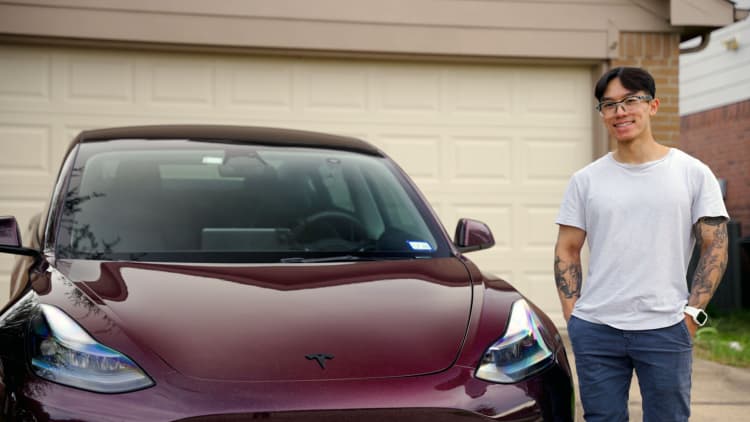
“I was choosing between a Honda Civic and a Tesla Model 3, and my friend, he scheduled a test drive for me to drive the Model 3,” Luu said. “My plan was only to go into it just to test drive it. I wasn’t going to buy anything. I wasn’t going to put in any reservation. Long story short, after the test drive, I put in my reservation the same day, and I got the car like two weeks later.”
Seeing the value the car provides in his life, Luu said he can envision a future where electric and autonomous vehicles are commonplace. Because of how much he believes in that future, he considers Tesla the “easiest” investment he’s made, and over the course of seven years of investing in the company, he has generally held his shares.
Hy Luu, a 29-year-old engineering consultant and retail investor in Houston, stands beside his current Tesla, Sept. 10, 2026. Luu bought his first Tesla in 2019.
Daoud Qamar for CNBC
However, things got a bit more difficult with his strategy when Tesla shares began falling in 2022, putting him in the vulnerable position of potentially receiving a margin call. 2022 was Tesla’s worst year on record, with the stock finishing off the year at $123.18 after a roughly 65% decline.
In search of more capital, Luu made a serious financial decision with his mother’s approval.
“I refinanced the house to get access to an extra $30,000 of capital, and I used that to pay down my margin debt,” he said.
Luu understands the level of risk that accompanies trading with margin. Because he’s been using margin for most of the nearly seven years he’s been investing in Tesla, he has deemed his investing strategy “gambling with an asterisk.”
For now, it has paid off. In the last five years, Tesla shares have risen more than 43% to $375. However, the volatile stock is about 25% off of its all-time high near $499.
“It’s very easy to see it as gambling, because obviously all your money is in one stock, and that’s inherently risky,” he said. “But the reason why I say there’s nuance to it is because it’s a matter of investing temperament, financial discipline and time horizon.”
With a time horizon of “many decades,” a temperament he labels as “very calm and collected” and a “very high” conviction in Tesla, Luu believes he’s “at no risk of panic selling,” even when the market tanks.
Still, the situation points out another danger: Missing an opportunity to make an investment when an equity is undervalued. When Luu was scrambling to raise funds to meet his margin obligation, it reduced his flexibility to purchase more Tesla shares at the lower price.
Affecting equities
Margin levels this high have been followed by risk-off periods in equities.
Whenever monthly margin debt has grown above 45% year over year since 1960, there were declines in the stock market five out of six times, data from Fundstrat Global Advisors shows. June’s margin debt record came in at 49%, but the S&P 500 has still added more than 13% in 2026. A swing into the red by year-end in accordance with this historic pattern would be a dramatic move — one that would be considered highly unusual for the stock market.
The firm also found that the median performance for S&P 500 forward returns following a breakout of 40% year-over-year margin debt growth has been worse off 12 months later as opposed to one month after it. To be exact, the S&P 500’s median 12-month forward return is a 4.2% decline, while the median one-month return is a drop of 2.2%.
In essence, the more rapidly margin debt rises, the worse it is for S&P 500 returns over 12 months.
While margin debt doesn’t necessarily cause S&P 500 declines, it can exacerbate existing moves to the downside if there’s a significant amount of leverage in the market, said Hardika Singh, economic strategist at Fundstrat.
“The premise of gains beget gains, it turns into losses beget losses, and that’s what’s troublesome,” Singh said. “You have these losses, they keep piling up, and then the stock gets sold, and everyone’s starting to close out their position, and it becomes this huge train wreck that’s very hard to stop, and it adds a lot of volatility to the market.”
Then again, Singh sees why investors like Luu are leaning into such a risky strategy. “No one ever got rich by diversifying,” she said.
A new hobby
Luu, who said he’s been a “hobbyist” from an early age, has folded in investing as one of his many hobbies, which include activities like climbing and playing guitar. It’s become such a hobby that he’s created his own social media account detailing his investing journey.
Even if Luu reaches his financial goals, he “wouldn’t ever stop investing,” he said. Instead, he said he “would probably start investing in SpaceX.”
It’s not just Luu who views trading as a hobby.
Fundstrat’s Singh explained that American traders, particularly younger ones, feel they have to take bigger risks to get ahead. She said it’s part of a broader trend dubbed financial nihilism, in which young investors grappling with a tough job market and high inflation turn to less-stable investing tools.
“It makes a lot of sense why individuals, specifically retail investors, keep gravitating towards this margin debt,” the economic strategist added. “This is like a drug, and I think people just can’t get enough of it in this economy.”
Kevin Davis, a 59-year-old retail investor who made a living as a rapper in the 1980s and ’90s before becoming a stock broker, believes the risks with leveraged trading outweigh the rewards.
“It’s gambling. You’re borrowing money you don’t have, and so if it goes the other way, now you have a clock on your money, and it’s ticking,” said Davis, who owns an investing technology platform. “The market’s not going to save you. It never does.”
“Don’t play the margin game,” the Florida resident warned.
But Luu’s mother has faith in him.
Hy Luu and his mother, Kim Nguyen, stand beside his Tesla at their Houston home. Luu exercised call options to acquire 500 additional Tesla shares, taking on six figures in margin debt.
Daoud Qamar for CNBC
Luu became an engineering consultant because his father, who died of lung cancer in 2012, exposed him to computing. His mother said that between her two sons, Luu most resembles his father not only in terms of his features but also his character.
Reflecting on what her late husband might have thought about Luu’s investing pursuits, Nguyen paused for a moment, holding a slight smile.
She then said, “He would’ve said he’s proud of him.”
— CNBC’s Charlotte Morabito and Deena Zaidi contributed to this report.