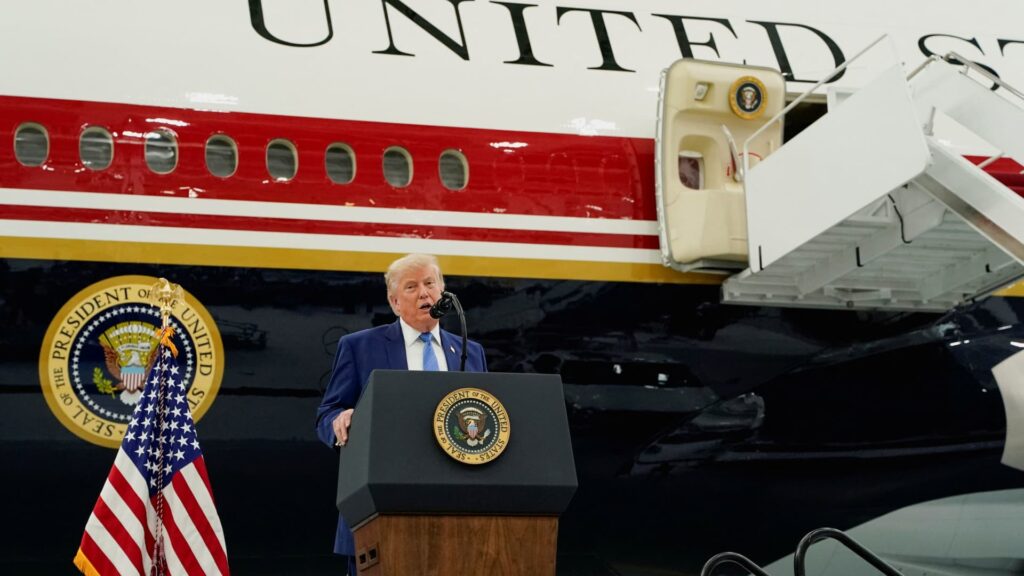
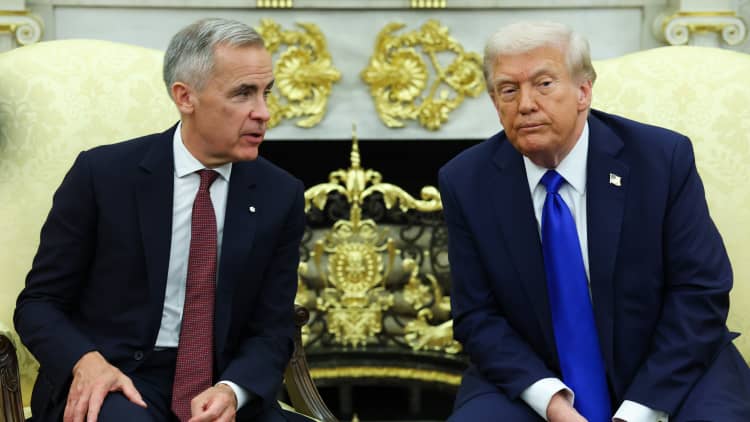
US President Donald Trump speaks with Canada’s Prime Minister Mark Carney during a work lunch as part of the G7 summit, in Evian, eastern France, on June 16, 2026. A G7 summit is set to take place June 15 to 17 in the French town of Evian-les-Bains near Switzerland and it will be attended by country leaders as well as the EU’s foreign policy chief and ministers from Brazil, Canada, the United Arab Emirates and Turkey. (Photo by Evelyn Hockstein / POOL / AFP via Getty Images)
Evelyn Hockstein | Afp | Getty Images
Trade talks between the U.S. and Canada fell apart on Friday, triggering a new set of 50% Trump administration tariffs.
Negotiators for both sides had been working on a deal all week, at times signaling that an agreement was near. President Donald Trump had postponed the original deadline of Wednesday just hours ahead of it being imposed, saying that there was a soon-to-be finalized deal. Dominic LeBlanc, Canada’s trade minister for the U.S., told reporters on Thursday that a deal was “very close.”
However, both sides blamed the other on Friday as the tariffs, impacting roughly $20 billion in Canadian exports, including wine, furniture, dairy products, cement, clothing, fishing rods, hockey equipment, went into effect on Saturday morning.
Canadian Prime Minister Mark Carney said in a statement released on Friday that despite working toward a deal, “that progress has not been enough to meet our objectives for Canadians,” saying that “last-minute changes in the U.S. proposed terms were unfair, uneconomic, and called into question the reliability of any deal.”
In his statement, Carney said that Canada would retaliate against the new tariffs “dollar for dollar.”
U.S. Trade Representative Jamieson Greer told reporters in a White House briefing on Friday night that “Canada declined to finalize the trade deal under the terms agreed earlier this week.”
The Trump administration signed three proclamations to impose the additional 50% tariffs on a range of Canadian goods in July, a response it said was due to trade discrimination against multiple U.S. products and industries such as motor vehicles, alcohol and dairy. The tariffs fell under Section 338 of the Tariff Act of 1930, which gives the president the power to impose tariffs of up to 50% on the goods of countries found to be discriminating against the U.S., and which had not been used since 1949.
The failure to reach a deal adds another complication to the increasingly tense relationship between the U.S. and Canada. The two sides had already been at the negotiating table regarding their trilateral trade pact with Mexico, known as USMCA, which was not renewed in July over concerns with U.S. trade deficits — a deal that Trump once called “the best agreement we’ve ever made.”