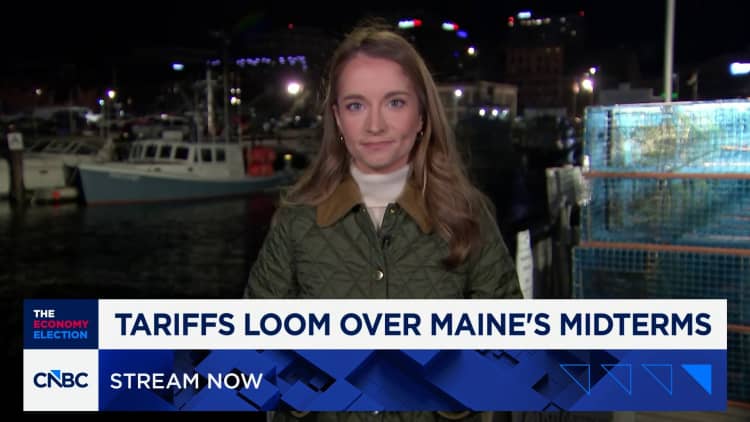

PORTLAND, Maine — The same week President Donald Trump imposed 50% tariffs on imported steel, the domestic supplier of the wire mesh Mark Brooks uses to make lobster traps in Maine hiked prices by 20%.
When diesel prices began rising as the U.S. war with Iran escalated, Brooks started paying freight surcharges on his materials and saw sales slow as lobstermen tightened their belts. And when Canadian Prime Minister Mark Carney slapped 50% tariffs on U.S. lobster traps in September as retaliation for Trump’s own duties on Canadian goods, the roughly $2 million in annual shipments Brooks typically sends over the northern border dried up virtually overnight.
“It’s basically the worst business climate for us that I’ve ever seen in 40 years,” said Brooks, a third-generation lobster-trap manufacturer and supplier, who along with his siblings runs Brooks Trap Mill and its seven locations across Maine. “We’ve eaten as much cost as we can to try to keep our prices down, but we just can’t eat any more than we have already.”
Few states have been as vulnerable in the U.S.-Canada trade war as Maine, which sends more than 40% of its exports to the U.S.’s northern neighbor. Those challenges are also piling on top of cost-of-living issues that were already spiraling, especially relating to things like home heating oil, on which Maine depends more than any other state. As a result, tariffs specifically — and affordability concerns more broadly — are center stage in this year’s “toss up” Senate race between GOP incumbent Sen. Susan Collins and Democrat Troy Jackson, a former president of the Maine Senate.
Polls show the economy is at the top of the list of voters’ concerns this election, in Maine and nationwide. More than 90% of respondents in a Suffolk University poll this month of likely Maine voters rated the state’s economy as “fair” or “poor,” while a majority said the state is on the wrong track and 57% gave Trump an unfavorable rating.
The key question here is whether that dissatisfaction will translate into votes against Collins, or whether she will be able to separate herself from an unpopular piece of Trump’s and the Republican Party’s agenda.
“That’s one of the big issues in this campaign: How independent is Susan Collins from Donald Trump?” said Jim Melcher, a political science professor at the University of Maine at Farmington.
Across the country, Republican candidates in competitive seats have been working to find ways to distance themselves from the White House.
In Michigan, GOP candidate Mike Rogers has criticized the Canada tariffs and called for a quick end to the Iran war. In Iowa, Ashley Hinson, a Republican running for Senate, came out against Trump’s decision to temporarily lower tariffs on imported ground beef, which she said would hurt U.S. cattle ranchers. And GOP Senate hopefuls in New Hampshire, Alaska, Ohio and Nebraska have all expressed concerns over Trump’s decision to allow imports of Russian diesel, reversing course weeks after signing legislation to expand sanctions on Russia.
But Maine presents the ultimate test of whether voters this year will distinguish between the president and the rest of his party. Collins, long known and praised for her independent streak, is the lone GOP incumbent running for reelection in a state that voted against Trump in 2024. And polls show the race is tight, with Jackson leading by an average of 2 percentage points in polls compiled by FiftyPlusOne.
‘We shouldn’t be in a trade war with Canada’
CNBC’s Megan Cassella speaks with Mark Brooks on Aug. 20, 2026, in Portland, Maine.
Ashlee Trujillo | CNBC
Both Collins and Jackson have sharply criticized the tariffs, which are deeply unpopular here: Seven in 10 likely Maine voters say duties on Canadian goods are bad for the state, while only 12% called them “a good thing,” according to a CNN poll last month.
But the candidates disagree over who bears responsibility for the economic damage, and who could better do something about it.
Collins has repeatedly pushed back against the Trump administration on duties and was able to secure exemptions from the Canada tariffs for some key items, including concrete, wood pulp and road salt. Jackson argues that Congress should have been able to prevent the tariffs altogether, and that Collins, for all her seniority in Washington, should have been able to do more to help her state.
“The bottom line is Troy and I both would have voted against the Canadian tariffs,” Collins said in an Oct. 13 debate, the third of four held between the two candidates. “But I have been able to negotiate and get certain items removed from the tariff list — Troy would have gotten nothing.”
“I’m not going to give Sen. Collins credit for taking things off the list, when we should have never had a list,” Jackson replied. “We shouldn’t be in a trade war with Canada.”
“Troy spent most of his life working along the Canadian border, so he knows how important this relationship is to Maine’s economy, and he sees Trump’s tariffs for what they are: a tax on Maine families and small businesses,” Maggie Amjad, a Jackson’s campaign spokesperson, said in response to CNBC’s request for comment about the effects of tariffs and the Iran war.
The Collins campaign declined to comment further on the tariffs.
The lobster industry escaped the worst of the Canada tariffs, after Ottawa made a last-minute decision to leave lobster off its retaliation list. Collins’ team says that move, too, was partly due to her influence: She met with Canada’s ambassador in Washington to discuss lobster and seafood exclusions, and released a statement afterward warning that tariffs “would have caused tremendous harm to Maine’s lobstermen.”
Lobster-trap maker Mark Brooks on Aug. 20, 2026, in Portland, Maine.
Ashlee Trujillo | CNBC
But lobster fishermen say nearly everything else they use on the boat every day is still getting more expensive. The traps that Brooks makes are selling for $180 now, versus $130 two years ago. The diesel fuel that runs the boats is up 67% statewide over the past year, according to AAA. The rope, much of which is imported from India, and the bait, which largely comes from Europe, is also more expensive due to the combination of tariffs and higher fuel costs.
“Everything we do in this business costs more money right now,” said Steve Train, a lobsterman who hauls 400 lobster traps a day out of Casco Bay. “These tariff wars are not helping us.”
Train faults Trump for the tariffs and criticizes him for “bypassing Congress” to “issue executive orders to do things that cause us a problem.” But he credits Collins for the work she has done to help the lobster industry. A registered independent, he says he will split his vote between the parties this election, but one vote will be for Collins.
“She has been like a guardian angel for the lobster industry for many years,” he said. “I can’t oppose her because she’s in the same party as somebody I don’t like.”