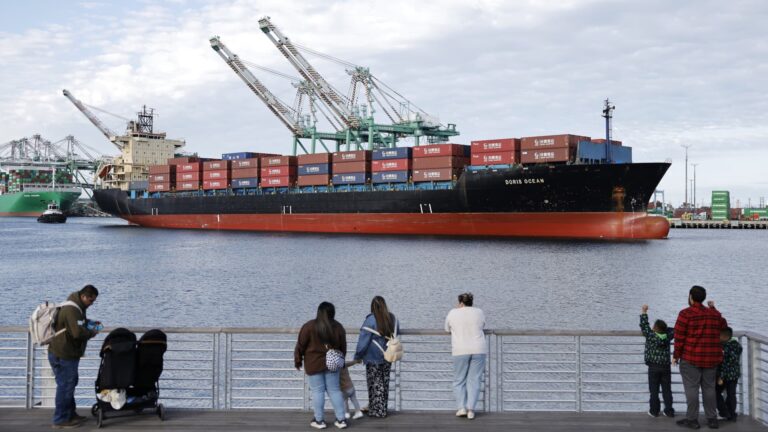
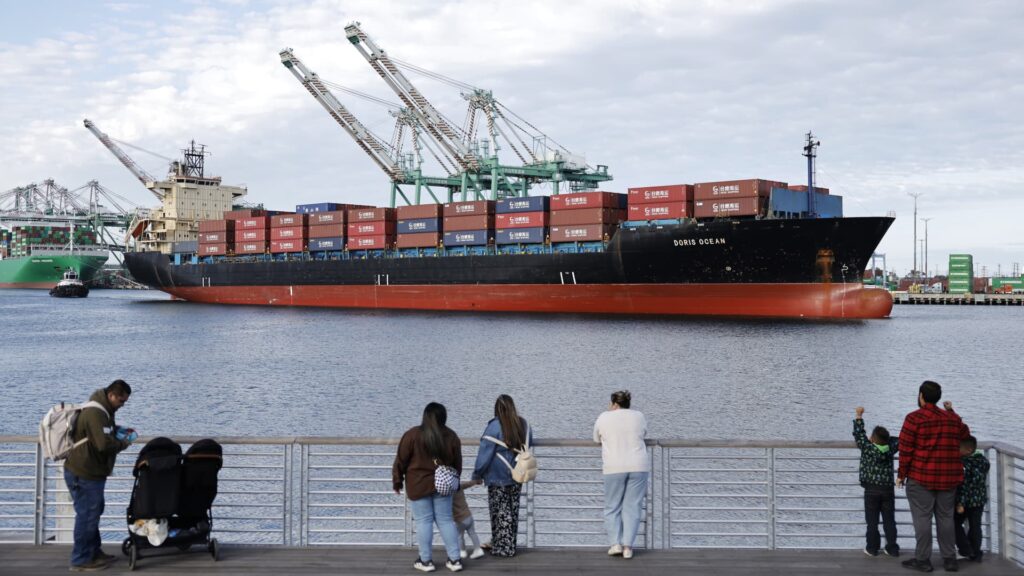
People watch as the Doris Ocean container ship departs from the Port of Los Angeles, in Los Angeles, May 28, 2026.
Mario Tama | Getty Images
President Donald Trump‘s global “liberation day” tariffs were struck down in the courts, shattering the cornerstone of his trade agenda. Some trade experts say his newest duties — which have already caught their first legal challenge — could meet the same fate.
The Trump administration on Friday imposed broad tariffs on goods from more than 80 countries, alleging they have failed to effectively prohibit the use of forced labor practices.
The latest tariffs — which apply to trade partners covering 99.4% of U.S. trade — were brought under Section 301 of the Trade Act of 1974, which enables the government to impose import levies in response to unfair trade practices. Section 301 has been used many times across presidential administrations to threaten or impose tariffs — including against China during Trump’s first administration.
But Trump is “using the statute in a fundamentally different way,” Peter Harrell, visiting scholar at Georgetown University Law Center’s Institute of International Economic Law, told CNBC.
Section 301 was “never intended for the president to just wholesale rewrite the tariff schedule” and impose “permanent” duties, Harrell said, adding that Trump’s latest use of it could “for sure” be struck down in court.
Trump appears to see Section 301 as a key pathway for more tariffs. On Friday, he declared that the U.S. will “immediately” start a 301 investigation into the EU in retaliation for the hefty fines it has imposed on U.S. tech giants. It was the latest in a flurry of tariff actions Trump has taken in recent days, including slapping 25% duties on Brazilian imports — also via a 301 probe — and vowing 50% tariffs on some goods from Canada.
The legal battle has already begun. Just hours after the new tariffs took effect, two small businesses sued, arguing that the government is using Section 301 as a pretext to re-create the same global tariff regime that the Supreme Court torpedoed five months earlier.
The new lawsuit, filed in the U.S. Court of International Trade, notes that the Section 301 tariffs took effect right as another batch of tariffs expired.
Those lapsed duties, brought under Section 122 of the 1974 law, were announced by Trump mere hours after the Supreme Court struck down his global tariffs on Feb. 20. By using the Section 122 authority, those tariffs had a set end date.
The high court had ruled that the law Trump used to unilaterally slap tariffs on nearly every other country — the International Emergency Economic Powers Act, or IEEPA — did not actually allow him to impose the levies.
Friday’s lawsuit argues that Trump’s new tariffs, while ostensibly aimed at addressing forced labor practices, are “designed to preserve substantially the same broad tariff regime that this Court and the Supreme Court have held Congress did not authorize.”
Section 301 “is not a freestanding authorization to tax substantially all imports from substantially all trading partners at rates selected to replicate the invalidated IEEPA tariff regime rather than to eliminate identified foreign practices,” the suit says.
The Trump administration has insisted it’s not merely looking for ways to resurrect its “liberation day.”
Addressing forced labor “is something that President Trump has been focused on … for many years,” a senior administration official told reporters Thursday in a call about the tariffs.
As for the timing, the official said, “We’re implementing this at this moment really to avoid complexity.”
A spokesperson for the Office of the U.S. Trade Representative did not immediately respond to a request from CNBC seeking comment on the lawsuit.
The new lawsuit was brought by the Liberty Justice Center, which represented plaintiffs in the successful challenge of Trump’s use of IEEPA.
The legal nonprofit contends the Trump administration “cannot preserve a predetermined global tariff policy simply by moving from one statute to another.”
Other experts contacted by CNBC agreed.
“In my view, the Section 301 tariffs are clearly unlawful,” Kimberly Clausing, a professor of tax law at the UCLA School of Law and a senior fellow at the Peterson Institute for International Economics, said by email.
Read more CNBC politics coverage
The tariffs reach beyond the statute’s intention, Clausing said, arguing that the administration’s focus on forced labor “is a mere pretext for recreating the IEEPA tariff regime.” And there is “no evidence linking this sort of trade measure to the supposed policy goal” of cracking down on forced labor, she said.
“One can never be certain” how the courts will rule, Clausing noted, adding that any legal challenges will take time to make their way through the legal system.
Alan Wolff, another senior fellow at PIIE, wrote in a blog post Thursday that the Supreme Court would likely strike down the forced-labor tariffs.
“To use the retaliatory authority of Section 301, the acts, policies, or practices of a country must be found to burden US commerce,” Wolff wrote. “That requirement is not clearly satisfied for the 60 targeted countries, which account for nearly all US imports and 90 percent of world trade.”
Greta Peisch, former general counsel for the Office of the U.S. Trade Representative and a partner at Wiley Rein, was less certain, telling CNBC the Trump administration has followed the legal procedures required to impose tariffs under Section 301.
The statute’s language “gives a lot of flexibility” to the government, she said. “I think it’s a pretty difficult standard to have to argue against.”
Andrew Siciliano, global and U.S. head of trade and customs at KPMG, told CNBC in an email that because of Section 301’s extensive record, the new tariffs “may be harder to unwind.”
“From a business perspective, this means companies should plan around the tariffs that exist today rather than assume they will be quickly reversed or modified,” he said.