This report is from this week’s The Tech Download newsletter. Like what you see? You can subscribe here.
Hello and welcome to this week’s edition of the Tech Download.
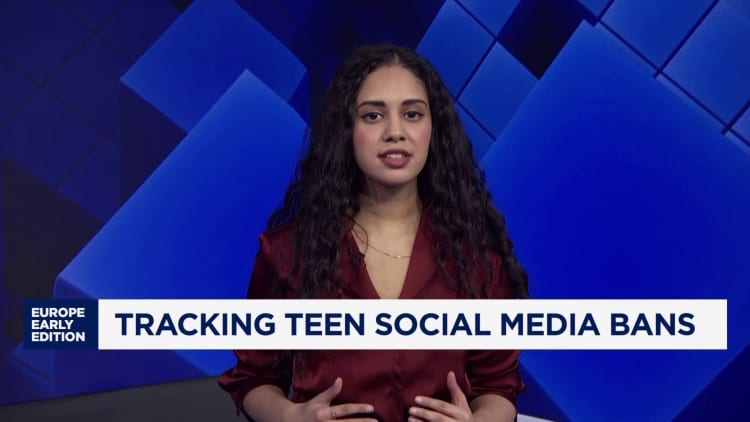
We’re doing things a little differently today! I’m Sawdah Bhaimiya, business news reporter and CNBC’s resident Gen Z and social media expert. Taking over from Kai Nicol-Schwarz this week, I’ll be diving into teen social media bans and the missing puzzle piece: AI chatbots.
Elsewhere in the tech sector, the week started on a somber note with Microsoft announcing it is eliminating 4,800 jobs. It’s the latest in a string of Big Tech layoffs, as firms look to reduce costs in an era of big AI spending.
Also on the agenda:
Teen holding smartphone with chat conversation on screen late at night at home.
Chebotkevich | Istock | Getty Images
Are AI chatbots a social media 2.0 problem?
A new addiction is quietly taking hold among teenagers.
They’re not just doom-scrolling social media anymore. They’re increasingly locked into conversations with AI chatbots that seem endlessly knowledgeable, supportive and ever-validating. And they’re struggling to break up with it.
Roughly half of U.S. teens now use chatbots like ChatGPT, Copilot, and Character.AI for schoolwork, information, or just for fun, according to Pew Research Center.
Meanwhile, a growing body of evidence shows that teens are using chatbots as a substitute for real-life friendships and relationships and are showing patterns related to addiction.
Does this sound like a painfully familiar story? That’s because it is. Let’s zoom out for a second.
When Australia became the first country to legally enforce a teen social media ban in December, it became a trial run for the rest of the world. It led to several governments, from the U.K. to Spain, France, Greece, and Canada, following suit in the months after. Meanwhile, state-level bans are gaining traction in the U.S.
However, as a member of the generation that grew up in the throes of social media, I fear we’re 15 years too late. And as this new, shiny technology in the form of AI and chatbots takes over, experts I’ve spoken to are calling it déjà vu.
“It is right that we use social media as a case study for what we don’t want to repeat. I mean, it’s kind of like, fool me once, shame on you, fool me twice, shame on me,” University College London’s Associate Professor of Digital Humanities, Kaitlyn Regehr, told CNBC.
Regehr said governments spent years catching up to social media regulation, only to repeat the same mistake by allowing untested AI products to reach children.
Are regulations falling short?
Earlier this year, companies including Meta, owner of Facebook, Instagram, and Threads, and Google‘s YouTube were found negligent for failing to adequately warn users about the dangers of using their platforms, with harms ranging from addictive infinite scrolling features to body dysmorphia.
Yet as the dangers of AI chatbots unravel, there’s shockingly little to no mention of them in most of the legislation above.
So far, the U.K.’s teen social media ban has briefly mentioned restricting under-18s from AI ‘romantic companion’ chatbots designed to foster sexual relationships or roleplay with users. The U.S. House recently passed the KIDS Act to restrict AI chatbot interactions with children, though it still awaits Senate approval.
Regehr noted that much of the legislation, particularly in the U.K., is still limited and only touches on some of the most extreme harms, while still ignoring how chatbots more broadly can foster emotional and social dependency as well as cognitive de-skilling.

Sonia Livingstone, a professor at the London School of Economics specializing in children’s digital rights and online safety, agreed that legislation isn’t moving fast enough.
“I don’t know that AI safety is being neglected, but clearly investment in AI is being prioritised, and it does still seem that regulation is seen as stifling innovation rather than providing a commercially productive pathway to trustworthy products,” Livingstone said.
Just days before unveiling a landmark social media ban for under-16s, the U.K. government was championing billions in AI investment and positioning Britain as an AI superpower at London Tech Week.
It appears that although AI safety and protecting children are topics dominating headlines, the government is again missing the mark on where the real dangers lie.
Regehr puts it this way: “We have seen a generation who have grown up on social media. Do we want it again?”
News
Elon Musk’s SpaceX joined the Nasdaq 100 index on Tuesday, less than a month after its stock market debut on June 12.
Micron announced billions more in chipmaking investments, aimed at boosting the U.S. semiconductor supply chain, and said it plans to accelerate its spending in the country through 2035.
Samsung-backed chipmaker Rebellions is targeting an initial public offering in South Korea in the first or second quarter of next year, the CEO told CNBC’s Arjun Kharpal exclusively on Wednesday.
China’s Alibaba banned employees from using Anthropic’s AI tools for work starting July 10, citing concerns that the U.S. company poses backdoor security risks, CNBC confirmed Monday.
SK Hynix, a trillion-dollar chipmaker and the second-most-valuable company in South Korea, behind only Samsung, is slated to begin trading on the Nasdaq on Friday.
Chart of the week
Eighteen months on from the seismic — though admittedly fleeting — market shock caused by DeepSeek, Chinese AI models are beginning to gain traction with U.S. companies.
New releases from companies based in China have narrowed the performance gap with leading American rivals while remaining significantly cheaper to use.
And growing adoption in the West is seeing U.S. lawmakers increasingly consider how to curb their rise.