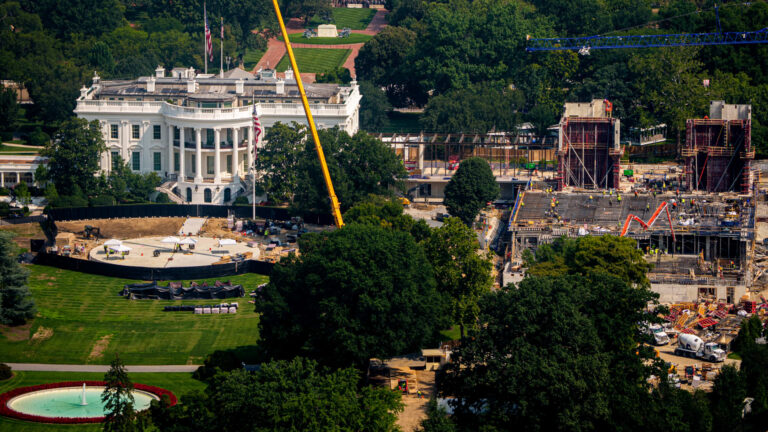
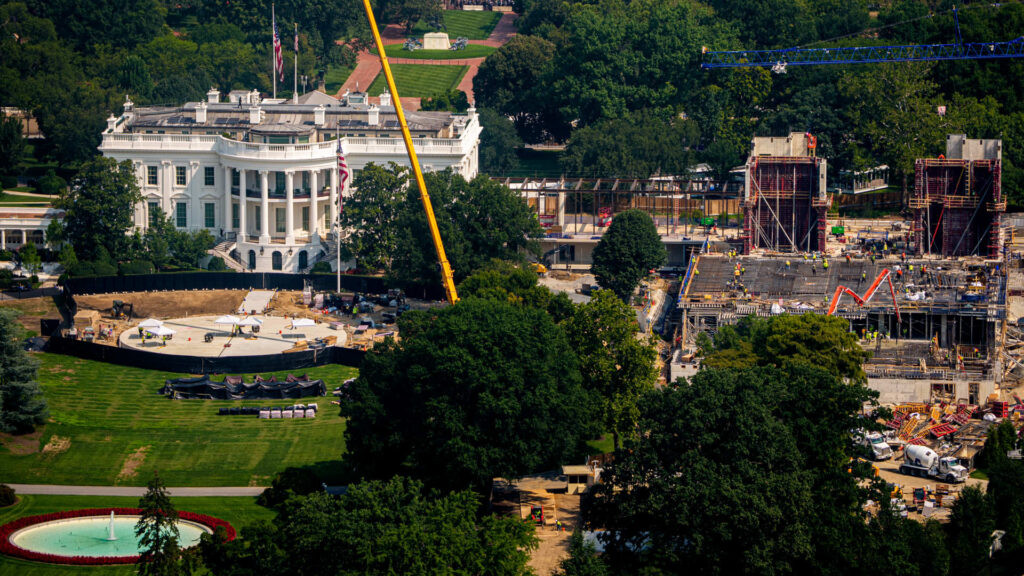
Construction continues on a new helipad on the South Lawn of the White House and the East Wing ballroom on August 10, 2026, in Washington, DC.
Andrew Harnik | Getty Images
The Supreme Court, in a split decision Monday, allowed President Donald Trump to continue construction of his controversial White House ballroom as legal challenges to the project play out.
A five-justice majority of the court said that the plaintiff challenging the ballroom, the National Trust for Historic Preservation in the United States, likely lacks legal standing to sue to block the roughly $400 million project.
The majority’s unsigned order does not address whether Trump has the legal authority to build the ballroom without approval by Congress, which remains an open question as the Trust’s lawsuit continues.
The order said that a declaration by a member of the Trust, Alison Hoagland, that having to view the finished ballroom during her periodic visits to the neighborhood would cause her “injuries,” was likely insufficient basis for standing.
“Mere offense, disagreement, or distaste does not qualify as a concrete and particularized injury under Article III” of the U.S. Constitution, the order said. “Perhaps nearly any government action or project offends someone’s sensibilities.”
Chief Justice John Roberts and the court’s three liberal members dissented from the order.
“The President ordered the demolition of the East Wing of the White House to make way for a new, privately funded state ballroom in its place,” the dissent said. “Construction of the ballroom has proceeded apace for the better part of a year.”
“That construction is likely unlawful.”
Last week, Roberts issued a temporary stay of a U.S. District Court judge’s order, which a federal appeals court affirmed, that had blocked the construction of the ballroom while the National Trust’s lawsuit continued.
The chief justice’s action gave the full Supreme Court time to consider whether there should be a longer stay as the litigation proceeded.
Read more CNBC politics and policy coverage
In his dissent Monday, Roberts wrote that Congress has explicitly barred the construction of any building on federal properties without Congress’ “express authority.”
“The ballroom is a building or structure being erected on federal park grounds — President’s Park — in the District of Columbia,” Roberts wrote. “Yet Congress has not passed any law resembling ‘express authority’ for the Executive’s construction of it.”
The chief justice also took aim at the majority’s finding that Hoagland was unlikely to have legal standing to challenge the ballroom’s construction.
“The White House is an iconic American building whose symbolism and history are wrapped up in its architecture,” Roberts wrote.
“A historic preservationist such as Hoagland can be aesthetically injured in a concrete, particularized way by the transformation of a historic building that she frequently enjoys,” he wrote.