


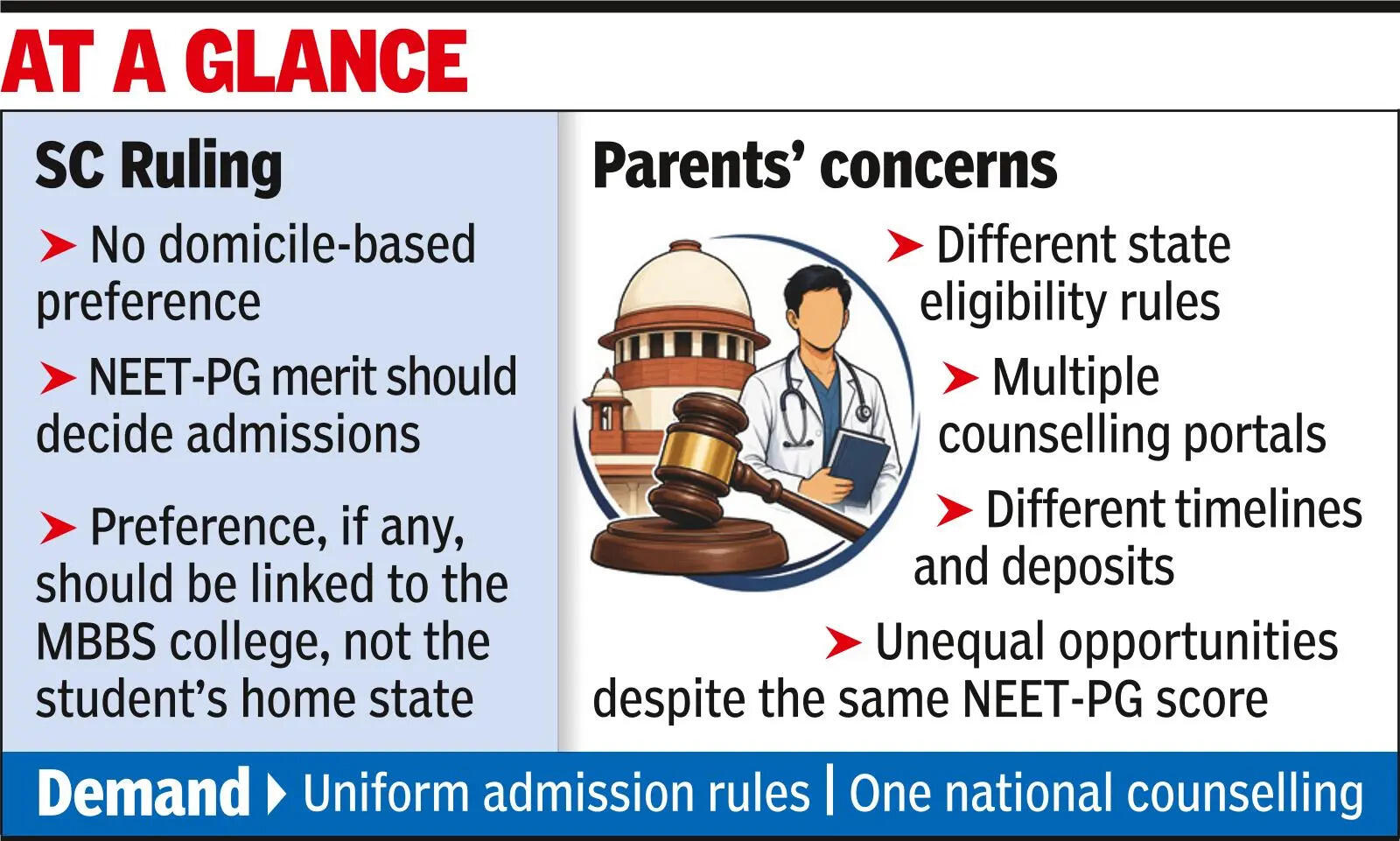
NEW DELHI: More than a year after Supreme Court ruled that residence or domicile cannot be the basis for postgraduate medical admissions under the state quota, parents of NEET-PG aspirants say admission rules still vary across states, leaving students with unequal opportunities despite having taken the same national entrance examination.The concerns stem from SC’s Jan 29, 2025, judgement in Dr Tanvi Behl vs Shrey Goel case, which held that residence-based preference in postgraduate medical admissions is not permissible. The court said admissions should be based on NEET-PG scores while allowing only limited institutional preference, meaning a student may receive preference for having graduated from a particular medical college – and not because he or she is a resident or domicile of a state.
. Some states appear to have implemented the judgement, while others continue with different eligibility conditions.
The dispute primarily concerns private medical colleges, where admissions are conducted through state counselling. Several states prescribe domicile or other state-specific eligibility conditions. “The intention of the SC judgement was to replace residence-based preference with institutional preference. Some states appear to have implemented the judgement, while others continue with different eligibility conditions. If these policies are challenged, the courts will decide whether they are consistent with the judgement. The Centre can still review the issue and issue uniform guidelines to states,” a health ministry official said.State counselling brochures for the NEET-PG admission process, reviewed by TOI, indeed show differences in eligibility rules. Gujarat requires additional state-specific eligibility conditions for some candidates who completed MBBS outside the state. Maharashtra allows only certain Maharashtra domicile candidates who studied outside the state to apply, while Karnataka permits candidates from other states to participate in counselling, though without Karnataka reservation benefits.
Share your thoughts in the comments
Be respectful · TOI community guidelines
Parents say these differences mean students with the same NEET-PG score may not have equal opportunity to compete for PG seats.In a representation to PMO in July, a parent sought uniform implementation of the SC judgement, a common national counselling portal and biannual NEET-PG examinations, arguing that students continue to face unequal admission opportunities across states. PMO has acknowledged the grievance, but no final decision has been communicated.Parents say the system also increases costs as candidates must register separately for multiple counselling processes, each with its own eligibility rules, timelines and security deposits. In response to one representation, NMC said domicile or residence-based reservation under state quota falls within the states’ jurisdiction and advised the complainant to approach the state or UT concerned. A similar representation to PMO in 2022 seeking uniform rules was closed after noting the concerns.