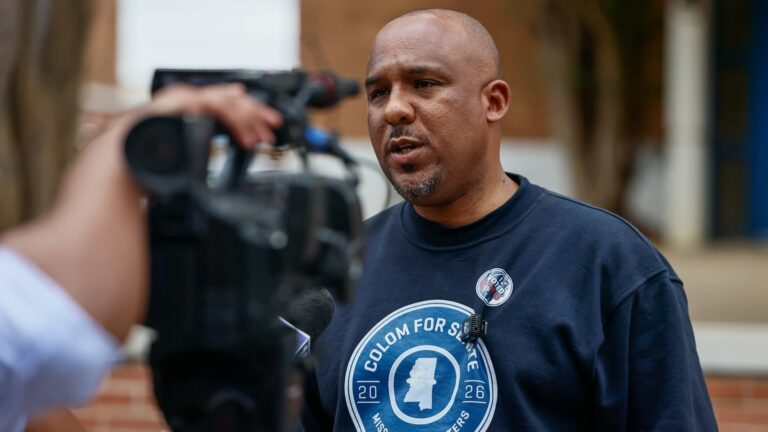
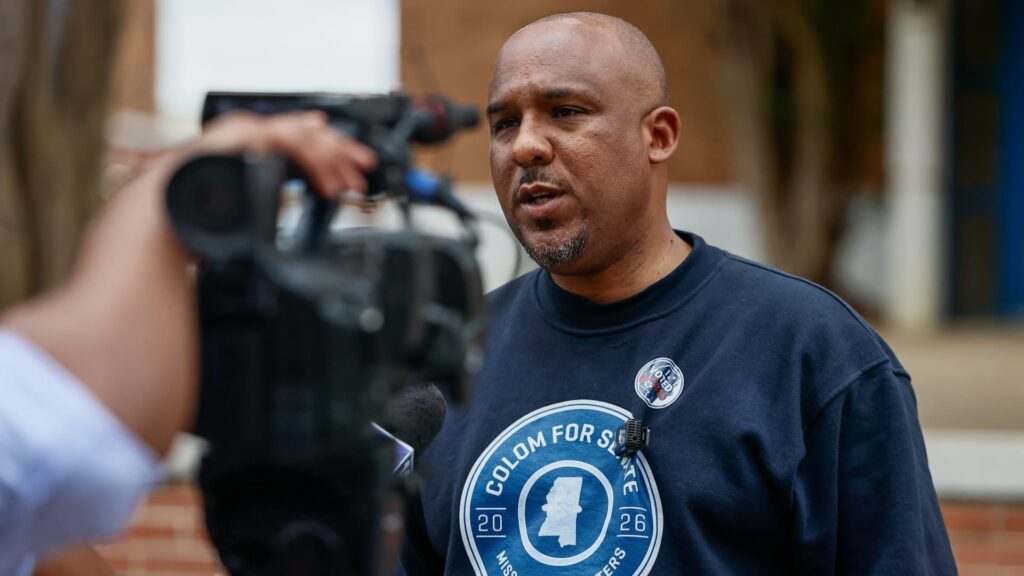
Mississippi’s uncalled Senate election could provide one of the biggest shocks in a midterm election cycle already chock full of stunning defeats of Republican candidates.
Sen. Cindy Hyde-Smith, the GOP incumbent, is trailing Democratic nominee Scott Colom in an extraordinarily tight race in normally solidly red Mississippi.
Colom led by 1,724 votes out of 930,728 votes counted as of Thursday afternoon, according to the Associated Press. Ty Pinkins, an independent candidate, had 19,978 votes, or 2.1% of the total count.
A final result may not be available until next week because more ballots can still arrive and be counted.
Mississippi’s election procedures do not have an automatic recount provision.
“Absolutely, I didn’t think it would be this close,” said Brian Anderson, a political science professor at the Mississippi University for Women in Columbus.
Anderson said that before the election, he thought Colom, a 43-year-old district attorney, might get into position to lose by just 3 or 4 percentage points, which would have been a very solid showing in a state that hasn’t elected a Democrat to the Senate since 1982.
“I’m much more surprised” now that Colom has a chance to win, Anderson said.
If Colom defeats Hyde-Smith, 67, he would be the first Black senator from Mississippi since the post-Civil War Reconstruction Era.
“The Democrats have struggled here to create a pipeline of candidates,” Anderson said. A Colom win “would galvanize the Democratic Party in a way it has not been,” he said.
Neither candidate’s campaign immediately responded to requests for comment from CNBC.
In a pair of ironic twists, if Colom wins, his victory could be attributed in some ways to actions taken by two Republicans: President Donald Trump and Hyde-Smith herself.
Supreme Court Justice Amy Coney Barrett, whom Trump appointed, wrote the court’s 5-4 majority ruling in June that upheld a Mississippi law allowing mail-in absentee ballots postmarked by Election Day to be counted if they are received within five business days.
Those ballots could provide Colom a margin of victory. There are also an estimated 10,000 to 15,000 provisional ballots that require verification of eligibility to vote.
A lawyer for the Republican National Committee, whose lawsuit argued federal law barred counting votes received after Election Day, noted in a brief to the Supreme Court, “Democratic voters tend to mail their ballots later on average than Republican voters, which results in late-arriving ballots favoring Democratic candidates.”
Trump at the time of the Supreme Court ruling called it “a tremendous loss” for voters’ rights.
Hyde-Smith was appointed to her Senate seat in 2018 after the resignation of Thad Cochran and later that year won a special election for the seat. She was elected to a full term in 2020.
In 2023, she effectively blocked Colom’s nomination by then-President Joe Biden to a post as a federal judge for the Northern District of Mississippi. Colom’s nomination had the support of Mississippi’s other Republican senator, Roger Wicker, and two former GOP governors.
Hyde-Smith said she opposed Colom’s nomination for reasons that included his purported support for transgender students participating in girls’ sports and because his campaign for district attorney had allegedly received money from billionaire George Soros.
Colom, in an April 10, 2023, letter to Hyde-Smith, said he was unaware before his hometown newspaper reported it that Soros had donated to a political action committee that had supported his campaign. He also wrote that he was not sure why Hyde-Smith had suggested he “opposed legislation to protect female athletes.”
Colom concluded the letter by promising to be guided by the law, not his personal views on public policy, if he were confirmed as a judge.
“I hope you will reconsider your views about my nomination,” he wrote.
Hyde-Smith did not reconsider her views and maintained her block on the nomination.
Colom announced his candidacy for the Democratic nomination for Senate in September 2025 and recently told CNN, “Me not having a federal judgeship is not a motivating factor for me at all” in running.
Anderson said Hyde-Smith ran “a low-visibility campaign,” at least compared to Colom’s, and that she focused on voters who traditionally would be expected to support her.
Hyde-Smith refused to debate Colom several times.
Colom “knows how to speak to people’s interests, and Hyde-Smith was all about values, which is great for a lot of people, but it’s all about the interests right now,” Anderson said.
Those interests include concerns about affordability, the Iran war and corruption.
Colom is “bringing up all those,” Anderson said.
Anderson noted that Colom’s campaign had pounced on a remark Hyde-Smith made during a Feb. 22 interview with a local television outlet.
In the interview, Hyde-Smith answered a question about rising beef prices by saying, “You know, there so many proteins to choose from.”
Colom’s campaign featured a video clip of that remark in an ad featuring people reacting incredulously to Hyde-Smith’s suggestion.
“Pick another protein?” one woman said in the ad. “She done lost her d— mind. I’d rather pick another senator.”