
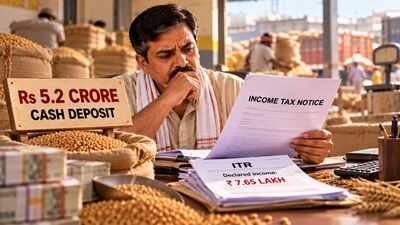
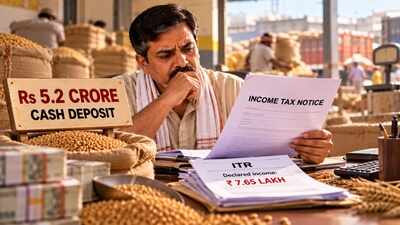
You make large cash deposits in your bank account, but report a much lower income in your tax return. The bank reports the deposits to the Income Tax Department as part of due process, what happens then?Banks in India are required to report specified financial transactions, including cash deposits and withdrawals above prescribed limits.A grain trader came under the income tax department’s scrutiny after depositing Rs 5.2 crore in cash into his bank account while declaring an income of only Rs 7.65 lakh in his Income Tax Return (ITR).
What the case is about
The first alert was generated when the bank disclosed the cash deposit through its specified financial transaction (SFT) return.In this case, the Rs 5.2 crore cash deposit resulted in the transaction being reported to the tax authorities.A second issue emerged from the person’s ITR. Although the bank account did not appear in the ITR itself, it was disclosed in the Form 3CD filed along with the return. The Income Tax Assessing Officer (AO) initially took the view that the grain trader had failed to disclose the bank account in his ITR.Also Read | Her employer deducted Rs 3.91 lakh TDS but failed to deposit it; Mumbai IT professional got just Rs 79,030 credit and faced Rs 3.36 lakh demand, ITAT gives reliefOn the basis of this understanding, the AO issued several notices to the individual seeking an explanation for the cash deposit and details relating to his ITR. The responses did not satisfy the tax department, following which the AO passed an assessment order. Through the order, the Rs 5.2 crore deposit was treated as unexplained money under Section 69.The grain trader was represented before the Income Tax Appellate Tribunal (ITAT), Delhi, by two chartered accountants. They submitted that the person in question was engaged in grain trading and had furnished Form 3CD along with his ITR. The form contained the details of his bank account maintained with the bank.They argued before the ITAT that when he filed the ITR, the applicable provisions did not require taxpayers to provide details of bank accounts other than the account into which an income tax refund was to be credited.The individual had therefore believed that there would be no issue because the bank account had already been disclosed in the balance sheet attached to Form 3CD. The AO, however, treated the absence of the account details from the ITR as a significant issue and proceeded on the assumption that the man had failed to disclose the account, according to an ET report.The argument by the chartered accounts was that this conclusion was factually incorrect because the bank account had in fact been disclosed and formed part of the balance sheet. Therefore, the AO’s conclusion that the amount represented escaped income could not be sustained on the basis that the account had not been disclosed, they said.On September 15, 2026, the ITAT Delhi ruled in the grain trader’s favour.Also Read | Delhi couple repaid Rs 1.41 crore home loan, but the bank lost their original sale deed property papers; consumer commission orders Rs 15 lakh compensation plus Rs 50,000 costs
Why did the grain trader win the case?
While examining the ITR, the ITAT Delhi found that the bank account details had been provided through Form 3CD.The tribunal said: “We further find that the bank account of Allahabad Bank has been duly disclosed in the ITR vide Form 3CD which give details of all bank accounts.”Based on this finding, the ITAT Delhi held that the reasons recorded for reopening the case were founded on incorrect facts. This, in turn, vitiated the assumption of jurisdiction through the notice issued under Section 148.The tribunal therefore quashed the tax notice as well as the assessment order that was subsequently passed.Advocate Somesh Jain of Sachdev & Jain, Advocates, told ET that the grain trader’s success before the tribunal was based on a jurisdictional issue rather than the merits of the cash deposits themselves.He said a reassessment can be initiated validly only when the reasons recorded by the Assessing Officer are based on accurate facts. In this case, the recorded reasons proceeded on the premise that the man had not disclosed his bank account in his income tax return.The ITAT Delhi examined the individual’s ITR for AY 2014-15 and found that the return had been accompanied by the tax audit report in Form 3CD, which contained details of the bank account.Jain said that once the basic fact underlying the reasons for reopening was found to be incorrect, the assumption of jurisdiction under Sections 147/148, as applicable at the time, was affected. Consequently, the notice issued under these provisions, along with the assessment order that followed it, could not stand.Akhil Chandna, Partner, Global People Solutions Leader, Grant Thornton Bharat, told ET that agricultural income is generally exempt from tax. However, where the applicable ITR form requires it, the income still needs to be disclosed appropriately in the return.The ITR forms have designated fields and schedules for reporting exempt income, including agricultural income. Such reporting can also become relevant when agricultural income is taken into account for partial integration while determining the tax rate applicable to non-agricultural income.Chandna says: “As a matter of good tax compliance, agricultural income should be appropriately and consistently disclosed in the ITR wherever required by the applicable form.”