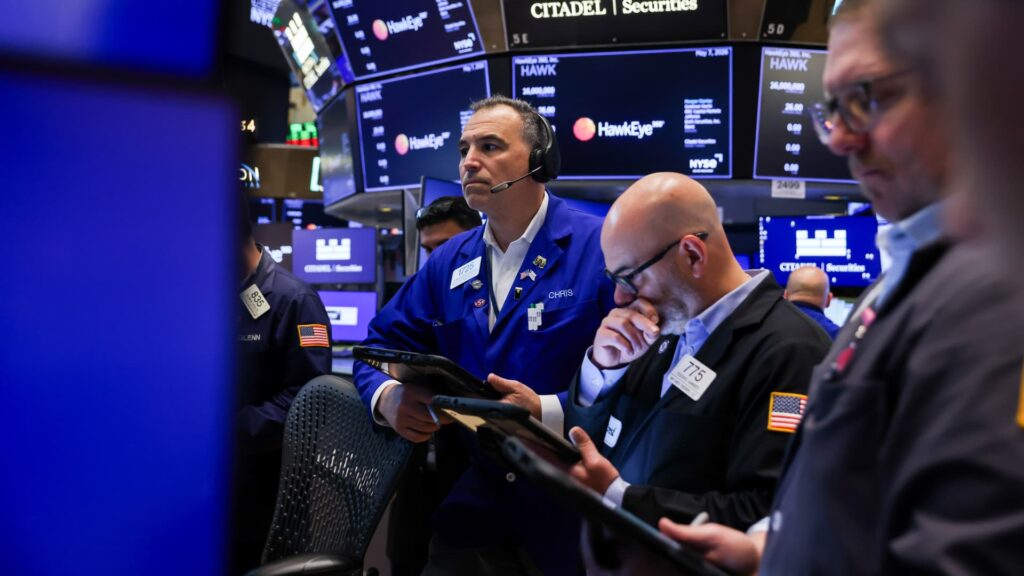
Retail investors are back in the stock market, and they’re driving key trades, according to Goldman Sachs. Individual investors were sitting out the stock market earlier this year, in March and for part of April, following the start of the U.S.-Iran war. That’s in contrast to their buy-the-dip mentality last year, when they bought the post-“liberation day” correction with a vengeance, besting institutional investors who were certain the downturn had further to go. Now Mom-and-Pop investors have returned as a force in the market, driving the rally that has lifted the S & P 500 to all-time highs and the Dow Jones Industrial Average back above 50,000 . Goldman Sachs found that retail trading volumes surged 28% since mid-April, as a renewed enthusiasm for artificial intelligence drove Main Street investors back into their high-growth mainstays. Retail traders are a growing force in the market. They’re responsible for roughly 20% of total U.S. equity trading volumes despite holding just 10% of the entire equity market value, the firm found. But the impact their trades have is amplified in the overall market, as retail investors prefer to use both margin and leveraged ETFs that give them two times or three times the daily returns of an asset. It underscores retail investors’ preference to go big or go home using aggressive, high-risk trades. For now, that approach is working for them. Goldman Sachs found that an indexed return of retail favorites far outpaces the equal-weight S & P 500. But it also raises the volatility of their most preferred stocks. Here are some of retail’s favorite names. To no one’s surprise, high growth stocks were among the leading retail names. Nvidia , which has 15% of its trading volume driven by retail, is expected to post sales growth of more than 34% in 2027. It’s also up 25% year to date. Micron Technology , the memory stock that has skyrocketed more than 176% this year, has 16% of its trading volume exposed to retail. Advanced Micro Devices , with 16% exposure, has more than doubled this year. However, not all of the stocks exposed heavily to retail are outperforming this year. In fact, retail traders are piling heavily into some names that are actually declining. American Airlines Group , which has roughly 27% of its trading volume dominated by retail, is down by 17% this year. Nu Holdings , which has 21% of its trading volume exposed to retail, is down nearly 22% in the same time period.