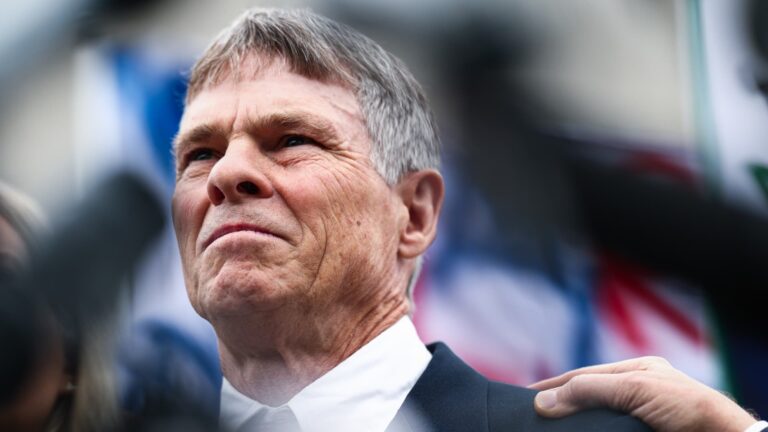
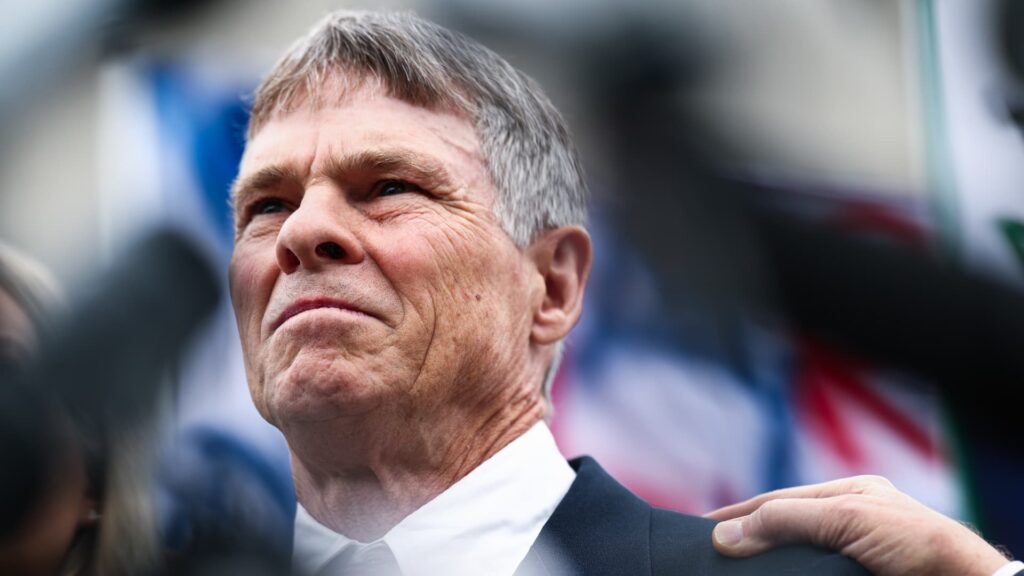
Former Olympian David Hearn after his arrangement at Moultrie Courthouse on July 09, 2026 in Washington, DC.
Finn Gomez | Getty Images
A Washington judge on Friday said he will rule quickly on whether to dismiss a now-discredited indictment charging former U.S. Olympic canoeist David Hearn with vandalizing the Lincoln Memorial Reflecting Pool with prejudice, which would bar prosecutors from refiling charges against Hearn for the same alleged conduct in a case that has drawn intense focus from President Donald Trump.
Prosecutors, who admit there are no current grounds to sustain a criminal case against Hearn, urged Judge Todd Edelman at a hearing to dismiss the indictment in D.C. Superior Court without prejudice.
That would let prosecutors ask a grand jury to charge Hearn again if new evidence were discovered implicating him in vandalizing the pool.
“I do think there is a public interest in allowing a grand jury at a future date” to issue an indictment if new information comes to light, Assistant U.S. Attorney Michael Spence told Edelman, according to reporting by MS NOW.
But Hearn’s lawyer, Steve Levin, argued, “There is nothing that can save the case that was dismissed.”
“There is no valid reason to keep it alive, to hold it over Mr. Hearn’s head for the next five years,” Levin told Edelman.
At the end of the nearly hour-long hearing, Edelman said, “I’m going to take this under advisement.”
“Won’t take long to issue a ruling,” the judge added.
Hearn, speaking to reporters after the hearing, said, “I just want to thank everyone who’s out here supporting me and everyone across the country.”
“I want to thank my lawyers for making sure that this case is represented well, and I just want to say it’s not about me,” Hearn said. “This is about defending democracy.”
Read more CNBC politics and policy coverage
During the hearing, Edelman questioned the speed with which prosecutors obtained their indictment against Hearn while knowing they had not yet received all of the information from the Department of the Interior about the installation of a new pool liner.
Hearn, 67, was indicted in early July on a charge of destruction of property for what U.S. Attorney Jeanine Pirro said was intentionally and “violently” damaging of a two-square-foot piece of liner from the Reflecting Pool on June 19. The three-time Olympian faced a possible maximum sentence of 10 years in prison if convicted.
Hearn, after his arrest on an initial misdemeanor charge in the case in June, told The Washington Post that he had stopped at the Reflecting Pool after a long bicycle ride to look at it and reached into the water to feel a partially detached piece of blue liner.
“I didn’t vandalize anything,” Hearn told The Post. “I didn’t destroy or break or peel anything. By the time I realized what was going on, I was being put in handcuffs.”
In late July, Pirro asked Edelman to dismiss the indictment without prejudice.
Pirro said then that, despite her prior allegations against Hearn, her office had learned from the Department of Interior that damage to the pool’s sealant resulted from a “flawed installation,” not Hearn pulling it up.
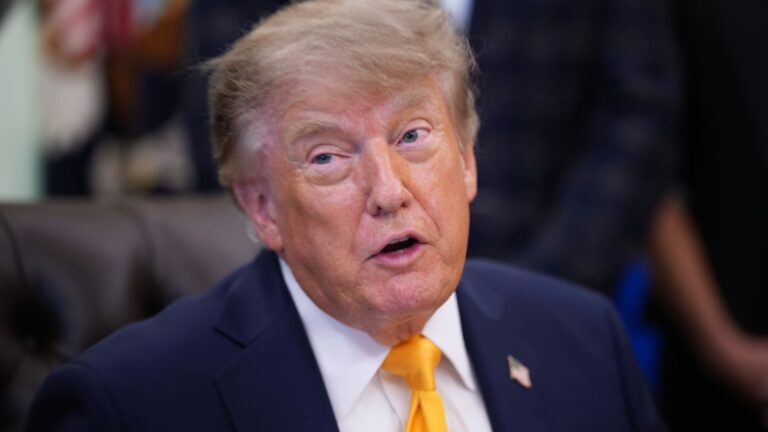
Trump at the time reacted angrily to Pirro’s move, writing in a Truth Social post, “I disagree 100% with Jeanine Pirro, the U.S. Attorney for the District of Columbia, on the Reflecting Pool.”
“I don’t know what she was thinking?” the president wrote. “To me, it was a pure case of VANDALISM.”
Trump has made the renovation of the Reflecting Pool, along with the building of a White House ballroom, a triumphal arch overlooking Washington, and other construction projects a focal point of his second term as president.
At Friday’s hearing, Hearn’s lawyer Levin argued to Edelman that a dismissal with prejudice was required to protect Hearn from being indicted again on baseless charges.
“I think it’s clear why they moved to dismiss the case, because they had no case,” Levin said.
“The court has the obligation to ensure that the government doesn’t abuse its prosecutorial discretion,” Levin said. “The question is: why are they reserving [the right] to reindict a case they acknowledge should have never been indicted?”
Levin accused Pirro’s office of acting in bad faith.
Spence, the prosecutor, told Edelman that prosecutors had acted in good faith and argued that “I do think there is a public interest in allowing a grand jury at a future date” to bring new information if it comes to light.
Spence confirmed, when questioned by the judge, that whatever Hearn might have done at the pool had no economic impact on the Reflecting Pool’s liner and as a result did not constitute destruction of property.
Edelman then asked Spence whether, given that fact, there could ever be an economic loss that could lead to a renewed prosecution of Hearn.
“I don’t know what the future will bring. None of us do,” Spence replied. He added that if more evidence was found, prosecutors wanted to be able to lodge charges again.
“There’s no reason this court should tie the hands of a future grand jury,” Spence said.
Edelman then brought up Trump’s public comments about Hearn, blaming the canoeist, not contractor error, for the damage to the Reflecting Pool’s liner despite Pirro’s statement to the contrary and evidence from the Interior Department.
Edelman asked Spence how the judge could look at Trump’s statements as anything other than the president telling prosecutors to “pursue a prosecution that you told me is meritless?”
The prosecutor replied: “I think the president’s statements speak for themselves. At the end of the day, the president can remove the U.S. Attorney … he can remove me if he so chooses.”