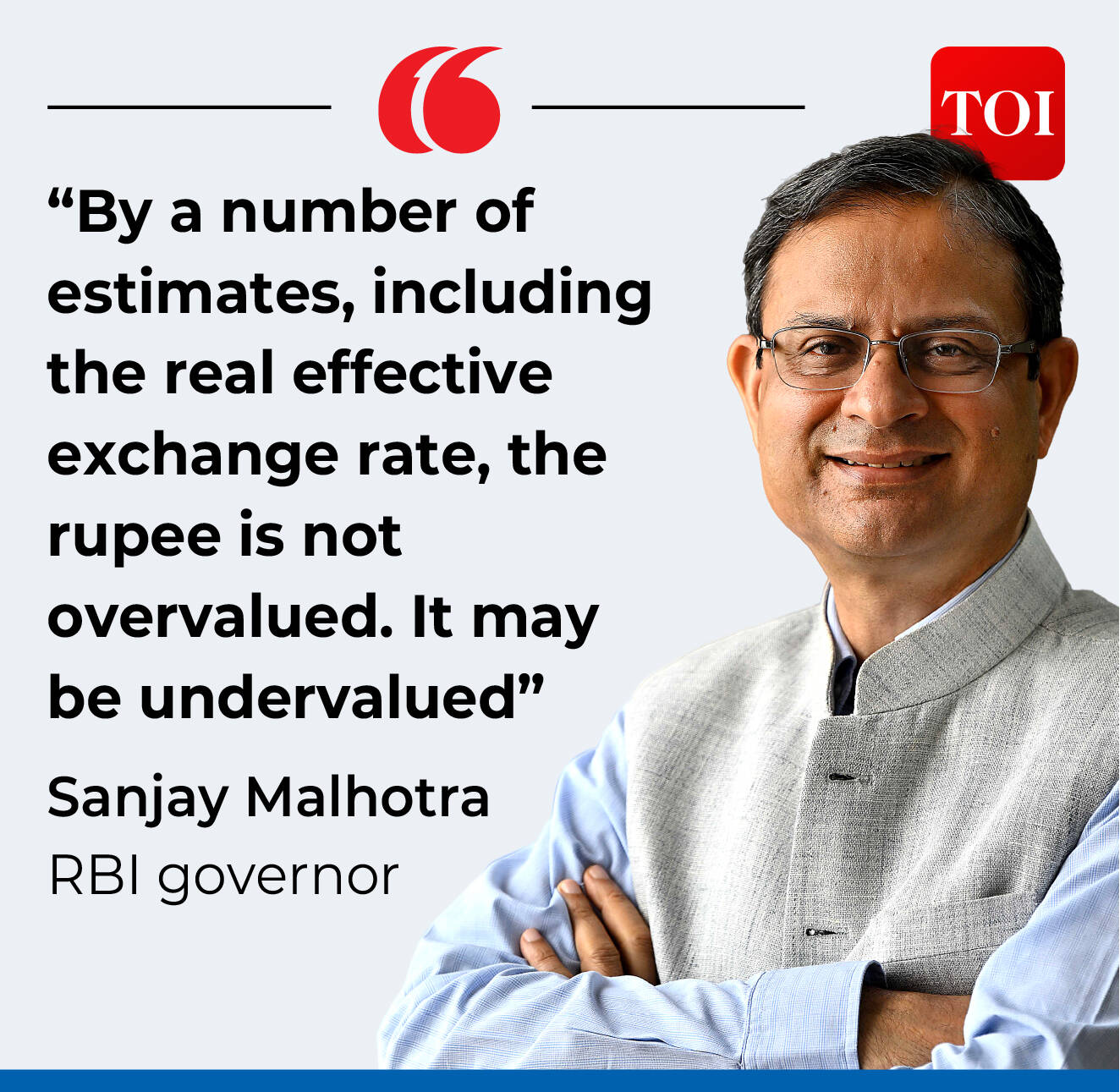
Where is the rupee headed? The Indian currency has been in a free fall for several quarters now. At one time its one-year forward even breached the 100 mark prompting experts and economists to wonder if the rupee will cross the 100 mark versus the US dollar.A lot has changed since then. The Reserve Bank of India (RBI) has stepped in to build a record foreign exchange reserves chest to arm itself with tools to intervene in the forex market. The FCNR(B) deposits scheme helped attract billions of dollars, putting India in a comfortable position on the forex reserves front.Yet continued capital outflows, high oil prices, uncertainty on the US-Iran war front, and rising US bond yields have added pressure to the currency, pushing it to record lows of almost 97.More recently, RBI’s measures unveiled last week have led to the rupee appreciating sharply. On Friday it closed at 96.61. Since then it has appreciated by Re 1.36 or 1.41% to 95.24.One thought process is that the RBI should allow the market forces to let the rupee find its levels. Indeed the IMF recently said that India should allow the exchange rate to act as a shock absorber.Interestingly, RBI governor Sanjay Malhotra believes that the rupee is actually undervalued.A currency is said to be undervalued when it is weaker than what experts believe is its fair value based on underlying economic fundamentals.However, an undervalued currency does not automatically mean it will strengthen soon. The currency can continue to remain weak for an extended period because of capital outflows, global uncertainty or other market pressures.What should RBI do? How effective would its latest measures be for long-term prospects of rupee? And, should the rupee be allowed to depreciate?
RBI’s measures
Last week, RBI unveiled what SBI Research has called a bazooka to protect the rupee’s slide.These measures were:RBI opened a direct dollar-supply window for three state-run OMCs shifting roughly $10-12 billion per month away from the open spot market.The daily CRR maintenance has been raised to 99% and simultaneously to tighten liquidity in the system the RBI has announced a Rs 25,000 crore OMO sales.RBI has tightened foreign exchange derivative regulations by prohibiting the rebooking of cancelled rupee derivative contractsIt has lowered the threshold for taking FX derivative positions without underlying exposure from $100 million to $5 million across all Authorised DealersIt has strengthened documentation requirements to prevent duplicate hedging, and introduced a Foreign Exchange Risk Reserve for larger contracts.
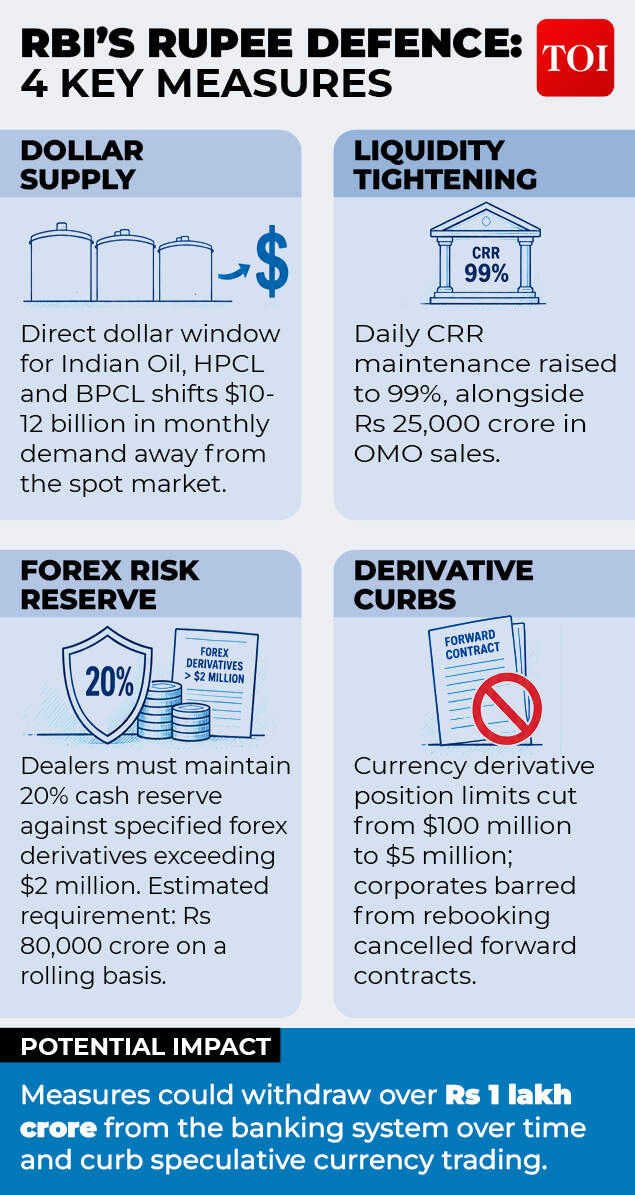
RBI’s Rupee Defence: 4 Key Measures
Vivek Kumar, Economist at QuantEco sees RBI’s special measures as a comprehensive package for addressing both internal and external macro pressures.“The dual focus on increasing the price of money (i.e., interest rate) and restricting its availability (i.e., draining surplus liquidity) is an appropriate policy response to the emerging inflation and currency risks,” Vivek Kumar tells TOI.In addition, tighter regulation of rupee hedging and trading will dramatically shrink space for speculation and short-circuit the self-fulfilling expectation of currency weakness.
How long will the effect last?
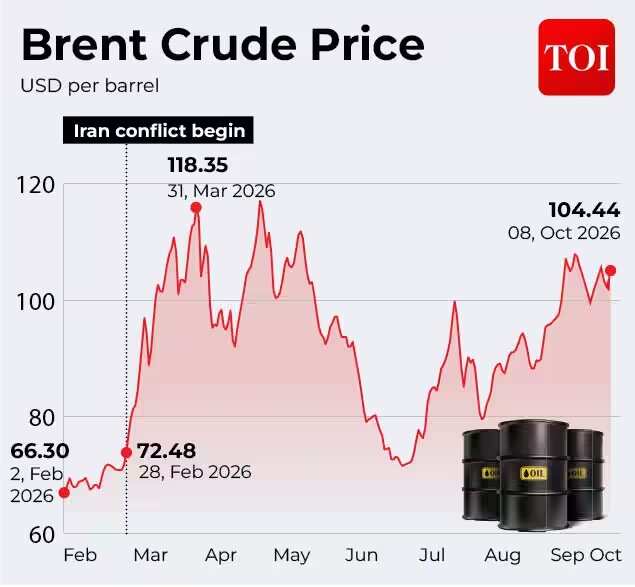
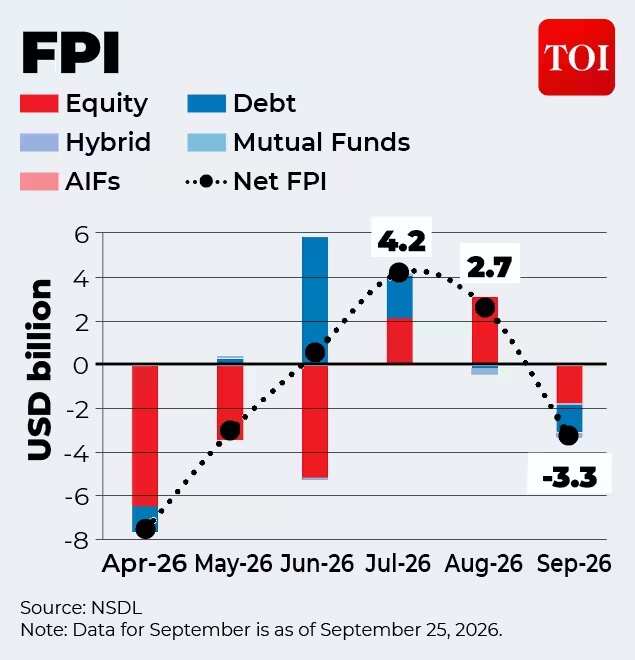
The effect may however be short-term.Interest rate increases by the US Federal Reserve have historically put emerging markets under pressure through shifts in capital flows, financing conditions and exchange rates.The Federal Reserve raised rates on September 17, marking its first increase since July 2023.As Vivek Kumar points out: the underlying pressure on the rupee from a firm dollar, elevated energy prices, and continued portfolio outflows persists.
Brent Crude Price Trend Line
“As such, while these measures will help to stabilise the rupee, they won’t engineer a reversal beyond the initial knee-jerk relief rally. Since the rupee remains exposed to the current set of adverse global factors, durable stability will be conceivable only if the global tensions ease,” he says.“Meanwhile, the RBI could focus on maintaining an ex-ante real policy rate of 1.0-1.5% to ensure durable macroeconomic balance. This can be complemented with measures to attract foreign investment,” he adds.Yet another important factor is the central bank’s stance that it will not target any particular level of the rupee versus dollar. Any intervention will be aimed at curbing speculative pressures and volatility.
FPI outflows
Ranen Banerjee of PwC India says that the recent measures taken by RBI will surely address the pressures on rupee caused by speculative trades.“These measures are not towards addressing the fundamentals of demand and supply of forex but more to make the supply more orderly for the oil companies and make the demand for forex real and not speculative,” he explains.SBI Research says that while the RBI has been taking all possible steps to thwart a seemingly difficult global playbook, there is an urgent need also by the government to address some of the long pending structural issues regarding capital inflows. For example, it recommends abolishing the long-term capital gains tax on equities. This would help deal with capital outflows more effectively.
Should RBI let the rupee depreciate?
There are the costs associated with a weaker rupee.While exports benefit from a depreciating currency, imports become costlier. In the current scenario, with oil prices high, it acts as a double whammy when India imports higher inflation.And, the inflationary pressures for a net importing country like India increase with a weaker rupee. The fiscal pressures also increase owing to higher energy and fertiliser costs in rupee terms.Sujan Hajra, Chief Economist at Anand Rathi Group notes that the immediate costs are especially relevant for India, whose crude-oil import dependence reached approximately 88.7% in FY2025–26, according to PPAC data. “Depreciation compounds an oil-price shock, raising domestic production costs and potentially inflation. It also increases the rupee burden of unhedged foreign-currency debt, reduces purchasing power and can weaken foreign investors’ dollar returns. Crucially, depreciation raises the rupee cost of imports immediately; improvement in the dollar trade balance requires a subsequent response in export and import volumes,” he explains.
What RBI governor said on rupee
Hence, experts say the aim should be to have the exchange rate closer to the real effective exchange rate and not target a particular exchange rate.Radhika Rao, Senior Economist and Executive Director at DBS Bank cautions against the fallout of letting rupee depreciate.“While exchange-rate flexibility is a shock absorber, policymakers will be mindful of the risk that one-way currency depreciation can become self-reinforcing. Preventing a disorderly depreciation is therefore as important as preserving flexibility,” she tells TOI.“Beyond a point, it can become destabilsing for capital flows, price stability and sentiments, requiring an active policy response,” she adds.Rao is of the view that the breadth of the restrictions highlight the authorities view that the USD/INR is nearing a defacto red line and that the recent bout of rupee depreciation is being viewed as disorderly rather than fundamentals driven.Ranen Banerjee, Partner and Leader, Economic Advisory at PwC India says that the rupee should find its natural level based on the dollar forex demand and supply.“Targeting an exchange rate is always futile as we have only limited firepower and means to address external factors that determine forex flows. Volatility owing to speculation on the rupee needs to be managed and that is what RBI is doing,” he tells TOI.As Sujan Hajra points out: A record low against the dollar does not, by itself, establish whether the rupee is cheap or expensive. “Valuation requires examining inflation-adjusted exchange rates against trading partners, productivity and the external balance. Equally, a fundamentally undervalued currency can weaken temporarily when dollar demand exceeds supply,” he tells TOI.“I favour calibrated intervention to prevent self-reinforcing depreciation, alongside sufficient flexibility to accommodate persistent external pressures. The objective should be orderly adjustment and anchored inflation expectations,” he says.Economists believe that the economy’s growth momentum, demand in the Indian economy and the opportunities for growth are being currently overshadowed by capital flows to AI centred investments, higher yields in the developed markets and higher oil prices.“It is a cycle and we need to manage the macro through this cycle as there has been no change in the underlying fundamentals of the Indian economy as can be seen from the growth forecasts being upgraded by almost all external agencies,” Banerjee says.IMF may favour market-driven exchange rate adjustments, but for RBI orderly currency movements assume priority.And, as the RBI governor pointed out, the rupee is undervalued, which means the economy’s fundamentals do not warrant such sharp levels of depreciation.DK Srivastava, Chief Policy Advisor at EY India says the US dollar remains overvalued and the rupee undervalued.“Rising US bond yields are attracting capital flows into the US, including from India, adding pressure on the rupee and deepening its undervaluation,” he tells TOI.“In this environment, the RBI should continue to guide the rupee along a trend consistent with inflation differentials. While inflation remains elevated in both economies, India’s CPI inflation averaged 4.8% during June-September 2026, compared with about 3.4% in the US during June-August 2026, suggesting that some depreciation may be warranted,” Srivastava adds.