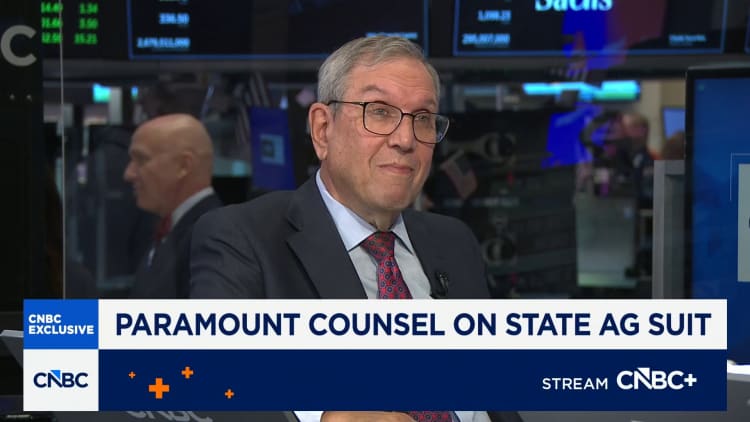

Paramount Skydance is still aiming to close its proposed acquisition of Warner Bros. Discovery by the end of September despite a recent lawsuit filed by state attorneys general challenging the deal, Paramount’s lead trial counsel Jeffrey Kessler told CNBC’s David Faber in an interview on Tuesday.
On Monday, a group of state attorneys general led by California’s Rob Bonta filed a lawsuit aimed at blocking the merger due to antitrust concerns. Later in the day, the group filed court papers seeking a temporary restraining order to put the deal on hold so that legal proceedings could move forward.
Either way, Kessler said that the company is prepared to bring the matter to the Supreme Court if it faced a prolonged blockade in closing the deal.
“The company believes strongly in this,” Kessler said of the combination of the entertainment and media companies.
Kessler told Faber on Tuesday the temporary restraining order came after Paramount “indicated” that its intention was to be able to close as early as July 22, when the company expects to have all regulatory clearances.
The July date stems from the next big hurdle Paramount needs to clear. The European Union has been reviewing the deal for approval and recently set July 22 as a new provisional deadline. Paramount recently submitted concessions to the EU as it looks to smooth concerns regarding the deal.
In an aerial view, the Paramount logo is displayed on a water tower at the Paramount Studios lot on July 13, 2026 in Los Angeles, California.
Justin Sullivan | Getty Images
The proposed acquisition that would bring together the two storied film studios of Warner Bros. and Paramount, as well as a sprawling portfolio of pay TV networks, has already received approval from the Antitrust Division of the U.S. Department of Justice, as well as other global jurisdictions.
“Or we could work out a schedule to get this all decided by early September, that would be perfectly acceptable to the company if we could create an orderly procedure,” Kessler said. “The states rejected both alternatives so right now we have a [temporary restraining order] that’s been filed.”
If granted, it would pause the deal for 14 days. Up to two temporary restraining orders could be granted before the coalition seeks a preliminary injunction, putting the deal on ice while it’s sorted out in court. Kessler said on Tuesday the company doesn’t expect it to get to that point, arguing this isn’t an antitrust issue.
A long delay could be costly for Paramount. As part of the deal, Paramount has agreed to pay a so-called ticking fee, meaning that if the closing goes past Sept. 30, Paramount would pay additional fees to WBD shareholders per quarter until closing. That fee would equal roughly $650 million in cash value per quarter.
For it to be delayed or blocked, “the merger has to be anti-competitive. This merger is pro-competitive,” Kessler told Faber.
“Anybody who knows the entertainment industry knows it is in deep trouble,” he added, noting widespread challenges as consumers flee pay TV bundles and competition among streaming giants like Netflix intensifies.
He added that the merger would create a competitor that could “go toe to toe with a Netflix or Disney or [Amazon’s] Prime,” which would be a positive for the theater industry and Hollywood workers.
On Monday, Bonta said in a release that the merger would “lead to higher prices, lower quality, and less content for film and television, harming movie theaters, basic cable distributors, and ultimately, audiences on every sofa and movie theater seat in the U.S.”
As Hollywood has expressed concerns since the deal was announced, Paramount CEO David Ellison has promised that once merged, the film studios would together put out a slate of 30 movies annually.
“We’ve told the states if they have what they think are legitimate concerns, they should come to the table and we talk about them,” said Kessler, noting the question of whether Paramount could deliver the 30 films per year.
Kessler said that Paramount has told state attorneys general the company is willing to put in writing that it would commit to the 30 films, and if it doesn’t happen, litigation could then take place.