Open AI CEO Sam Altman speaks during the G20 Innovation Ministerial in Chapel Hill, North Carolina, on September 2, 2026.
Matt Ramey | Afp | Getty Images
OpenAI on Thursday announced it will begin rolling out its latest artificial intelligence model, GPT-6 Astra, which the company said is the product of “years of research and big bets.”
The model is launching in phases, and OpenAI said a limited group of companies participating in its application-based cybersecurity program Daybreak will be the first to get access. OpenAI disclosed earlier this week that Astra is its first model to reach its “Critical” internal cybersecurity threshold, and said it planned to limit access to those advanced capabilities.
OpenAI has been under pressure to shore up its security and safety protections after two of its models escaped containment, accessed the open web and breached Hugging Face’s systems last month.
The company temporarily paused some of its research and training efforts following the incident, including for Astra, even though it was not one of the models involved.
“AI can only benefit people when safety is a core part of it, and so we’re putting more compute and effort towards safety, security, alignment than ever before,” OpenAI President Greg Brockman said during a briefing with reporters on Thursday.
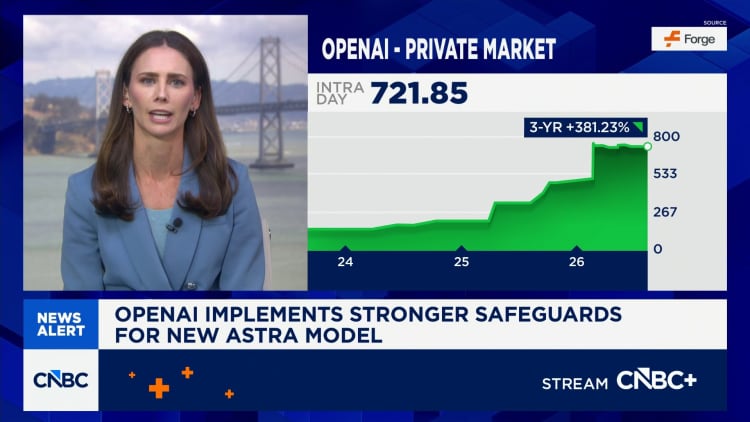
The company added additional safeguards to Astra following the Hugging Face breach, and it said Tuesday that it believes those safeguards “sufficiently minimize the risk of severe harm for release.”
Astra will roll out to users across OpenAI’s ChatGPT Plus, Pro, Business, Enterprise plans, as well as through the OpenAI API and Amazon Web Services in “the coming days,” OpenAI said.
In addition to its advanced cybersecurity capabilities, Astra is state-of-the-art across functions like computer use, software engineering, professional work and science OpenAI said. The model is also better at staying oriented, respecting task boundaries, understanding user intent, completing tedious tasks and carrying out multi-step workflows, according to a release.
“There’s still more to do, I think that there’s still lots of improvements to be made, but there is something significant here that I think is qualitatively improved, and that that to me is, is what is significant and a real shift in what kind of work people can delegate to AI and how it can empower them,” Brockman said.
OpenAI has spent much of the last year courting business customers in the fiercely competitive enterprise market, where it is racing against rivals including Anthropic and Google.
CFO Sarah Friar told employees last month that its enterprise unit now accounts for more revenue than its consumer business, as CNBC previously reported, which makes it a crucial revenue engine as it gears up for what is widely expected to be a blockbuster IPO.
The company confidentially filed its prospectus with the Securities and Exchange Commission in June, but it has not officially disclosed when it plans to debut. Friar recently told employees that OpenAI “will be a public company in 2027,” but said the company could go out sooner if “our business continues to inflect.”
WATCH: OpenAI implements stronger safeguards for new Astra Model