10 Indian sailors have been killed in the Middle East while hundreds are still sailing the dangerous waters
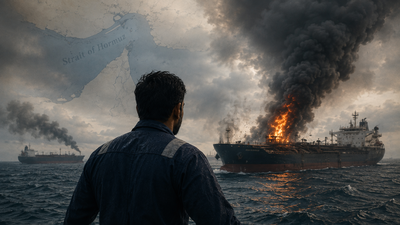
For thousands of Indian merchant seafarers, the Middle East war has transformed the sea from a workplace into a battlefield.They are not soldiers. They are civilians who keep global trade moving, transporting oil, fuel and essential cargo through some of the world’s busiest shipping lanes, including the Strait of Hormuz, the Gulf of Oman and the Red Sea. But since the US-Israel war with Iran erupted on February 28, many have found themselves navigating through missile strikes, drone attacks and naval hostilities.Some never made it home. Indian sailors have been killed in attacks on commercial vessels. Others have been injured or stranded at sea for weeks, unable to escape the conflict. Back home, anxious families spend their days glued to news bulletins, fearing every report of another ship being struck and praying for a phone call confirming their loved ones are still alive.The scale of the crisis is stark.The ministry of external affairs (MEA) recently said 166 Indian seafarers remained in the Persian Gulf and Strait of Hormuz region, with 125 aboard six Indian-flagged vessels and another 41 serving on foreign ships. In an update on August 4, the Ministry of Ports, Shipping and Waterways said 3,972 Indian seafarers had been repatriated from the Gulf region, underscoring the massive effort to bring them out of one of the world’s most dangerous conflict zones.
Numbers tell the story
India is the world’s second-largest supplier of seafarers after the Philippines, with 311,936 personnel accounting for 12.16 per cent of the global maritime workforce, according to the BIMCO-ICS Seafarer Workforce Report 2026.Indian officers make up 13.41 per cent of the world’s officer workforce, while the country also supplies 171,218 ratings, representing 11.29 per cent of the global ratings workforce.That vast presence at sea has come at a heavy cost since the Iran war erupted.Last month, the MEA said Indian seafarers had suffered the highest number of fatalities of any nationality in attacks on commercial shipping. Later, the government informed Parliament that 10 Indian seafarers were among the 16 Indian nationals killed in the Middle East conflict.However, the human cost extends far beyond those killed in missile and drone attacks.Hundreds of Indian sailors stranded in conflict-hit waters have faced prolonged deployments, delayed crew changes, disrupted medical evacuations, supply shortages and worsening onboard conditions, exposing them to mounting physical and mental risks.One such tragedy unfolded in June when 35-year-old Second Officer Nishanth Uirthanathan died from medical complications aboard the MT Celestial near Oman after falling seriously ill.
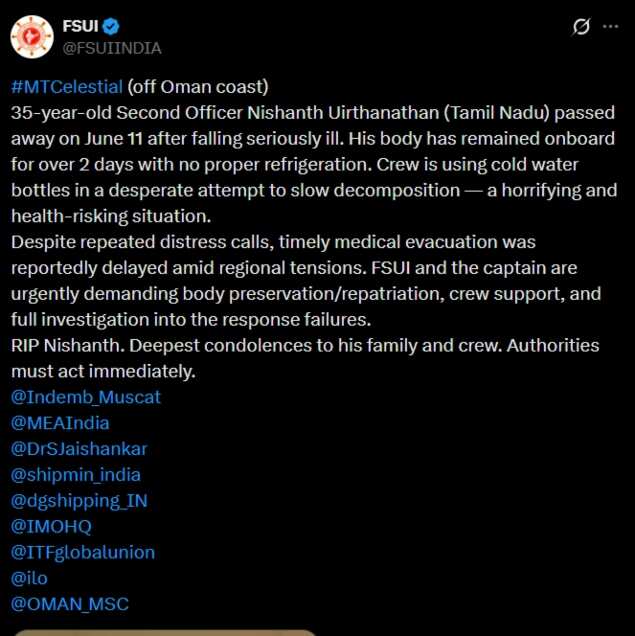
An officer died as he got sick on vessel off Oman Coast
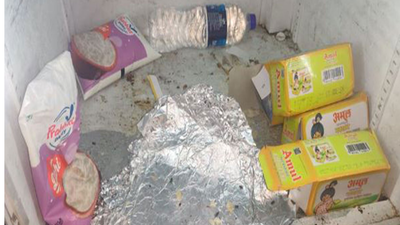
The Indian Embassy coordinated the repatriation of his remains, while the Federation of Seafarers’ Unions of India (FSUI) alleged that critical medical assistance was delayed because the vessel was operating in a conflict zone. Following his death, crew members reportedly had to preserve his body using bottles of cold water as the ship lacked adequate refrigeration facilities.The silent toll on IndiaThe human cost for India was almost immediate.
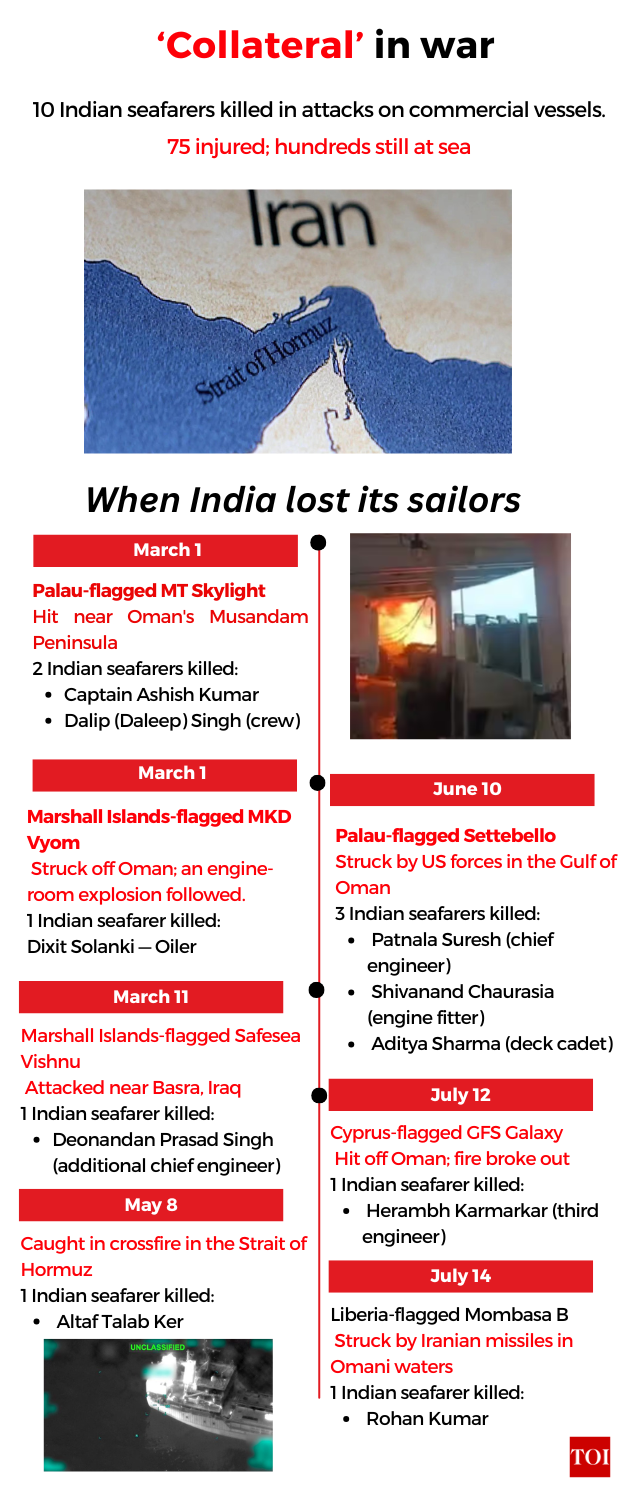
The cost of war that India has paid
Within 24 hours of the Iran war erupting, Indian seafarers had begun paying the price.On March 1. Captain Ashish Kumar and crew member Dalip (Daleep) Singh were killed when the Palau-flagged tanker Skylight was attacked near Oman’s Musandam Peninsula. Hours later, another Indian seafarer lost his life after the Marshall Islands-flagged gasoline tanker MKD Vyom was struck off the Omani coast.The attacks continued over the following months.On March 11, 54-year-old Deonandan Prasad Singh was killed when the Marshall Islands-flagged Safesea Vishnu came under fire near Basra, Iraq.On May 8, Indian seafarer Altaf Talab Ker died and four others were injured after the Indian-flagged dhow Al Faize Noor Suleimani was caught in crossfire in the Strait of Hormuz.The single deadliest attack came on June 10, when the Palau-flagged Settebello was struck by US forces in the Gulf of Oman, killing Chief Engineer Patnala Suresh, Deck Cadet Aditya Sharma and Fitter Shivanand Chaurashiya.The toll continued to climb in July.Marine engineer Herambh Karmarkar was killed on July 12 after the Cyprus-flagged GFS Galaxy was hit shortly after transiting the Strait of Hormuz. Ten of the vessel’s 11 Indian crew members were rescued.Two days later, Indian seafarer Rohan Kumar was killed when the Liberia-flagged Mombasa B was struck by Iranian missiles alongside Al Bahyah in Omani waters.Together, the two vessels carried 30 Indian seafarers.Other India-linked vessels also came under attack but avoided fatalities. The cargo ship Haji Ali was hit on May 13, while Marivex and Jalveer were attacked in June, with all Indian crew members rescued.The violence has shown little sign of easing.On August 4, the Indian-flagged MSV Faize Noore Oliya was hit near Yemen and sank. All 13 Indian crew members survived, narrowly escaping what could have been another deadly addition to India’s mounting toll.‘Seafarers are not warriors’For merchant seafarers, the risks are fundamentally different: commercial vessels can become targets, crews can be stranded for days and even routine medical emergencies can become life-threatening when ports and evacuation routes are disrupted.That has put a new question at the centre: who protects the people onboard?Recently, the sinking of the Indian-flagged MSV Faize Noore Oliya on 4 August has intensified calls for stronger protection of merchant crews. The Federation of Seafarers’ Unions of India (FSUI), one of the key seafarer bodies advocating for their safety, has asked PM Modi to deploy Navy assets to protect Indian-flagged ships and Indian crews across the Hormuz, the Red Sea and the Black Sea.The Navy already operates Urja Suraksha, an escort mission for energy shipments through the Strait. FSUI wants such protection extended to commercial vessels and says it had warned the government about the risks in the Bab-el-Mandeb Strait roughly a month before the Faize Noore Oliya attack.Raising concerns on safety, FSUI general secretary Manoj Yadav told TOI. “Today’s escalation of war, which has reached the sea from land, targets commercial vessels from either side — the US and Iran,” adding that crews, including large numbers of Indians, are being caught in a conflict they had no role in.Yadav argued that military or naval forces can stop a commercial vessel without harming its crew; by boarding or detaining it, for instance instead of targeting sensitive areas such as engine rooms and accommodation blocks.“Seafarers are not warriors. They work to serve the nation and the global supply chain,” Yadav reiterated.FSUI’s concerns extend beyond attacks. It says thousands of seafarers remain at risk in the Persian Gulf and Black Sea, while war-risk insurance gaps can leave families without compensation. The union has called for a government-backed insurance mechanism, $5 million for each deceased seafarer’s family and employment support for next of kin.FSUI has also urged the government to seek a UN-backed independent inquiry into the deaths of seafarers in conflict zones and establish accountability.“Seafarers are the heartbeat of the ocean,” Yadav said. FSUI has called on seafarers both aboard ships and ashore to observe September 25 as a Day of Global Maritime Mourning.Life on boardFor the people actually on ships, the war is not a headline, it’s a watch schedule.Deepak Kumar, a Third Officer in the Merchant Navy, said shipping companies now run detailed risk assessments and add security measures before entering high-risk waters, and depending on the threat level, some deploy armed guards while naval forces patrol the surrounding sea.But no amount of planning removes the strain.“No seafarer wants to sail through a high-risk maritime zone,” as every transit means disturbed sleep, patchy contact with home, and having to “put your emotions aside” and keep the ship running regardless.Kumar added that the hardest part often isn’t the danger itself but the silence around it: families hearing of an attack near their loved one’s trading route and waiting for a message confirming they’re safe.
While world powers engage in military blockades and political posturing, the people suffering the real humanitarian crisis are the innocent seafarers trapped onboard.
Deepak Kumar, third officer in merchant navy
Ritik Raina, another Third Officer, explained why the Hormuz transit is uniquely brutal.There is a distinction between a High Risk Area, where seafarers face threats such as piracy and armed attacks, and a Warlike Operations Area, where they are exposed directly to an ongoing military conflict. The latter carries far greater implications for crews, including enhanced compensation and, under international maritime labour agreements, the right to refuse to enter the area, he explained.The Strait of Hormuz was initially designated a High Risk Area on March 2, before being upgraded to a Warlike Operations Area three days later.For crews already inside the Gulf, however, the geography makes that distinction consequential.The Gulf is enclosed on three sides, with the Strait of Hormuz as its only maritime exit.“Once a ship is inside the Gulf, it simply cannot leave until the blockade lifts, leaving crews to ration food, watch fresh water systems run down, and lose internet access as onboard connectivity, decided by shipowners, thins out or disappears,” said Raina.Contracts do carry war-zone bonuses, he further explained, and sailors can refuse to sail into a designated danger area before a vessel enters it.Meanwhile, former chief engineer and managing director at Barrow & Trent Shipping India Amit Khareta said geopolitical risk is increasingly becoming a reality the shipping industry has to plan around. Larger companies can sometimes divert via the Cape of Good Hope, but the added cost is not always practical for smaller owners, who may continue using high-risk routes after risk assessments and taking additional war-risk insurance.For seafarers, the choice is complicated.Khareta said many crews he has spoken to are willing to sail.Higher war-risk bonuses and additional compensation also influence that decision, with some owners offering several times the normal salary for such voyages.While Khareta himself has chosen not to sail through the current danger zone because of family obligations, he said he understands why experienced seafarers do it. But the decision, he stressed, must remain voluntary; “every seafarer should have the right to decline sailing through a high-risk area without fear of damaging their career.”
Every seafarer should have the right to decline sailing through a high risk area without fear of damaging their career.
Amit Khareta, MD at Barrow & Trent Shipping India
The bigger burden, he said, is often psychological. Families worry constantly, seafarers face enormous pressure themselves while longer routes, disrupted schedules and fatigue add to the strain, but the uncertainty of not knowing what may happen once a ship enters a conflict zone weighs most heavily. “Merchant seafarers are civilians,” Khareta said. “They are not part of the conflict, yet they are exposed to its consequences simply because global trade depends on them.”Protecting sailorsBeyond the decisions made by individual seafarers and shipping companies, the crisis has also put the spotlight on the systems meant to protect shipping in conflict zones.International maritime law already provides several layers of protection.The Maritime Labour Convention, 2006 sets minimum standards for seafarers’ working and living conditions, including wages, medical care, repatriation and welfare. SOLAS lays down safety requirements for ships, while the ISPS Code deals specifically with ship and port security, requiring vessels to assess security risks and maintain plans and procedures to respond to them. But these rules were not designed to make merchant ships immune to an active war.In this context, Vidhu Shekhar, associate professor at SPJIMR, brought an economic lens to the problem, particularly on how maritime risk is distributed between shipowners, insurers and crews.“Routing decisions are made principally by owners and charterers, while the physical risk is borne by crews who have little influence over those decisions,” Shekhar said. He said sharper protections such as hazard pay and refusal rights have therefore often come through collective agreements, leaving some seafarers facing the same danger without equivalent protection. “Risk is therefore priced by contractual coverage rather than consistently by the hazard itself,” he added.For Indian sailors, Shekhar said the exposure is particularly unusual because most Indians serving internationally work aboard foreign-flagged vessels, making protection dependent on coordination between India, flag states, shipowners and insurers.India has meanwhile strengthened its own safety net. The government’s ‘Seafarer-First’ framework includes real-time tracking of vessels and Indian crews, a 24-hour control room, coordination with the Indian Navy and voyage-specific risk assessments.Government advisories have also directed shipping companies and licensed Recruitment and Placement Services (RPSL) agencies to avoid deploying Indian seafarers on voyages through the Strait of Hormuz during periods of heightened risk.Meanwhile, for Upasha Kumari, a researcher on India’s SAGAR doctrine, the bigger problem is that the human cost remains secondary to discussions around shipping.“We often discuss oil prices and shipping routes, but rarely the people operating those ships,” she said. “Indian seafarers are on the frontlines of these crises.” As commercial routes increasingly overlap with conflict zones, she argued that protecting civilian crews must become a central part of maritime security and not an afterthought.
Share your thoughts in the comments
Be respectful · TOI community guidelines
Cost of trade For India, the challenge is not only keeping its seafarers out of danger, but ensuring that those who keep global trade moving are not left to bear the cost of conflicts they did not choose.They are civilians, working far from home, often on vessels whose routes and risks they do not control.As the war pushes commercial shipping deeper into contested waters, the question is no longer simply how to keep the cargo moving. It is how to make sure the people carrying it can make it home.