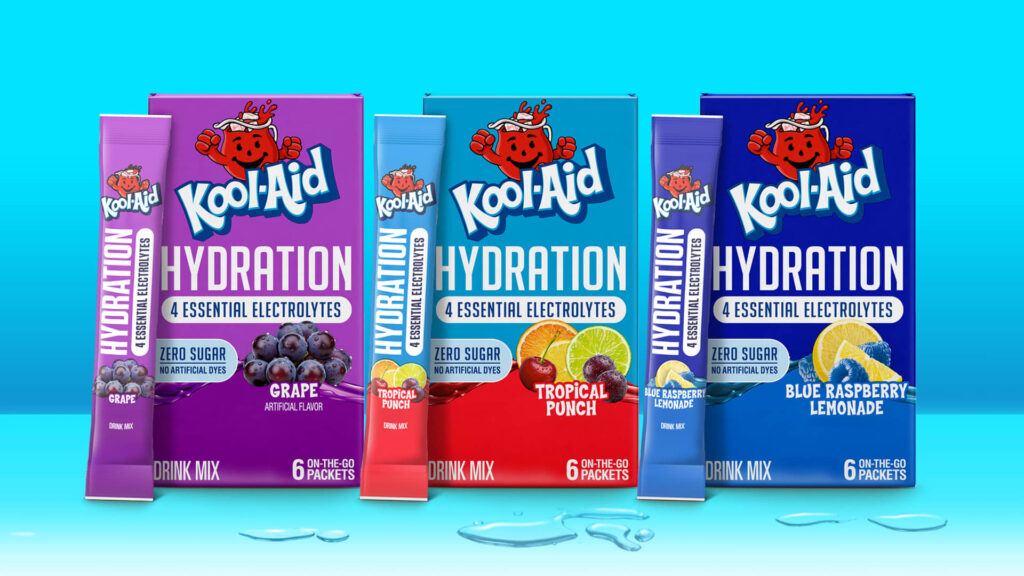
Kool-Aid Hydration is launching with three flavors: grape, tropical punch and blue raspberry lemonade.
Source: Kool-Aid
Kool-Aid is launching electrolyte packets made without artificial dyes, aimed at reaching consumers who want to hydrate, but not for Gatorade or Liquid I.V. prices.
The new product is part of parent company Kraft Heinz’s broader plan to modernize its portfolio and reverse a sales slump that has lasted nearly a decade. Its top brands, including Capri Sun, Oscar Mayer and Kraft Mac & Cheese, have struggled as consumers have sought fresher and more nutritious options to feed and hydrate their families.
One year shy of its 100th birthday, Kool-Aid is — somehow — on the younger end of Kraft Heinz’s portfolio. But its relative youth and iconic mascot have not shielded the brand from many of the same issues dogging the company’s older brands, such as Maxwell House and Philadelphia.
Earlier this year, Kraft Heinz said it was pausing its previously announced plans to split the company in two. CEO Steve Cahillane said that many of the company’s issues were “fixable” and committed to investing $600 million to fuel a turnaround of its U.S. business.
Kool-Aid is part of that plan. Investment in the brand is slated to increase 70% this year compared with 2025, according to Kraft Heinz.
Some of that money went into the development and launch of Kool-Aid Hydration. The line rolls out in retailers later in May with three flavors: fruit punch, grape and blue raspberry lemonade.
“We think it’s the right step to take to contemporize brand and make sure the product offerings remain as relevant as the brand equity and cultural currency,” said Caroline Boulos, president of hydration, desserts and meals at Kraft Heinz.
An electrolyte spark
The U.S. market for powder concentrates has exploded in recent years. The category, which spans all dissolvable powder mixes and tablets from Kool-Aid to Nestle’s Nuun, has more than tripled over the past five years to more than $4.6 billion in sales, according to Euromonitor International data.
Much of that growth comes from the rise of single-serve electrolyte sticks, which were popularized by Liquid I.V., now owned by Unilever. PepsiCo has also introduced single-serve packets and tablets under its Gatorade and Propel brands. And then there’s a number of smaller upstarts such as LMNT and Unwell Hydration from podcaster Alex Cooper.
But Kraft Heinz sees an opportunity for Kool-Aid to make its mark on the electrolyte powder category. Many of the current options available to consumers are “very performance driven” and “very intense,” according to Boulos.
“Consumers find a lot of those offerings to be too salty or bitter, and also, it’s a very premium subset of the category, so it’s not attainable to a larger swath of consumers,” she told CNBC.
Kool-Aid Hydration is launching at an average price point of $4.99 for a pack with six sticks. That price is several dollars below the typical cost of the same pack size of single-serve packets from Gatorade and Liquid I.V.
And in contrast to the electrolyte drinks created with athletes in mind, Kool-Aid Hydration is targeting young adults looking to meet their everyday hydration goals. As a result, the taste is more “approachable,” according to Boulos.
She described the flavor as “very recognizable” as Kool-Aid, although the sodium, potassium, calcium and magnesium are also noticeable.
“You do get a little of that salinity that you do from the presence of electrolytes, but it’s not overpowering or overwhelming,” Boulos said.
A Kool-Aid revamp
Kool-Aid isn’t selling the Hydration line on the electrolytes alone. The brand is also trying to win over shoppers by trumpeting what isn’t in the packets.
Kool-Aid Hydration does not use artificial dyes, as part of Kraft Heinz’s broader pledge to phase out synthetic colors by the end of 2027. Under the influence of Health and Human Services Secretary Robert F. Kennedy Jr. and his “Make America Healthy Again” platform, the Trump administration has put pressure on Big Food to cut out petroleum-based synthetic dyes, although the Food and Drug Administration has not yet revoked authorization for any of them.
In addition to lacking artificial colors, Kool-Aid Hydration also does not contain sugar.
“This is a brand that people love, but from a product side, we took a step back and talked to consumers about why they had stopped buying the brand, and what we heard is they were turning to other alternatives that are better suited to their needs,” Boulos said. “That could be they were seeking out specific benefits or maybe there were barriers over time of [consumers] trying to reduce sugar consumption or reduce certain ingredients.”
Kraft Heinz is taking that approach elsewhere in its portfolio.
In April, it unveiled Capri Sun Hydrate, with electrolytes and vitamin E. Its packaging also touts five grams of total sugar per pouch — less than half of the sugar found in a classic Capri Sun.
And in March, the company showed off Kraft PowerMac, with 17 grams of protein and six grams of fiber.
“All of our innovation really remains rooted in consumer-led insight, and consumers are telling us that they’re looking for their food and their drinks to do more for them,” Boulos said. “We really see an opportunity for legacy brands to play a role there, and the response has been overwhelmingly positive.