


Layoffs have headlined the global tech landscape for over a year now and the trend continues as the industry faces one its biggest disruptions in recent years. In India too the tech hiring and firing situation is evolving fast.Global tech giant Microsoft has put around 500 employees in India on performance improvement plans (PIPs), while Oracle is preparing to cut roughly 3,000 jobs in the country as technology companies reorganise their workforces and redirect spending towards newer areas. Experts however note that performance improvement plans need not translate into layoffs.Industry executives point out that putting employees on PIPs does not necessarily mean the company is pursuing layoffs, as such plans can also form part of normal performance management processes.
Oracle job cuts , Microsoft PIPs in focus
Pareekh Jain, chief executive of market research firm EIIRTrend told ET that about 2% of Microsoft India’s workforce, or approximately 400-500 employees, could be affected by the company’s global PIP exercise.Jain estimated that Oracle’s latest job cuts could affect between 2,000 and 3,000 employees, with the layoffs expected to take effect from September 1.Oracle employs around 30,000 people in India. The company had already eliminated about 12,000 jobs in the country during an earlier round of layoffs.In response to a query from the financial daily, a Microsoft spokesperson said the company follows a formal performance improvement plan and global voluntary separation agreement processes. Employees who fall short of the expectations associated with their roles may be offered coaching, placed on a PIP, given the option of voluntary separation, or terminated.
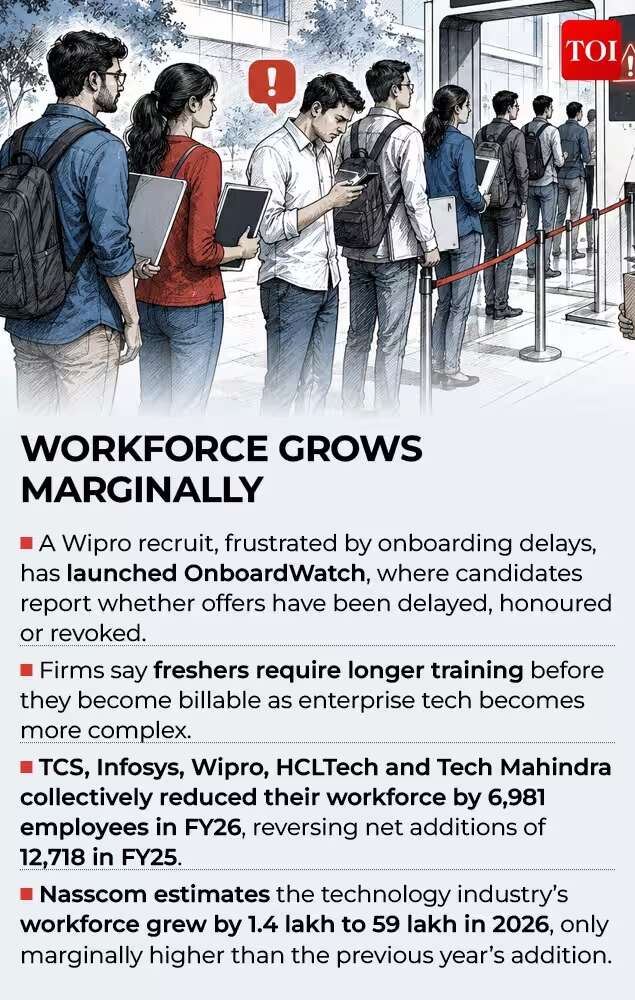
IT sector workforce trends
“The share of employees globally on PIPs is a very small percentage,” the spokesperson said, adding that Microsoft does not comment on individual personnel matters or provide regional breakouts.Gaurav Vasu, chief executive of market research firm UnearthInsight, said the reported 2% figure in India should not automatically be viewed as evidence that companies are replacing layoffs with performance-based exits. “Typically, 1% to 2% of the workforce is what can be considered involuntary attrition or PIP-related attrition,” he said. “This can be due to a skill mismatch or a performance issue. So the reported 2% figure is part of a regular process.”According to Vasu, Oracle’s restructuring is indicative of the changing skills and functions that technology companies are choosing to prioritise. “The restructuring is essentially about moving budgets from legacy sales skills to new-age skills,” he said.“In Oracle’s case, it is a combination of PIP and a shift towards new-age areas. It is an AI-led restructuring where budgets are being reallocated between legacy skills and new-age skills.”Kamal Karanth, co-founder of staffing firm Xpheno, said PIPs are “not necessarily an alternative to layoffs” and are instead intended to provide employees with an opportunity to improve their performance.He added that the effects of AI on engineering employment are expected to become increasingly apparent over the next two to three years. Junior and mid-level engineers working on lower-complexity tasks are likely to face greater exposure to this shift.
Indian IT sector churn
India’s IT hiring landscape is undergoing a significant change, particularly for freshers, as large technology companies become more cautious about campus recruitment. Alongside selective hiring, a growing number of companies are also delaying the onboarding of fresh graduates, leaving many candidates uncertain about when they will actually begin their jobs.
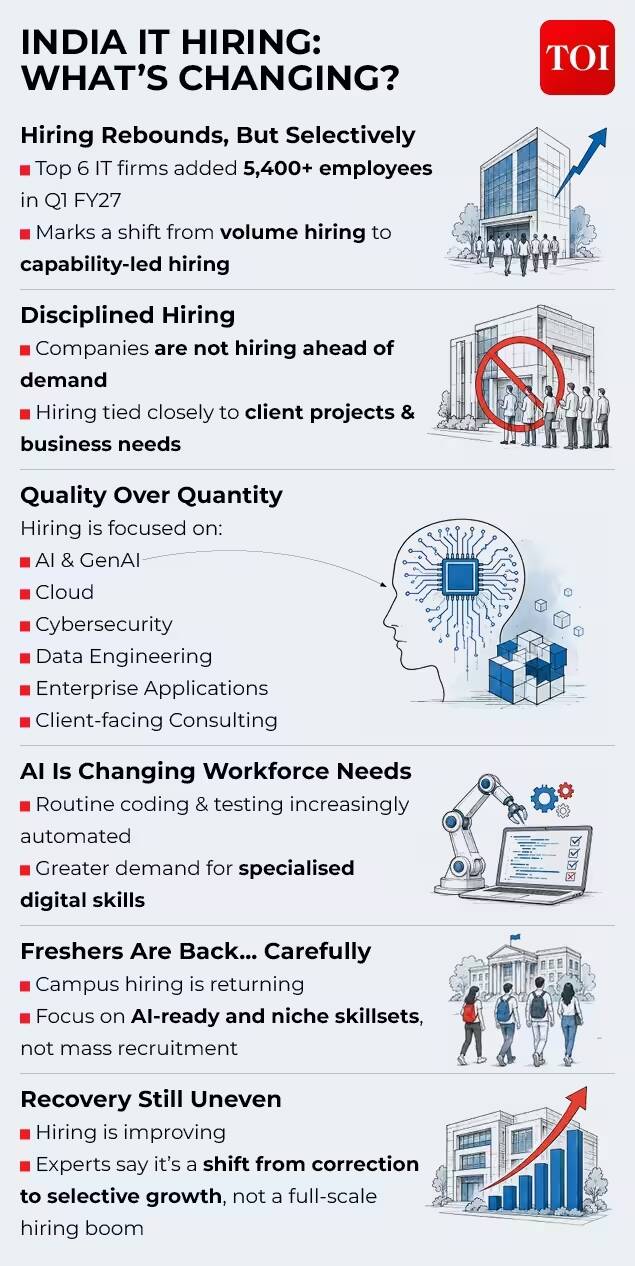
Indian IT hiring: What’s changing
Earlier this year it was reported that companies such as IBM, Accenture, Oracle Financial Services Software and Cognizant have told candidates that their joining dates will depend on factors including project availability, business needs and administrative processes. As a result, some engineering graduates were left waiting for months, and in certain cases more than a year, before they can start work.Experts say hiring is increasingly being determined by specific projects and actual demand, rather than companies recruiting large numbers of freshers simply to build bench strength.The shift is part of a wider reset across the IT industry. India’s five largest IT companies reduced their combined workforce by a net 6,981 employees in FY26, after adding 12,718 employees in FY25. Meanwhile, Nasscom estimates that the industry’s overall workforce increased by only 1.35 lakh to 5.9 million in 2026.There are, however, some signs of improvement. India’s six largest IT companies added a net 5,400 employees in the first quarter of FY27, reversing the net reduction of 7,100 jobs recorded in the preceding quarter. TCS accounted for much of the increase, adding 9,000 employees net, its largest quarterly workforce addition in three years.As the traditional IT hiring model changes, Global Capability Centres (GCCs) are becoming important employers for technology talent. These offshore units of multinational companies manage functions such as technology, engineering, finance, R&D, analytics and other business operations for their global organisations.However, HR professionals do not see GCCs as a direct, like-for-like replacement for conventional campus recruitment. Their hiring is increasingly centred on specialised capabilities, including AI, data analytics, product development, cybersecurity and digital engineering, rather than large-scale recruitment of fresh graduates.