
What are the common mistakes that can lead to tax department queries or notices? (AI image)
ITR filing FY 2025-26: Filing your income tax return (ITR) accurately is the first step to ensuring compliance. Any errors can invite questions from the Income tax Department, which may eventually lead to a tax notice as well. The error could be as simple as wrong ITR form selection, not reporting capital gains, or even forgetting to add interest income earned from all your banksOne important thing to understand is this: In the current compliance environment, tax notices are increasingly driven by data inconsistencies rather than intent. “With the Income Tax Department leveraging advanced analytics and third-party reporting, even minor gaps in reporting can trigger system-based queries,” says Amarpal Chadha, Tax Partner, EY India. A tax notice can not only mean a process of explaining discrepancies but can also put any refund claims on hold till the matter is resolved.So, what are the common mistakes that can lead to tax department queries or notices? What do the trends in the last few years suggest and what should taxpayers ensure when filing their income tax returns? We ask experts:
What are some of the common mistakes?
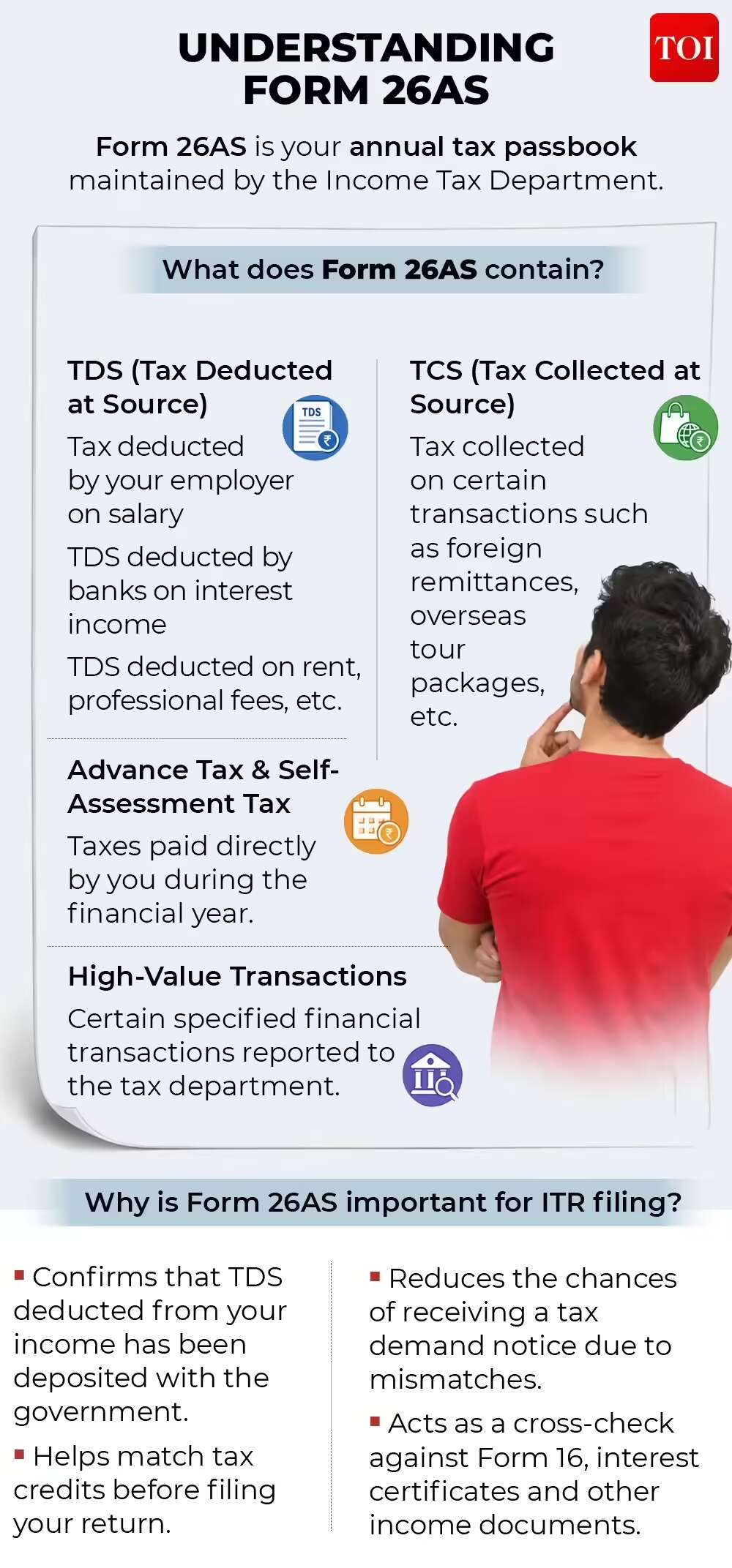
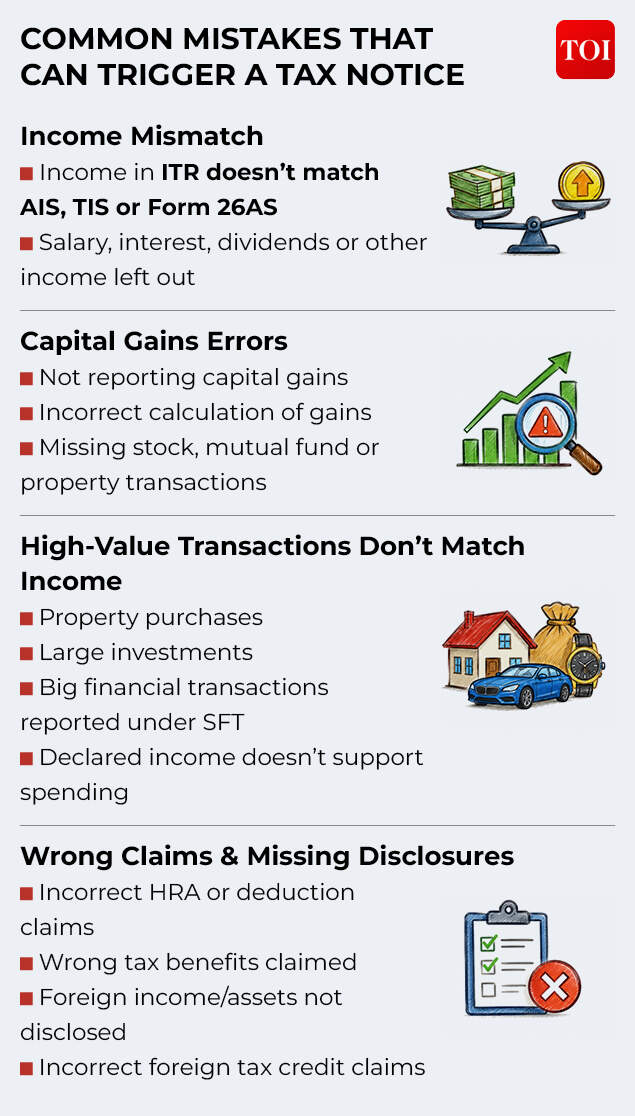
As Tanu Gupta, Partner at Mainstay Tax Advisors LLP points out: Today, the tax authorities receive data from multiple sources, including banks, financial institutions, brokers, employers, registrars of property transactions, and even foreign tax authorities under information-sharing arrangements.Tax experts list the most common mistakes that taxpayers can make when filing their income tax returns, that can trigger a tax notice:Mismatch between ITR and AIS/Form 26ASOne of the most common reasons for taxpayers getting a notice is the inconsistency between the income that has been reported in the return and the data that is available with the tax authorities through Annual Information Statement (AIS) and Form 26AS. What AIS essentially does is this: it consolidates financial information from multiple sources. Any deviation can hence lead to automated adjustments or notices.Capital gains reporting gapsThis is one area where taxpayers can make a mistake. With increasing transparency in capital market transactions, any discrepancies in reporting of capital gains – whether due to computational errors or omissions have emerged as a key point for scrutiny. Experts note that the tax administration now has visibility into most securities transactions through AIS feeds.
Understanding Form 26AS
Non-reporting of income streamsTaxpayers can often omit certain income components, particularly those that are not fully captured in Form 16. Some of the most common ones that can get missed are: interest income, dividends and small investment gains. Amarpal Chadha of EY India notes that there is a common misconception that tax deduction at source absolves reporting obligations; however, such income must still be disclosed in the return, failing which discrepancies may arise.Another reason for a tax notice could be incomplete disclosure of foreign income, foreign assets or foreign tax credit claims.Misalignment between high-value transactions and reported incomeAny high-value financial transactions that are reported under the Statement of Financial Transactions (SFT) framework such as property acquisitions, significant investments or large expenditures are closely monitored. Any misalignment between such transactions and declared income can result in queries from the tax authorities.
Common mistakes that can trigger a tax notice
Incorrect or Excessive Deduction ClaimsAmarpal Chadha says that the department has increased focus on overstated or incorrect deductions, including:
- Sections 80C, 80D and other Chapter VI-A deductions
- Claims of exemptions such as HRA, LTA without supporting evidence. For instance, HRA exemption claims may be examined where the corresponding rental income is not reported by the recipient.
- Artificial inflation of deductions to reduce taxable income
What trends from last few years show
Fundamentally, taxpayers need to understand that with data-driven technology use, inaccuracy in filing and unintentional errors can also lead to a tax notice. The tax department is stepping up scrutiny and the notices are not random. Instead, data is extensively made use of to catch any discrepancies. This explains why even salaried taxpayers are coming under scrutiny – the case could be as simple as forgetting to report a source of income.“Based on our experience, the tax department has paid significant attention to areas involving information mismatches and higher tax risk. Today, scrutiny selection is largely driven by data analytics and risk assessment systems that compare information reported by taxpayers with data received from third parties,” says Tanu Gupta of Mainstay Tax Advisors.“Tax scrutiny in recent years has broadly evolved into a risk-based, data-driven framework, supported by advanced analytics and third-party reporting,” says EY’s tax expert.“Separately, certain returns are also subject to compulsory selection for complete scrutiny, based on predefined triggers prescribed by the tax authorities – such as search, survey, or specific information indicating tax evasion,” he adds.
Tax notices: Trends in last few years
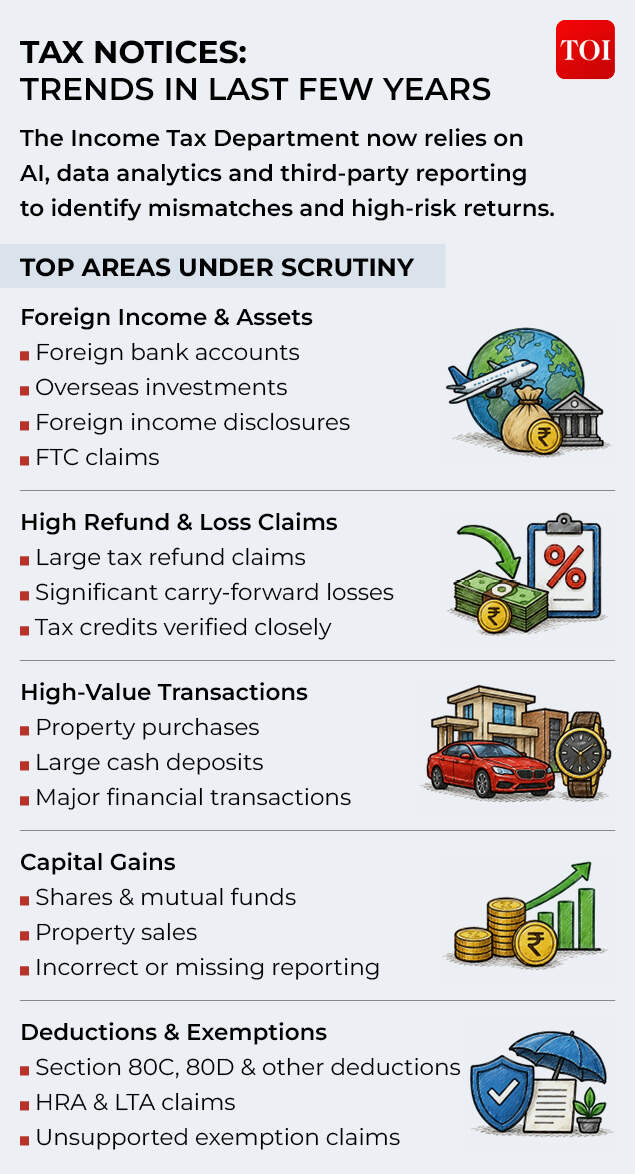
A significant portion of scrutiny continues to arise from data inconsistencies, incomplete reporting and misalignment between financial information available with the authorities and disclosures made in the return. In addition to these, Amarpal lists the following areas that have emerged as key focus points for scrutiny by the tax department:High Refund And Loss ClaimsReturns that reflect unusually high refund claims or significant carry-forward of losses are subject to heightened scrutiny by the Income Tax Department. In such cases, the authorities undertake a detailed examination to verify the correctness of tax credits and exemptions claimed to assess the legitimacy and accuracy of such claims, including the adequacy of supporting documentation.Foreign Assets and Cross-Border TransactionsUnder the global information-sharing frameworks, the CBDT receives details of overseas financial assets held by Indian tax residents from partner jurisdictions under the Common Reporting Standard (CRS) and from the United States under the Foreign Account Tax Compliance Act (FATCA). This enhanced exchange of information enables the Income Tax Department to maintain close scrutiny of taxpayers’ foreign financial interests and disclosures.This includes the monitoring of foreign bank accounts, overseas investments, and income earned outside India, with a focus on ensuring complete and accurate disclosure in tax returns. Non-disclosure or incorrect reporting may lead to scrutiny proceedings.
What taxpayers should do to avoid inaccuracies
Tax experts suggest double checking all sources of income and ensuring that all major documents like Form 16, Form 26AS, and AIS don’t have any mismatches or discrepancies.
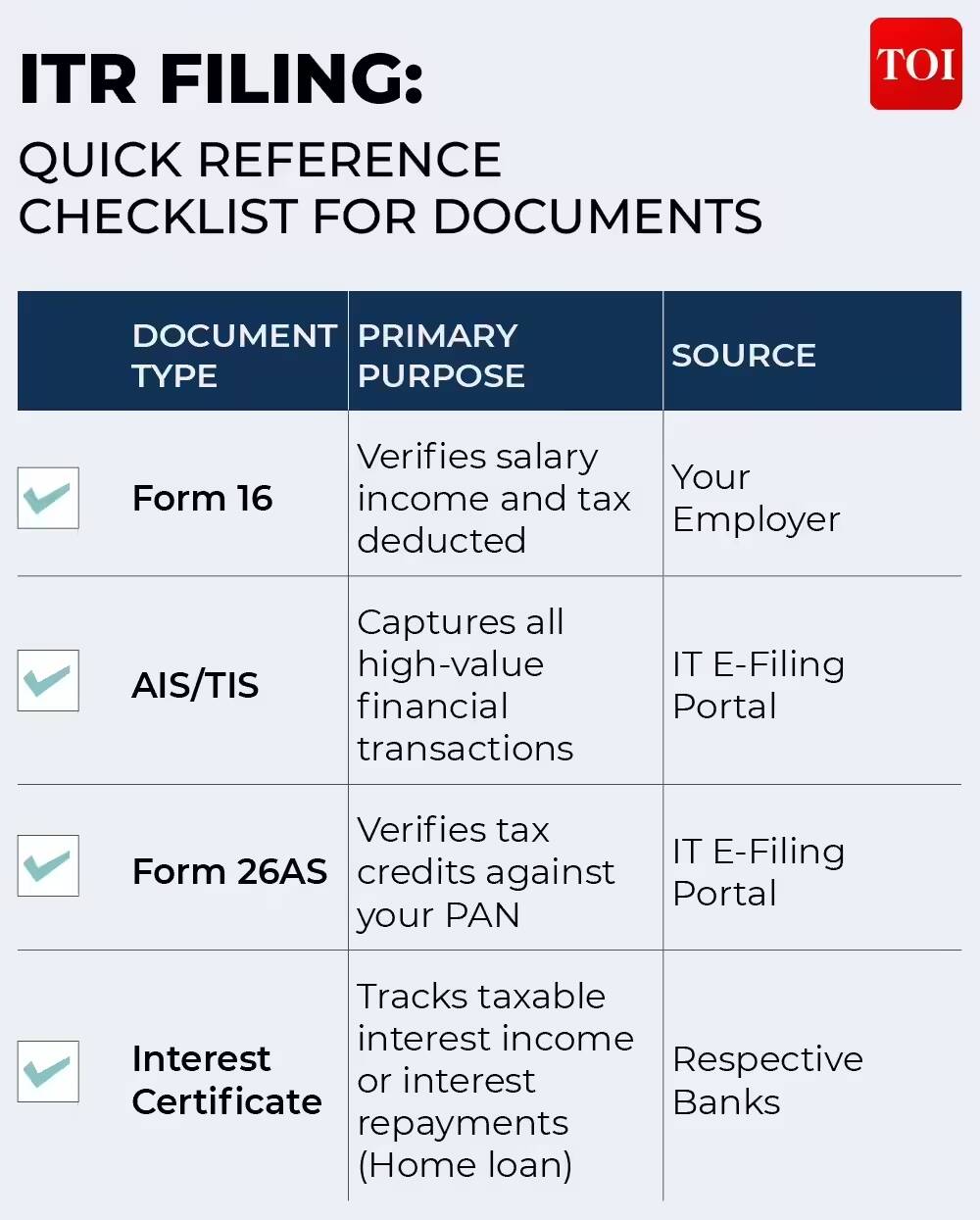
ITR filing documents checklist
Parizad Sirwalla, Partner and Head – Global Mobility Services, Tax, KPMG in India lists reconciling your tax return with Form 26AS, the AIS, and the Taxpayer Information Summary (TIS) before filing as the topmost thing to keep in mind. Any discrepancy should be understood and appropriately addressed before filing the return, she tells TOI.“Taxpayers should ensure that all sources of income, including interest, dividends, capital gains and salary income from previous or multiple employers, where applicable, are accurately reported. They should also retain supporting documents for deductions, exemptions and tax credits claimed. And a complete reconciliation of the documents (e.g. overseas bank statements, passport etc.) and income/ assets declared in the tax return should be undertaken,” she says.Not just that, careful selection of the correct ITR form, accurate disclosure of bank accounts, foreign assets and other reportable information, and timely filing of the return can significantly reduce the likelihood of receiving an enquiry or notice from the tax department.“It is also relevant to compare the return with the past year’s tax return filed to ensure consistency of positions taken and facts disclosed. Most importantly, taxpayers should view the tax return as a comprehensive disclosure document rather than merely a tax payment exercise. Ensuring completeness, accuracy and transparency at the time of filing remains the best safeguards against future notices,” she adds.
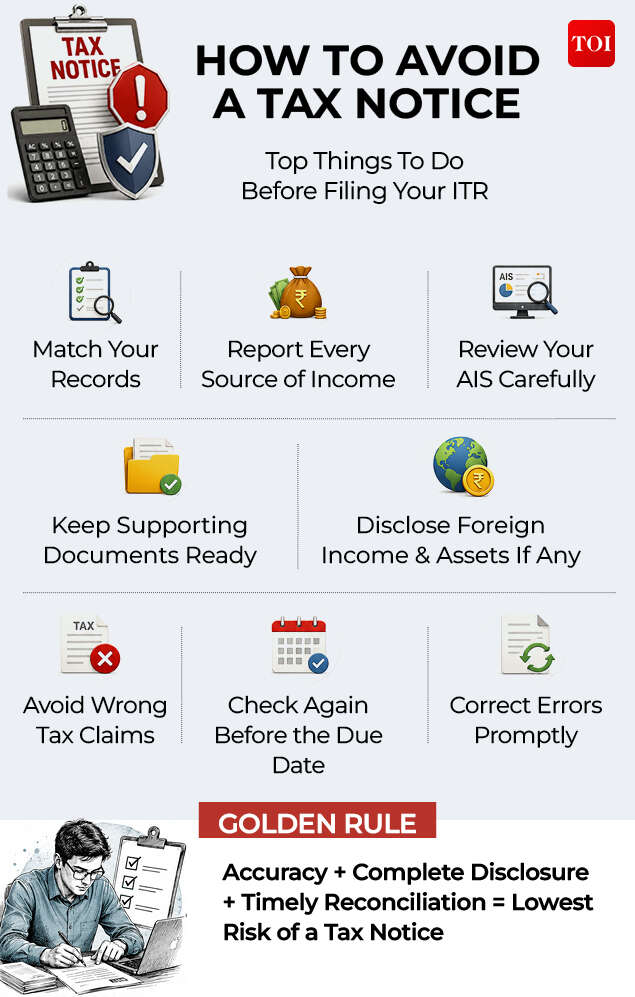
How to avoid a tax notice
Ensure complete reporting of incomeAll income streams, irrespective of tax deduction at source, should be duly disclosed in the return. This is particularly relevant for interest income, dividends and investment-related gains.Review and validate AIS dataAIS should be carefully reviewed for any inaccuracies, including duplicate or incorrectly reported entries. The portal-enabled feedback mechanism should be used to address such discrepancies prior to filing. Align financial transactions with reported incomeTaxpayers should ensure that high-value transactions and financial outflows are adequately explained and supported by documentation. Any inconsistency between reported income and financial activity may be flagged by the system.Avoid Deductions Without ProofTanu Gupta says that taxpayers should avoid making unsupported claims for exemptions or deductions. It is equally important to maintain proper supporting documentation, such as bank statements, investment records and documents supporting deductions and exemptions. Taxpayers should also verify whether any income is required to be clubbed in their hands under the tax law.Check after filingImportantly, what should one do if there are mismatches? “Even if the return is filed early, it is advisable to revisit AIS and Form 26AS before the due date to ensure that no subsequent updates by banks, employers or other reporting entities have created a mismatch. A little extra diligence at the time of filing can significantly reduce the chances of receiving a tax notice later,” she tells TOI.Amarpal Chadha suggests that in case any inaccuracies are identified post-filing, taxpayers should consider filing a revised return within the prescribed timelines to regularize the position and reduce the likelihood of further escalation.”“With the Income Tax Department increasingly adopting a proactive compliance approach, taxpayers should also pay close attention to ‘nudge’ communications issued by the authorities. These communications typically highlight potential discrepancies such as incomplete foreign asset disclosures, mismatch of deductions/exemptions between Form 16 and the return, or cases requiring refund revalidation. Reviewing such nudges carefully and taking corrective action, including revising the return where necessary, can help mitigate the risk of formal notice proceedings,” he concludes.