
Representational image
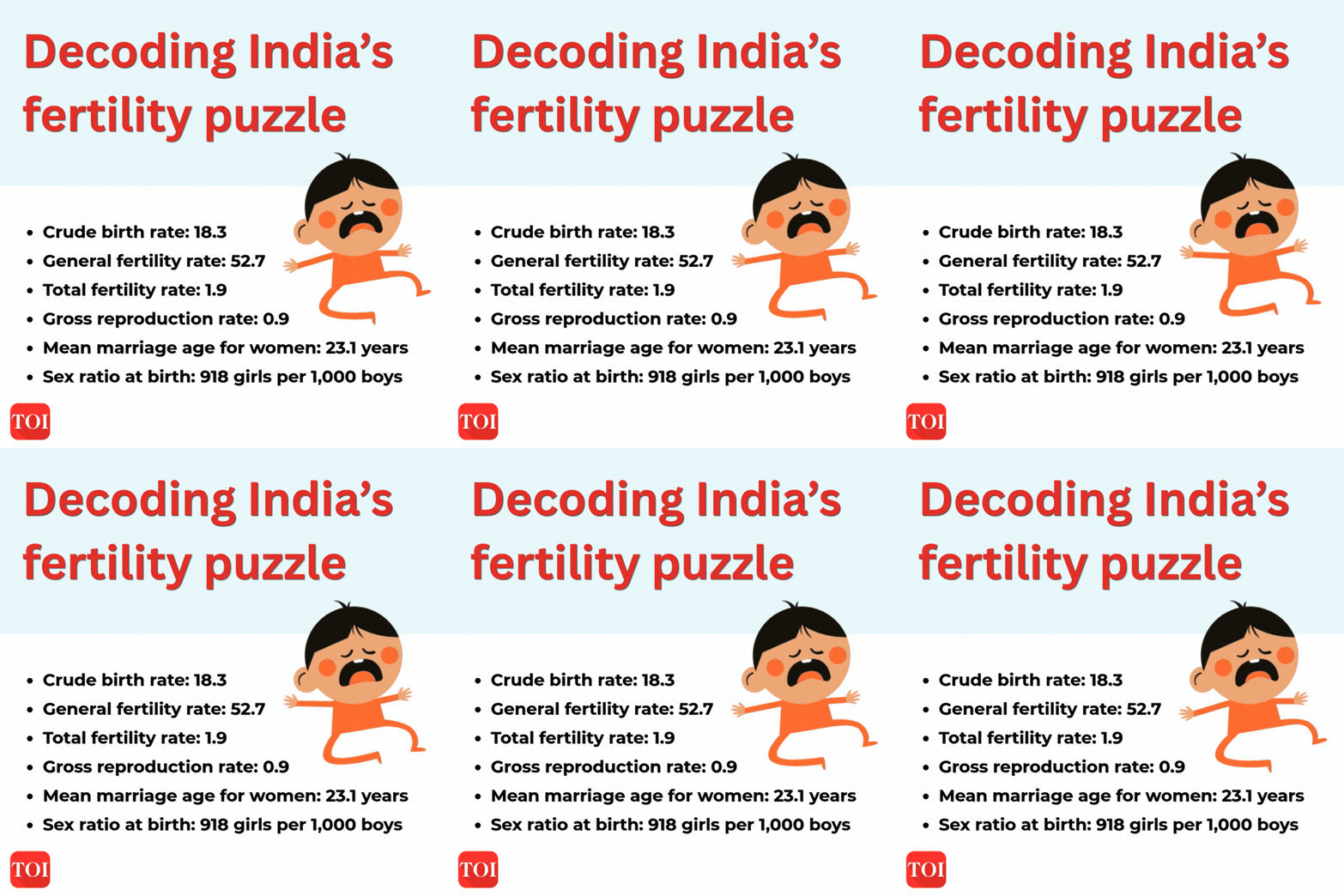
Back in 2023, India made headlines for becoming the world’s most populous country. For decades, the challenge was a booming population, prompting family-planning campaigns, the slogan “Hum Do, Hamare Do”, and concerns over feeding, educating and employing millions more people.Today, however, the conversation is changing, quite dramatically.For decades, the country was worried about having too many people. Now, it is facing a very different demographic reality: having fewer children than needed to replace the previous generation.According to the latest Sample Registration System (SRS) Statistical Report 2024, India’s Total Fertility Rate (TFR) has fallen to 1.9 children per woman, slipping below the replacement level of 2.1. In simple terms, Indian women are now having fewer children than are needed to maintain the population size over the long run, assuming migration remains unchanged.The decline has been swift. India’s fertility rate stood at 5.2 children per woman in 1971. It fell to 4.3 in 1985, dropped further to 2.9 in 2005, touched 2.0 in 2020 and has now reached 1.9 in 2024. Projections suggest the number could slide even further, to around 1.6 by 2031.On paper, these may seem like dry demographic statistics. In reality, they tell the story of a society in transition.Behind every decimal point are millions of women staying in school longer, enrolling in colleges, building careers, opening bank accounts, marrying later and taking greater control of decisions that were once largely dictated by tradition. The familiar script of “marriage first, baby next” is being rewritten.The fertility saga is no longer just about population but becoming a story about choice.Sejal Chaturvedi, a 34-year-old banking professional married for two years, said she and her husband are fond of children but are not ready for parenthood right now. “We like kids, but having our own is a big responsibility, it’s a lot of work, time and emotional investment, and we don’t feel we can give that right now,” she said. “It’s not about judging anyone who has children, it’s just a choice we’re making for this phase of our lives.”
The great demographic U-turn
India is home to more than 1.46 billion people and continues to be the world’s most populous country. Yet beneath that headline lies a very different reality.Unlike countries such as China, where fertility decline was accelerated through the controversial One-Child Policy, India’s fertility transition has largely occurred through voluntary choices made by families.
Having children is a deeply personal choice, and I’m not here to judge anyone who chooses differently. I’ve never been happier, but I only became a mother when I was truly ready—emotionally, personally, and professionally. Now, I understand the weight and meaning of raising another human being. And I genuinely believe there should be no pressure on anyone to have children. People should only become parents if and when they truly want to.
Shaili Kaushik, a 37 year old mother and accountant
The decline is being driven by a combination of urbanisation, rising aspirations, better healthcare, access to contraception, improved education and changing social norms.For generations, children were often a “necessity”. They were seen as contributors to household income, support systems for ageing parents and an extension of family lineage. In many parts of the country, parenthood was considered the natural and inevitable next step after marriage.That mindset is evolving.Today, a growing number of young Indians are asking questions that would have seemed unusual only a few decades ago. How many children can we afford? Should we prioritise careers first? Is parenthood necessary at all? What kind of lifestyle do we want?Children are increasingly becoming a choice rather than an expectation. This shift is visible across urban India and is gradually spreading into smaller towns and rural areas as well.Reema Dahiya, a 50-year-old mother, highlighted this contrast between generations.“The younger generation has far more awareness and freedom than we did in our time. Back then, having children was simply the next step after marriage. Today, couples have more choices when it comes to education, careers and the kind of life they want to build, and that is obviously changing how they think about having children,” she told TOI.
Women at the centre of India’s fertility transition
At the heart of India’s demographic story is one obvious but major factor: women.Women’s lives are changing faster than ever before. For decades, discussions about population focused on how many children women were having. Today, it is more about the choices they make.The traditional life path followed by many Indian women often looked like this:School → Marriage → ChildbirthToday, the sequence is more like:Education → Career → Financial independence → Marriage → Maybe parenthoodThis change may appear subtle, but its impact on fertility is enormous.
Degrees before babies
A 27 year old MBA student, told TOI, “My parents always prioritised my education first, and that changed everything for me,” she said. “I don’t feel any pressure to rush into motherhood — I want to have children at my own pace, when I’m truly ready.” “I can only give them a better life if I have one of my own first.”According to the latest available data, nearly 46.4% of Indian women have completed at least 10 years of schooling, up from 41% in the previous survey. Meanwhile, 89% of women now operate their own bank or savings accounts, compared to 78.6% earlier. The data shows a pretty clear pattern: the more educated women are, the fewer children they tend to have.These numbers indicate much more than educational achievement. They represent millions of women spending longer periods in classrooms, enrolling in colleges and universities, entering professional careers, earning their own incomes and participating in financial decision-making.
How education affects fertility rates
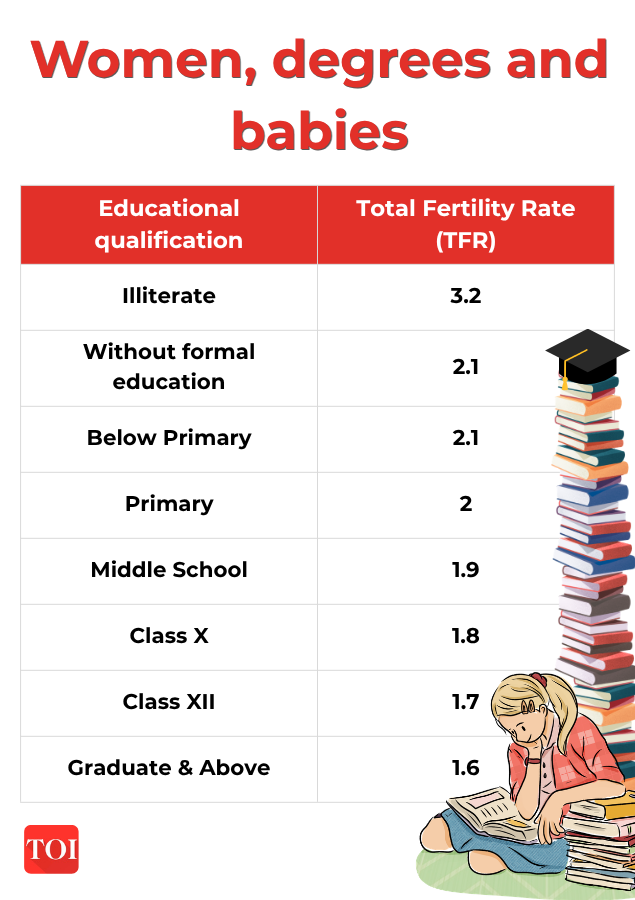
The total fertility rate is 3.2 for illiterate women, but drops to 1.8 for literate women. And within that, it keeps sliding step by step: 2.1 for those with no formal schooling or below primary, 2.0 at primary level, 1.9 at middle school, 1.8 at Class X, 1.7 at Class XII, and just 1.6 for graduates and above.Across states, the story changes in numbers but not in direction.While Bihar has one of the worst female literacy rates of a little over 50%, their fertility rate stands at 4.2 for illiterate and 2.8 for literate women.At the other end of the spectrum, Kerala with the best female literacy rate of over 90%, holds fertility rate at 0.8.Put simply: the more years in school, the fewer “how many kids?” conversations at home.As women gain access to more opportunities, they are also gaining greater control over reproductive decisions. Parenthood is increasingly becoming something that women actively choose rather than something they automatically enter into.The latest fertility trends suggest that women’s expanding opportunities are fundamentally reshaping India’s demographic future.
Smaller families: New normal
The fertility decline is accompanied by a significant reduction in birth rates across the country. India’s Crude Birth Rate has fallen dramatically from 36.9 births per 1,000 population in 1971 to 18.3 births per 1,000 population in 2024. The Crude Birth Rate (CBR) is a key demographic metric defined as the total number of live births per 1,000 population in a given geographical region during a specified year.In just over five decades, the country’s birth rate has effectively been cut in half.
How Indian demographics look
The data indicate that India is no longer a high-fertility society.One of the clearest signs of this shift is birth order.Nearly 66.4% of all births recorded in 2024 were first births. Meanwhile, only 3.5% were fourth-order births or higher. This implies that India is increasingly becoming a 1-child or 2-child country, and large families with over 3 children are now rare exceptions.Large families that were once common are becoming increasingly rare.
‘Not thinking about marriage now’
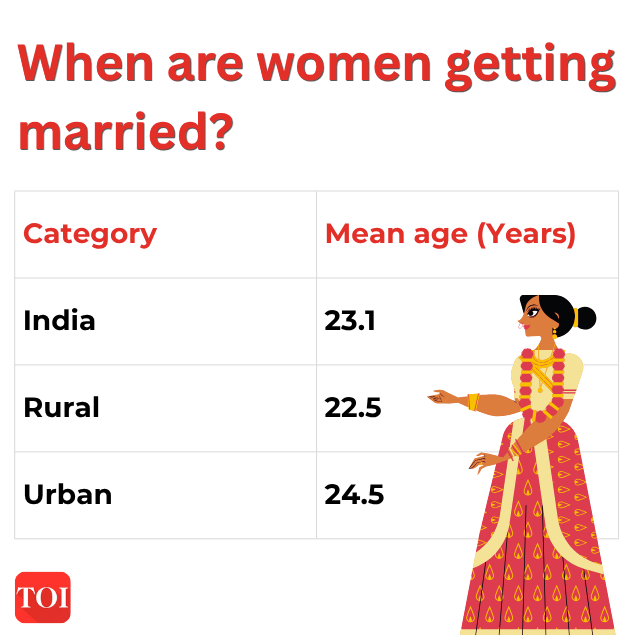
Another big reason behind India’s falling fertility is simple: marriage is happening later than before.The latest SRS 2024 report shows that the mean age at effective marriage for women has now risen to 23.1 years. But that number hides a clear split. Urban women are marrying at 24.5 years on average, two years later than rural women (22.5 years). As a result, childbirth is no longer concentrated in the early twenties. Instead, the action has shifted to the late twenties. The highest fertility is now in the 25–29 age group, with an age-specific fertility rate of 134.7 births per 1,000 women, compared to 105.5 in the 20–24 group. Put together, the pattern is pretty clear: Indians are not just having fewer children — they’re having them later. Marriage is getting pushed back, motherhood is getting rescheduled, and the whole timeline of family life is quietly shifting forward.
And when the clock starts later, it naturally stops earlier too. A shorter reproductive window usually means fewer children overall.Behind all of this are bigger social shifts, more years in education, better job opportunities for women, and growing confidence in deciding when (and whether) to start a family. It marks a clear break from the older rhythm of early marriage and early motherhood that once defined much of India’s demographic story.Now, that timeline is being rewritten, one late twenties milestone at a time.
The urban-rural divide
Fertility is falling everywhere, but the pace differs significantly between urban and rural India.According to the latest data:
- Rural India TFR: 2.1
- Urban India TFR: 1.5
- National TFR: 1.9
Urban India has moved well below replacement fertility.Several factors contribute to this trend.City life is more expensive. Housing costs are higher. Education expenses continue to rise. Women have greater access to employment opportunities. Dual-income households are becoming common. Space constraints and lifestyle preferences often encourage smaller families.As Tamanna, a PR professional puts it, “Everything is getting costlier, so it’s not that people don’t want kids, it’s just that in cities, every expense feels multiplied. Even basic living takes careful budgeting. So it ultimately requires a lot of planning.”
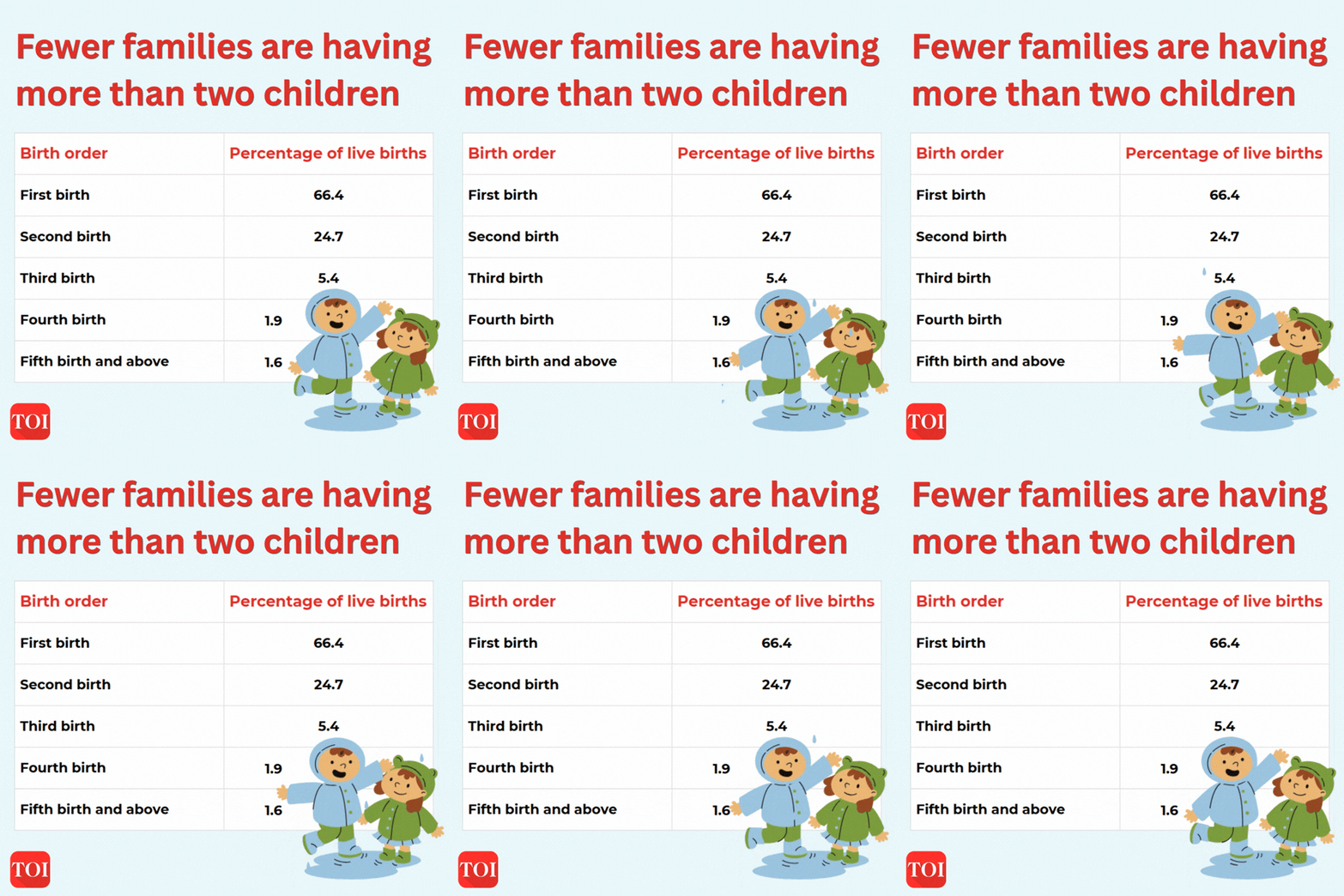
Family sizes are becoming smaller
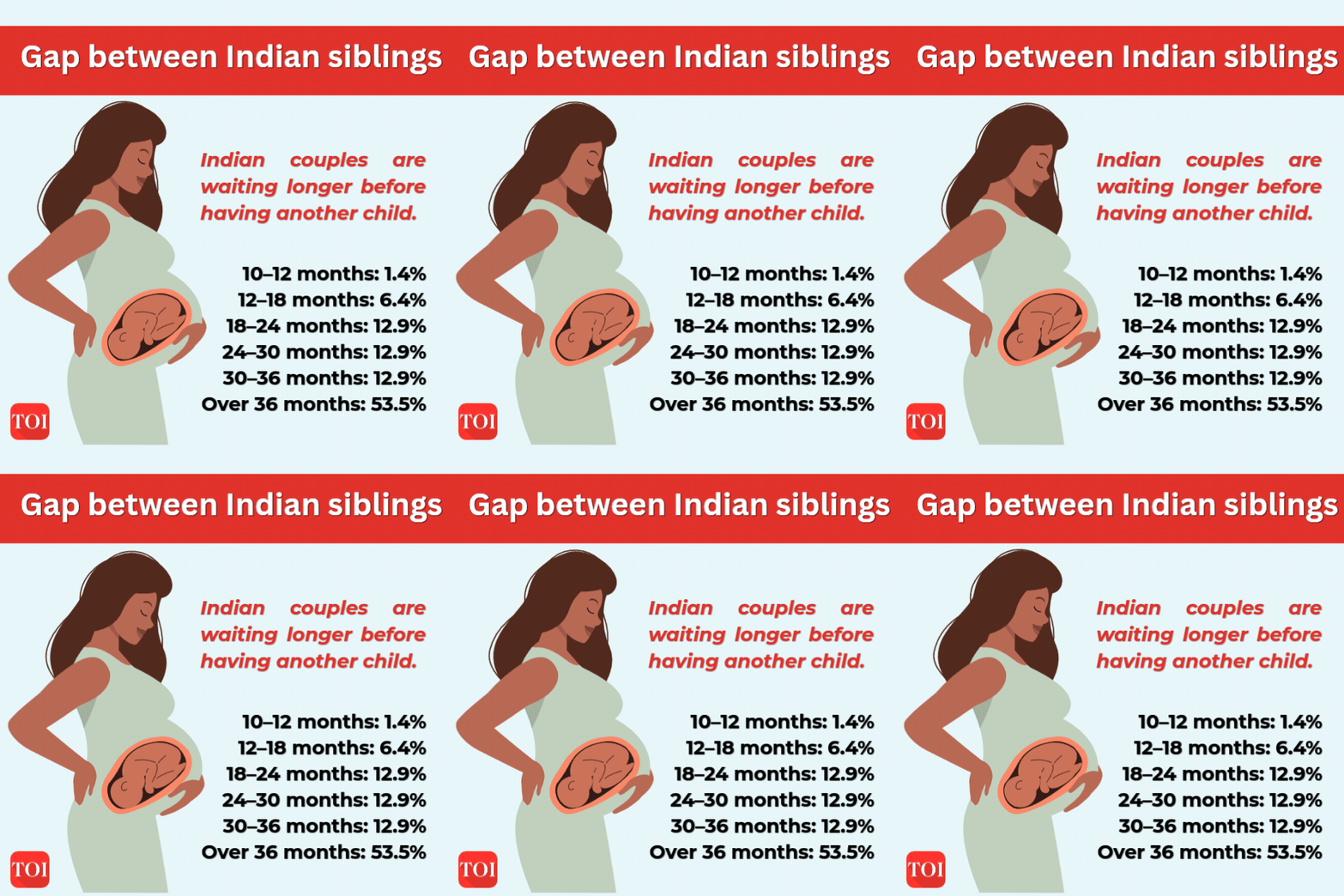
For many urban couples, raising multiple children can appear financially overwhelming.In rural areas, fertility remains somewhat higher, but the decline is still evident. The gap between rural and urban fertility continues to narrow as education, healthcare and media access spread deeper into rural communities.Families are waiting longer between childrenThe data also reveal another important behavioural change.Indian families are spacing births farther apart than before.More than half of all births occur after a gap of at least three years from the previous birth.This trend is significant because longer birth intervals are associated with improved maternal and child health outcomes.It also reflects better access to contraception and family planning services.Parents are increasingly choosing not only to have fewer children but also to invest more time and resources in each child.
Good news or bad news?
Despite falling fertility, India’s population is unlikely to shrink anytime soon.The reason is population momentum. India still has a large young population entering reproductive age. Even if each woman has fewer children, the sheer number of people in childbearing years will continue generating population growth for some time.However, the country’s age structure is gradually changing.Children aged 0 to 14 years currently account for 24% of the population.Meanwhile, people aged 60 years and above account for 9.7%.As fertility remains low, the share of elderly citizens is expected to rise steadily.This will create new challenges.India will need stronger healthcare systems, pension frameworks, elder-care infrastructure and social security mechanisms to support an ageing population.The country’s policy priorities may gradually shift from managing population growth to managing population ageing.
The bottom line
The country is steadily moving into an era where smaller families are becoming the norm rather than the exception. But this is not a simple story of decline or alarm. It is a story of choices, later marriages, longer education journeys, rising aspirations, better healthcare and, above all, women increasingly deciding when and how they want to build a family. The old rhythm of early marriage and early motherhood is giving way to a more flexible life course, where parenthood is planned, postponed, and sometimes even reconsidered altogether.So, is this good or bad? The honest answer is: both, depending on the lens. In the short to medium term, this shift is largely positive, it reflects better education, improved women’s empowerment, lower child mortality, and more financial stability within households. Smaller families often mean better investment in each child’s health, education and opportunities. But over the long term, sustained low fertility can also bring challenges, including an ageing population, pressure on the working-age workforce, and rising demand for healthcare, pensions and elder care systems. India is not facing these pressures immediately, but the direction is already visible. In the end, this is less about a “population crisis” and more about a societal balancing act, between progress and ageing, freedom and responsibility, and how India chooses to adapt to a future where families are smaller, but expectations from them are bigger.