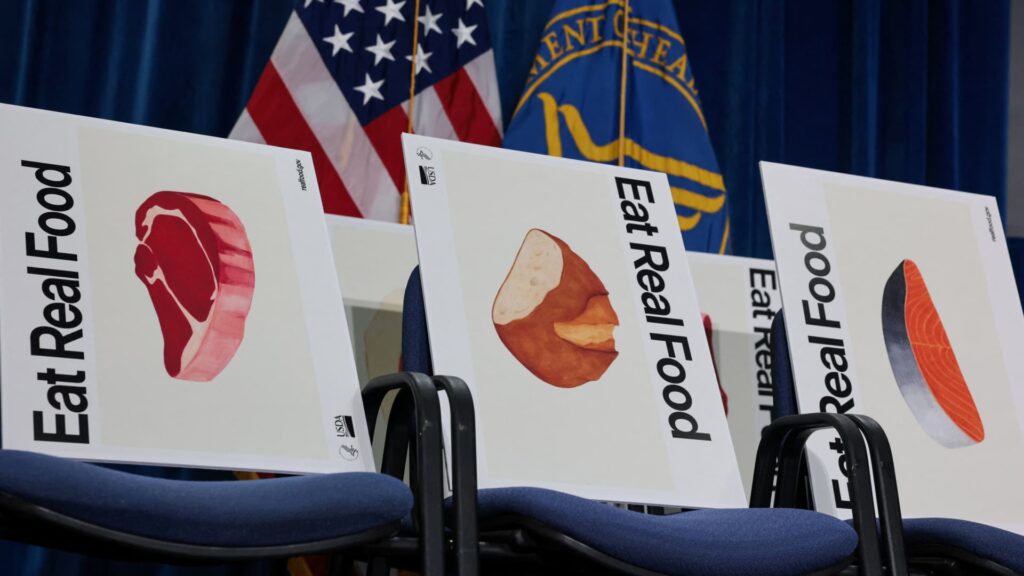
Attendees are greeted with”Eat Real Food” placards as they gather for U.S. Health and Human Services (HHS) Secretary Robert F. Kennedy, Jr. and Agriculture Secretary Brooke Rollins to announce new nutrition policies at the Department of Health and Human Services in Washington, D.C., U.S., January 8, 2026.
Jonathan Ernst | Reuters
The U.S. Department of Health and Human Services on Monday announced a policy proposal aimed at giving the federal government greater visibility into the nation’s food supply.
HHS proposed a requirement for manufacturers, like Pepsi or Nestle, to notify the Food and Drug Administration when they determine that an ingredient is “Generally Recognized as Safe,” or GRAS.
The department also said it and the U.S. Department of Agriculture submitted for final review the federal government’s first proposed definition of ultra-processed foods. Concerns have grown for years about the long-term safety of eating heavily processed foods, and the products have been a target of HHS Secretary Robert F. Kennedy Jr.’s “Make America Healthy Again” movement.
The proposals come as federal and state health officials grapple with a series of foodborne illness outbreaks this summer, including a multistate cyclospora outbreak linked to shredded iceberg lettuce and several other ongoing investigations. The FDA currently lists multiple active foodborne illness probes, including outbreaks involving salmonella and listeria.
U.S. Secretary of Health and Human Services Robert F. Kennedy Jr. speaks during a press conference discussing administration plans to lower drug costs, at the Department of Health and Human Services in Washington, D.C., U.S., Oct. 29, 2025.
Annabelle Gordon | Reuters
The announcements do not appear to address the key issues that experts said contributed to the food safety issues, but target broader criticisms of ingredient safety in the U.S.
“We believe that these initiatives will actually improve the FDA’s ability to effectively execute on its mission by having greater transparency into the number of ingredients in the food supply,” said acting FDA commissioner Kyle Diamantas on a call with reporters.
Under current law, substances intentionally added to food generally require FDA premarket approval unless they qualify for an exemption, including GRAS. An ingredient can qualify for GRAS status when qualified experts recognize it as safe in the context of its intended use.
The FDA has operated a voluntary GRAS notification program for years, but manufacturers have not been required to tell the agency when they determine themselves that an ingredient qualifies for the exemption. Under the proposed rule, manufacturers would have to notify the FDA when they reach that conclusion.
“GRAS reform is the preeminent regulatory reform that food advocates on both sides of the aisle have been saying is the most important food reform that the United States needs to do for the past 20 years,” a senior HHS spokesperson said.
The proposal would not create a premarket approval system for GRAS substances, meaning this process would not prohibit companies from entering the market. Instead, it would give the FDA greater visibility into ingredients entering the food supply.
That could become particularly significant as the administration develops its policy around ultra-processed foods.
HHS and the USDA filed a joint request for information in July 2025 seeking input from researchers, the industry and other stakeholders to define ultra-processed foods. Though the administration has submitted a definition for review, it did not say what that definition would be.
Ultra-processed foods can contain numerous ingredients, including additives and flavorings allowed to be included under GRAS rules.
“Nearly 60% of the American diet is made up of ultra-processed foods, and childhood obesity now affects more than one in five American children,” said HHS Secretary Robert F. Kennedy, Jr. in a press release. “We cannot reverse America’s chronic disease epidemic without transforming our food system.”
The GRAS proposal is subject to public comment and the federal rulemaking process before any requirements take effect.