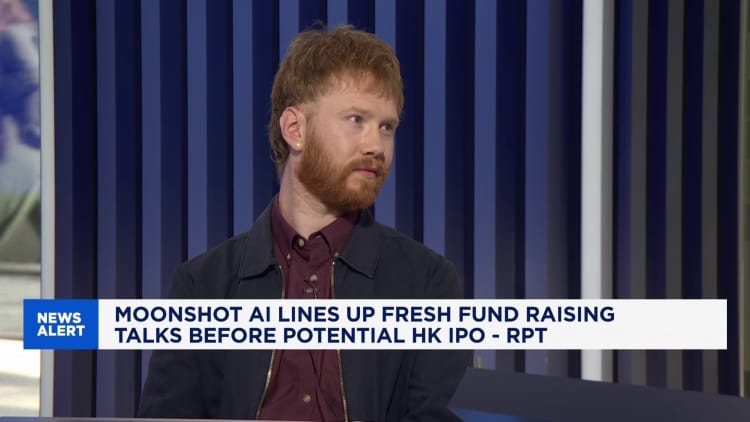
A White House official has accused Chinese AI company Moonshot of accessing Nvidia‘s advanced chips, despite export controls banning them from doing so.
Moonshot unveiled Kimi K3 on Friday. It closes the performance gap with frontier models including Anthropic’s Fable 5 and OpenAI’s GPT 5.6 Sol, even surpassing them on some benchmarks. It’s the largest open source model so far, with 2.8 trillion parameters, referring to the size of its neural network.
The Chinese company “acquired GB300-equipped servers and has accessed GB300s in Thailand, likely to train its AI models,” Michael Kratsios, director of the White House Office of Science and Technology Policy, said in a post on X on Wednesday.
Nvidia, Moonshot AI, the White House and the U.K. embassy of the People’s Republic of China have been approached for comment.
Nvidia’s most advanced AI chips are under export restrictions to China, though some less capable semiconductors are allowed to be shipped to the country. Nvidia’s GB300 chips are one generation behind its frontier Vera Rubin systems and are still considered cutting edge.
The U.S.-China AI arms race
The release came as the race for AI supremacy between the U.S. and China intensifies. Alongside limiting access to crucial AI hardware, lawmakers in America are also considering how to curb the growing adoption of Chinese AI models by Western companies.
ByteDance was reportedly assembling computing power outside of China as it looked to boost AI efforts, according to a Wall Street Journal report in March. ByteDance has been approached for comment.
The U.S. is looking to close export control loopholes that allow advanced AI chips to be accessed by Chinese companies.
The Remote Access Security Act (RASA), a proposed bipartisan legislation, seeks to expand U.S. export controls to include the remote cloud-based access of critical hardware and software. It passed the House of Representatives in January and is awaiting action in the Senate.

“It is well known that China is using American compute both within the country and abroad,” said Keegan McBride, director of science and technology at think tank the Tony Blair Institute for Global Change.
“It demonstrates just how far ahead the US is on compute,” he added. “American compute is the foundation for the AI race today.”
While the U.S. reportedly cleared 10 Chinese firms to buy Nvidia’s H200 chips in May, earlier this month a top U.S. trade official said “very few” had been shipped to China and Hong Kong. With access to the leading AI chips severely limited, Chinese tech companies have increasingly sought homegrown alternatives.
White House official Kratsios also said “we have information that Moonshot AI distilled Anthropic’s Fable for the development of its K3 model,” echoing Anthropic’s claims earlier this year of “industrial-scale” campaigns to extract information from its model.
Through distillation, smaller AI models can mimic the performance of larger, pre-trained models by extracting knowledge from the better-trained model.
A spokesperson for the U.K. embassy of the People’s Republic of China previously told CNBC that the country “opposes baseless allegations and malicious smears against its AI development.”
Treasury Secretary Scott Bessent threatened sanctions on Chinese companies that commit distillation attacks on Wednesday.
“When PRC firms conduct covert, industrial-scale distillation attacks that cross the line into IP theft, sanctions and Entity List designations will be on the table,” he said in a post on X.