China is focusing on large language models in the artificial intelligence space.
Blackdovfx | Istock | Getty Images
Production of Chinese chips could ramp up this year, as executives at the country’s biggest tech companies look to deploy more homegrown technology — as it’s reported U.S. chip giant Nvidia could return.
On Wednesday, internet titan Tencent suggested that production of Chinese homegrown chips could ramp up this year, while e-commerce giant Alibaba discussed how it is expanding its self-developed semiconductor usage.
The comments underscore how, in the absence of Nvidia’s technology due to export restrictions, China has pushed its domestically developed chips in the search for self-sufficiency to power its AI ambitions.
China chip ramp
Tencent Chief Strategy Officer James Mitchell said the company will have a “substantial increase” in capital expenditure, especially in the second half of the year, as more China-designed chips become “available to us month by month.”
Mitchell also said that the supply of China-designed graphics processing units (GPUs) would “progressively” ramp up through the year.
He also said that China-designed chips were seeing more supply from manufacturing facilities within China as well as “neighbouring countries.”
China has a swathe of local chip players that have ramped up activity by going public and launching products. Moore Threads, MetaX and Huawei are among the players trying to fill the void left by Nvidia since it was blocked from selling its chips to China more than a year ago.
This has underpinned record revenue at Chinese chip companies.

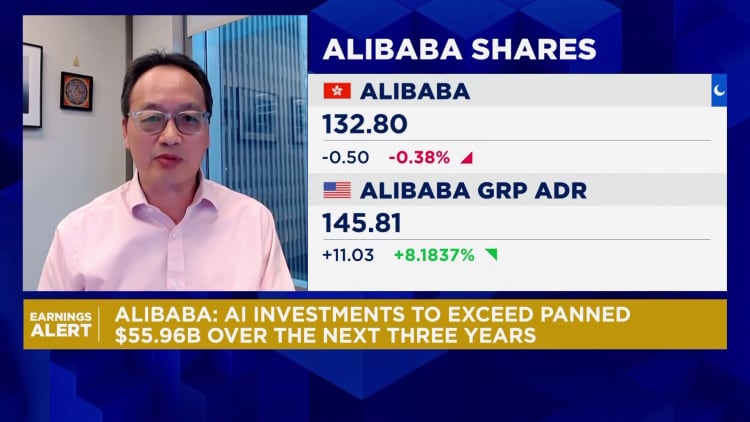
Alibaba designs its own AI chips, which it deploys in its data centers that power its cloud computing division.
“T-Head’s proprietary GPU chips have achieved scaled mass production,” an Alibaba executive said on the company’s earnings call on Wednesday. Alibaba talked up how its self-designed chips are an advantage in an environment where access to semiconductors is difficult.
“In an environment of compute scarcity, this structural advantage is favorable to our revenue growth and gross margin improvement,” an executive said.
Alibaba also signalled that it could sell servers that are equipped with its chips to companies building computing and data centers, or it could co-build those facilities with other firms, underscoring how the tech giant sees its growing role in China’s semiconductor space.
Will Nvidia be welcomed?
Alibaba and Tencent’s comments came a day before Reuters on Thursday reported that the U.S. gave the green light for several Chinese firms, including Alibaba and Tencent, to buy Nvidia’s H200 chips, one of the most powerful GPUs on the market.
However, no H200s have been made so far, Reuters added.
It’s still unclear whether Nvidia has indeed received the approval of the U.S. government. Asked by CNBC’s Joe Kernen about the report, U.S. Treasury Secretary Scott Bessent said: “This is news to me.”
“I know there’s been a lot of back and forth … and we’ll have to see on that. That’s a commerce department function,” Bessent added.

There have been several reports over the last year regarding Washington giving approval to Nvidia to ship certain chips, such as the less powerful H20, to China. However, some reports in that time frame suggested China encouraged local firms to buy domestic alternatives.
Neil Shah, partner at Counterpoint Research, said that as Chinese firms push toward “agentic AI,” the idea of AI systems carrying out more complex tasks, they will require more advanced chips. That means Nvidia’s H200 product will be welcomed, he said.
“We are seeing the Chinese AI roadmap pivot towards ‘domestic-only’ with AI training infrastructure,” Shah told CNBC. But he added that the “race towards Agentic AI” had shifted “from training to massive inference scaling” − the process of actually running AI models that have been trained.
“Chinese hyperscalers simply cannot afford to wait,” Shah said, adding: “The timing is right for NVIDIA H200 to get adopted in what could be a hybrid AI inferencing infrastructure based on Chinese and U.S. chips to scale the infrastructure sooner rather than later.”