Hi, this is Evelyn, writing to you from Beijing. Welcome to the latest edition of The China Connection — a succinct snapshot of what I’m seeing and hearing from local businesses.
Students and businesses alike are embracing AI in China, while the U.S. worries more about the negative impact. Will that encourage cooperation on AI safety when U.S. President Donald Trump and his Chinese counterpart Xi Jinping meet?
The big story
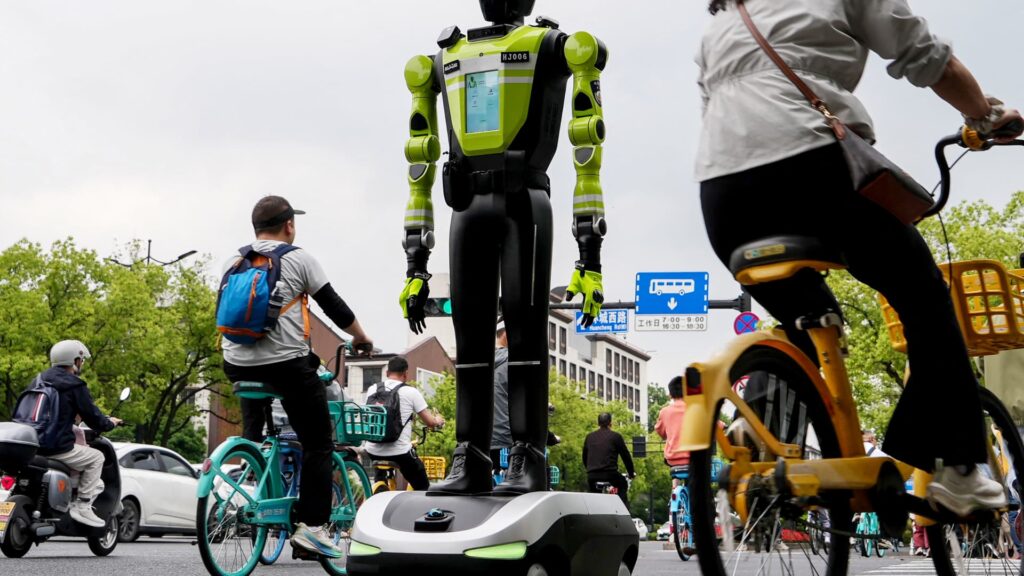
A robotic voice warned me (and others) at a Hangzhou street intersection that a scooter driver didn’t have a helmet on — even though I saw the rider wearing one.
Regardless, the city and others are ploughing ahead in testing robot police officers. The national cybersecurity regulator on Friday published guidelines for ensuring safe use of agentic AI.
It’s a reminder that in the U.S.-China tech race, Beijing has underscored AI control from the start; the U.S. seems only now to be taking it seriously.
As comparisons to the Cold War nuclear threat grow, hopes are rising that Trump and Xi will talk about AI cooperation in Beijing this week.
Given concerns about the latest AI models, “we are willing … [to explore] channels of deconfliction,” senior U.S. officials told reporters in a briefing ahead of the planned summit.
The stakes are rising sharply.
U.S.-based Anthropic rolled out cyber-focused Mythos to select clients in the last few weeks, a model Chinese state media has noted for its “unprecedented capabilities in cyberattacks.” Meanwhile, the latest version of China’s open-sourced DeepSeek model has weaned itself further off U.S. chips.
The two countries could work on “a global treaty to regulate the use of AI in the military,” said Hai Zhao, a director of international political studies at the Chinese Academy of Social Sciences, a state-affiliated think tank.
“If China [and the] U.S. get involved in an AI arms race, then it is bad not just for both countries,” he said, but for all humanity.
People cycle past one of 15 humanoid robot police officers deployed in Hangzhou, in China’s eastern Zhejiang province on May 3, 2026.
Agatha Cantrill | Afp | Getty Images
Governments, however, are typically followers rather than leaders of tech innovation. Education and research ecosystems remain the core drivers.
There, China is pulling ahead, under Beijing’s mandate to achieve an AI penetration rate of over 70% in key industries by next year.
Hangzhou’s Zhejiang University and Shanghai’s Jiao Tong University surpassed Harvard to take the top spots in a ranking of universities by scientific performance, according to the Netherlands’ Leiden University Ranking Traditional Edition.
And just as Silicon Valley has Stanford, many of China’s high-tech startups — including DeepSeek — have their roots in Zhejiang University. The school’s alumni association has released a list of 10 companies, such as quantum computing player Logistics Bits, which it says could be “the next DeepSeek.”
A divergent public
Rankings aside, there’s a striking difference in how eager the public is for AI adoption.
In the U.S., a backlash over defense-tech supplier Palantir’s manifesto last month reinforced fears about the dark side of AI. Teachers warn about the impact of AI on literacy. There’s more concern about the technology in the U.S. than in many parts of the world — 50% of Americans are wary of it, versus an average of 33% in other G7 countries, according to Pew surveys.
In China, fear of being displaced by AI has motivated people and businesses to adopt the tech more quickly, while courts are ruling in favor of human workers. After initially taking months to greenlight local ChatGPT alternatives, Beijing has come around to encouraging adoption, while issuing guidance on AI use in schools.
That’s reshaped the tech race. “The U.S.-China AI model performance gap has effectively closed,” Stanford researchers concluded in this year’s annual AI report.
For Hunter Roskom, a student from the University of Wisconsin–Madison who is spending two years at Zhejiang University on exchange, tech competition is more about different approaches.
In the U.S., he said, AI feels more behind-the-scenes. In China, he said, it’s integrated into daily life.
“At least not in the [U.S.] Midwest … you don’t really get exposed to the technology like you do here,” he said. “It’s everywhere here, even just walking on the streets of Hangzhou and you don’t see that in the Midwest, so definitely very eye-opening.”
And this week, Trump’s summit with Xi will test whether those differences translate into AI cooperation.
Need to know
Iran focus at Trump-Xi summit may delay progress on tariffs, rare earths
The U.S. government declined China’s invitation to organize industry-specific meetings between senior Chinese leaders and U.S. CEOs, thinking it could make American businesses appear too close to Beijing, according to a U.S. executive with direct knowledge of the arrangements.
China presses Iran against resuming war, urges Hormuz reopening ahead of Trump-Xi summit
Iran’s foreign minister met with his Chinese counterpart in Beijing on Wednesday. While China’s readout called for a “prompt resumption of shipping traffic through the Strait of Hormuz,” Iran’s statement did not mention that point.
BYD’s passenger EV sales drop for an eighth month as competition heats up
BYD’s passenger vehicle sales fell for an eighth consecutive month in April, while its domestic rivals Leapmotor and Zeekr notched record-high monthly deliveries.
Coming up
May 13: Alibaba to report March quarter results
May 14 – 15: U.S. President Donald Trump scheduled to meet with Chinese President Xi Jinping in Beijing
May 18: Retail sales, industrial production and fixed asset investment data for April
May 18: Baidu to report first quarter results