
Voters made it clear this week that they want to see limits put on data centers for artificial intelligence, passing 40 of 41 proposed ballot measures that would place restrictions on some of the more than 2,000 new facilities planned for communities around the nation.
Water and power top the list of ratepayers’ concerns. But calculating how much each data center draws from local resources is an elusive task, with operators typically reporting usage figures companywide instead of site by site.
Giant 1-gigawatt AI data centers from the likes of Meta, Google, Amazon and SpaceX can consume up to 10 million gallons of water per day, according to Shaolei Ren, a data center researcher and professor at University of California, Riverside.
The exact number varies greatly depending on what type of hardware is inside a data center, where it’s built, and what method is used to cool the servers and the building as a whole.
The complex ways data centers use water have left room for misinformation from both the builders and those fighting against them. CNBC talked to experts to get a clearer picture.
Air vs. liquid cooling
Data centers need serious internal cooling methods to keep chips and servers from overheating.
Legacy data centers, filled with lower-power servers used for things like networking or storage, are often air-cooled. Large fans move hot air away from the servers and outside the building.
But modern AI data centers are filled with high-power, denser graphics processing units, or GPUs, which Ren said can run so hot that the servers can “boil your eggs.”
Water is about 3,000 times more efficient for cooling down these GPUs, according to Equinix sustainability head Christopher Wellise.
GPUs “run at such a high wattage, a high temperature, you would need nearly hurricane-force winds to actually cool them down if you were just using air,” Wellise told CNBC in an interview.
That’s why the latest rack-scale AI systems, Nvidia‘s Vera Rubin and Advanced Micro Devices‘ Helios, rely on liquid cooling. Most large AI data centers use a closed-loop liquid cooling system that uses very little water on a daily basis.
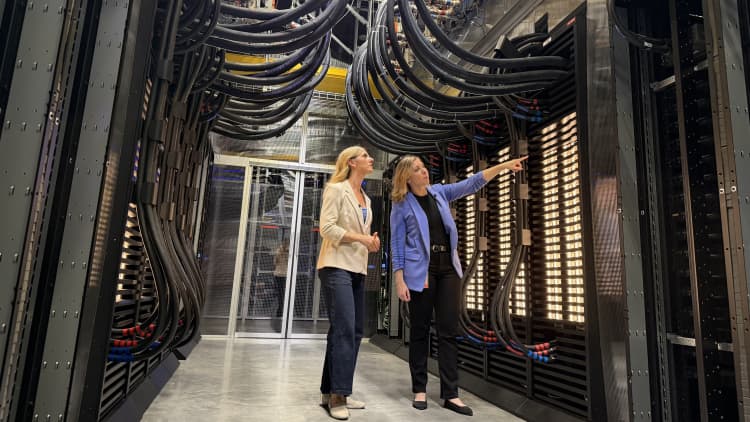
At an Equinix data center in San Jose, California, CNBC got an up-close look at the closed-loop liquid cooling system used to keep temperatures down in a row of eight Nvidia Grace Blackwell racks owned by AI marketing startup Alembic.
Equinix builds colocation data centers, where companies like Alembic rent space to run their own server racks, while Equinix supplies the power, network connections, interconnectivity and cooling.
Like many data center operators, Equinix doesn’t disclose water consumption at individual sites. In 2025, Equinix operations as a whole consumed 1.2 billion gallons of water, up 10% from a year prior.
Despite closed-loop internal cooling like what Equinix uses in San Jose, total water consumption is far more dependent on an additional cooling process that happens outside the data center.
“How do we reject the heat from the closed loop to the ambient environment?” Ren said. “That’s where the water usage comes in.”
In Lebanon, Indiana, for example, Meta is building a 1GW data center that it says uses a “closed-loop, liquid-cooled system that recirculates the same water and will use zero water for a majority of the year.”
Water allocation for the site, however, could ramp up to 8 million gallons per day by 2031, according to the company’s law firm. Meta says that figure represents peak usage on the hottest days. “We anticipate rarely reaching this maximum usage level, currently projected as only a few days per year,” Meta told CNBC in a statement.
That’s because the hottest days of the year will require more water for that external cooling process, removing the heat from that separate internal closed-loop system.
Less water, more power
There are two primary methods for this external cooling process at a data center: dry cooling and evaporative cooling. While dry cooling uses far less water, it can require far more power, especially in hotter climates where many of these AI data centers are being built.
“There’s no sort of silver bullet,” Wellise said. “At some point you need to eject that heat out to the atmosphere. And that’s where those trade-offs occur.”
Dry cooling relies on fans to blow air across heat exchangers, using the ambient air to cool it down. Those fans are less effective when the outside temperature is high, so data centers turn on refrigeration units to cool down the air first.
“That’s a very power-intensive process, and that’s exactly why we have power shortages in the summer,” Ren said. “Because everybody else turns on their AC.”
Evaporative cooling, meanwhile, uses very little power. The hot water circulates through cooling towers or over wet pads that are exposed to air, and the portion that evaporates carries heat away with it. Large amounts of water can be lost through that evaporation on the hottest days.
In between these two extremes, hybrid methods are common as companies try to find a balance.
Some data centers, like Equinix’s in San Jose, use dry cooling in the colder months and evaporative cooling when it’s hot outside. In Indiana, Meta relies on dry cooling and keeps power consumption down in hotter months by spraying a mist to cool the air instead of relying solely on refrigeration units.
Creating cooler chips
Near some data center projects, Meta, Amazon, Microsoft and others are building water treatment plants to help treat and recycle the necessary water. Meta, for example, spent $100 million on a new water and wastewater system near its data center in Kuna, Idaho.
Outside Memphis, Tennessee, Elon Musk pledged $80 million to build a water recycling plant that’s meant to turn treated municipal wastewater into cooling water for SpaceX’s Colossus data centers. The first data center there, Colossus 1, came online rapidly in 2024, but construction on the water treatment plant was put on hold in April of this year.
Colossus 1 has a water allocation of up to 1.28 million gallons per day, although it hasn’t yet reached that threshold, according to the local utility, Memphis Light, Gas and Water.
Tech firms are also building their own power plants on some data center campuses in an effort to secure enough supply, but those also consume a large amount of water. Colossus gets energy from gas-powered turbines it installed on-site, which have been the subject of multiple lawsuits over alleged Clean Air Act violations and noise pollution.
Meanwhile, some chip companies are directly working on ways to bring the heat of a chip down so less cooling will be needed to begin with.
South Korean startup DeepX makes an AI processor it says runs up to 100°F cooler than competitors. Hyundai Motor will use the DeepX chip in robotics offerings.
SK Hynix, the world’s leading maker of high-bandwidth memory, told CNBC in July that it’s working on a low-heat memory technology called iHBM that can reduce thermal resistance by 30%.
At Equinix, Wellise said each new site undergoes a water risk analysis to determine which external cooling method to deploy in areas with scarce water.
“Communities are beginning to ask the right questions. They’re concerned about water consumption,” Wellise said. “We take resource consumption, resource use very seriously.”
WATCH: The race to power AI data centers is reshaping America’s electric grid