


You invest in mutual funds, shares, ETFs, and even fixed deposits. But tracking your investments and keeping abreast with what money lies where can be a tricky and sometimes cumbersome task.This is where the Reserve Bank of India’s (RBI) latest move on Consolidated Account Statement (CAS) and interoperability of account aggregators can prove to be a game-changer for you.Announced on October 7, 2026, the measures will allow SEBI-regulated depositories to include information related to deposit accounts in CAS. RBI Governor Sanjay Malhotra said the measures would be implemented by December 31, 2026. Once operational, the move could give investors a more comprehensive view of their financial holdings in one place, alongside their stocks, mutual funds and other securities.Let’s take a look at what has been announced, how it will benefit you and what still needs clarity:
What has been announced on account aggregators and CAS
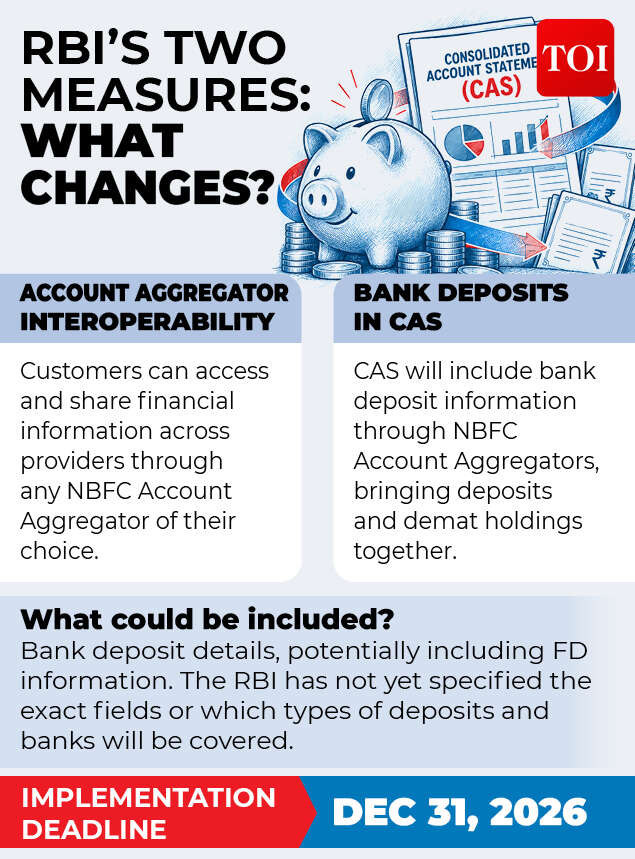
RBI’s statement said, “With an objective to enhance customer convenience, it has been decided to implement interoperability among NBFC-Account Aggregators (NBFC-AA).”According to the central bank, this will allow customers to access and share their financial information, across different Financial Information Providers, through any NBFC-AA of their choice.
RBI measure on CAS
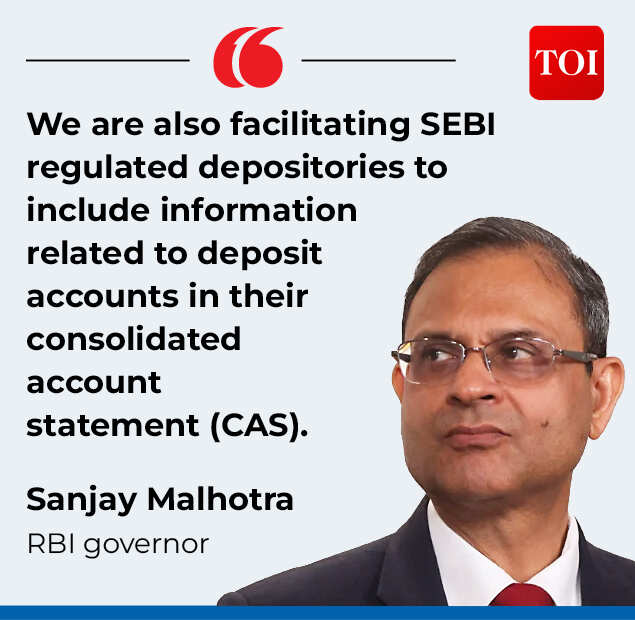
“Additionally, Depositories regulated by the Securities and Exchange Board of India are being facilitated to include information related to bank deposit accounts in their Consolidated Account Statement (CAS) through the NBFC-AAs,” RBI said.“This will enable demat account holders to view information relating to their demat account holdings and bank deposit accounts at one place in the CAS,” it added.
What is Consolidated Account Statement?
As the name suggests, CAS is a single statement that brings together an investor’s transactions and holdings across demat accounts and eligible mutual fund investments.Currently, CAS consolidates transactions and holdings in an investor’s demat accounts with the National Securities Depository Limited (NSDL) and Central Depository Services Limited (CDSL), as well as eligible mutual fund investments held in statement-of-account form.It consolidates the holdings linked through the investor’s PAN, making it easier to track stocks, mutual funds, bonds and other securities in one place.Mutual fund investors without a demat account can also receive consolidated statements covering eligible folios across fund houses. Bank deposit details are not currently included in CAS.

What is Consolidated Account Statement?
How it benefits you
Simply put, having bank deposits sit alongside holdings in the Consolidated Account Statement means demat account holders can see more of their money in one place, rather than checking separate statements.Experts say the proposed addition could make it easier to review how much money is held in deposits, possibly including the provision to check whether an FD has a nominee, reconcile bank interest with Form 26AS and the Annual Information Statement (AIS), and identify unfamiliar deposits that may warrant investigation.It could also help households assess how their money is distributed between market-linked investments and deposits.Let’s understand what all is expected to be consolidated:What could be visible: Alongside existing capital-market holdings – mutual funds, stocks, bonds – the statement is expected to show fixed deposit balances, bank names and term-deposit details such as principal and maturity, with account numbers masked. The precise fields are still being finalised.Which deposits? Standard retail deposits across scheduled commercial banks – fixed deposits and recurring deposits. Crucially, this only consolidates the reporting. Through the Account Aggregator framework, balances across banks can be pulled into one periodic statement via the depositories (NSDL/CDSL).“That can make it easier to get an overall picture quickly,” says Adhil Shetty, CEO of Bankbazaar.Rohit Shah, Founder & CEO, GYR Financial Planners believes that a single screen genuinely improves decision-making.“Most investors never sit down and build their full balance sheet – fixed deposits, mutual funds, stocks, bonds all sit in different places and are rarely looked at together. Bringing them into one view is exactly the gap CAS begins to close, and seeing the whole picture tends to lead to more rational choices,” he tells TOI.

What Sanjay Malhotra announced
Explaining the rationale of the move, Adhil Shetty says, “The RBI’s aim with interoperability among NBFC Account Aggregators is to make things more convenient for customers.”Financial information can be accessed and shared through an aggregator of the customer’s choice, without piecing it together from several sources.“A customer can use any aggregator they are comfortable with to access and share financial information held across different providers, which should make the process simpler for most people. The practical details, including how consent will work and what control customers keep over their data, are likely to become clearer as the framework takes shape,” he tells TOI.The direction is a useful step towards making it easier for people to keep track of their money, he adds.
What Sanjay Malhotra said on CAS
What still needs clarity
The implementation timeline for the move has been set out as December 31, 2026. Financial experts expect more clarity to emerge on the processes and privacy protection.According to Adhil Shetty, the finer points, such as which deposits will be covered, what details will show and whether deposits across banks will appear together, are likely to become clearer closer to implementation.As Rohit Shah notes, the limitations matter too. This is information, not advice – a single screen doesn’t make the decision for you.“The exact deposit details shown are still being finalised, and the real benefit depends on banks and aggregators coming on board and on your giving consent. Consolidating everything in one place also raises the usual data-privacy and consent questions,” he says.