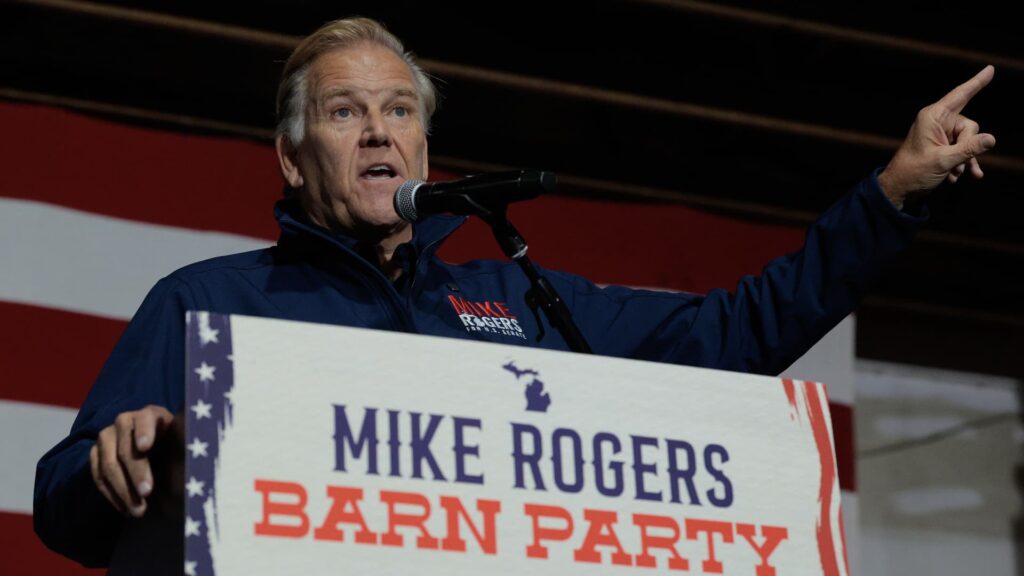
Michigan Republican Senate candidate, former U.S. Rep. Mike Rogers speaks during a barn party campaign event at Hoffman Farms Winery on Oct. 9, 2026 in Highland Township, Michigan.
Chip Somodevilla | Getty Images
Michigan Republican Senate nominee Mike Rogers sat at a neighborhood bar, a bottle of Canadian Labatt Blue pilsner in hand, and delivered a message that would have been hard to imagine just weeks ago.
“Here in Michigan, we know that Canada is not our enemy,” Rogers says into the camera in an advertisement released Oct. 7. “We need to end this tariff war now.”
He never mentions the man who started it: President Donald Trump.
It’s a dramatic reversal for Rogers, who spent months defending Trump’s tariffs, saying as recently as September that “Trump is right to put America first” by imposing duties. But in Michigan, where farms, factories and tourism rely on Canadian trade, Trump’s trade fight and Ottawa’s retaliation have become a political quagmire three weeks before an election that could decide Senate control.
Rogers is locked in a dead heat with Democrat Abdul El-Sayed. The Cook Political Report with Amy Walter rates the contest a toss-up, with neither candidate emerging as a clear favorite. Polling aggregator FiftyPlusOne has El-Sayed with a four-percentage-point advantage over Rogers.
And Rogers’ omission of Trump – mirrored in an earlier ad calling for an end to the war in Iran – reflects broader GOP anxiety heading into November’s election. Even as Trump urges voters to “pretend I’m on the ballot,” many battleground Republicans are barely talking about him in general election ads, with some using them to tacitly break with his signature policies.
Fifty-seven of 1,324 Republican candidate ads in the general election period mention Trump – 4.3%, down from 47.1% during the primaries, according to a CNBC analysis of AdImpact data. The analysis counts distinct ads, rather than how often they aired, and includes spots scheduled through the end of October.
Democratic candidates are invoking Trump far more often. He appears in 20.9% of their general election ads, nearly five times the Republican rate.
“Republicans needed to toe the Trump line to win the base in the primaries, but they need independence to survive November,” said Ron Bonjean, a Republican strategist and partner at ROKK Solutions.
Rogers breaks with Trump
Michigan conducts roughly $80 billion in annual trade with Ontario, according to the Michigan Chamber of Commerce. Canada is also Michigan’s top export market, buying $23.2 billion in goods last year, roughly 39% of all state exports, according to the Office of the U.S. Trade Representative.
The relationship is especially important to automakers, whose parts routinely crisscross the border before final assembly. The Detroit Three – General Motors, Ford and Stellantis – reported roughly $6.5 billion in combined tariff-related costs in 2025, according to a CNBC analysis of company financial disclosures.
“You can’t slap a tariff on goods crossing that bridge without immediately inflating the cost of every vehicle rolling off a Michigan assembly line,” said Richard Czuba, founder of the Glengariff Group, a Michigan polling firm.
Trump escalated the trade fight with Canada again in August. After negotiations collapsed, the U.S. imposed 50% tariffs on roughly $20 billion of Canadian goods, hitting steel, aluminum and manufacturing inputs on top of existing duties on lumber and autos. Canada responded with retaliatory tariffs.
The new duties landed as Michigan was already feeling the strain. The state reported Michigan’s agricultural exports to Canada fell 12.3% in 2025, while Democratic Gov. Gretchen Whitmer’s administration estimated tariffs were averaging Michigan households about $1,000 a year.
“Republicans in tight races like Rogers are largely avoiding Trump’s priorities — or breaking with him, especially on tariffs — because the cost of living is such a potent issue,” said Erika Franklin Fowler, a Wesleyan University professor and co-director of the Wesleyan Media Project, which tracks political advertising.
An early September WDIV/Detroit News poll by the Glengariff Group found 64.2% of likely Michigan voters opposed Trump’s Canadian tariffs, with nearly 62% saying they hurt the state’s economy.
Against that backdrop, Rogers pivoted. After calling tariffs “necessary” in late August, he was on the air by October demanding an end to the fight “to lower your prices.”
“Mike Rogers was a free-trade Republican until being a free-trade Republican put him at odds with Trump,” Czuba told CNBC. “Now he’s coming back to where he started because Michigan voters have made clear how much they dislike the tariffs on Canada.”
Rogers’ campaign did not respond to requests for comment on his shifts on tariffs and Iran or whether he is seeking greater distance from Trump.
Trump’s standing leaves Rogers little room for error in a state the president carried by just 1.4 points in 2024 even as Rogers lost in his earlier bid for the Senate. A September Emerson College/Nexstar Media survey found 55% of likely Michigan voters disapproved of Trump’s performance, while 47% cited the economy as their top issue.
That leaves Rogers walking a tightrope: energizing Trump’s base while convincing swing voters he can shield them from the economic fallout of the administration’s policies.
“When voters feel squeezed at the pump and the grocery store, tariffs and wars abroad are what they will vote on,” Bonjean told CNBC. “If a conflict drives up daily costs, battleground candidates have a harder time defending it. This cycle has created a storm.”
Rogers initially called Trump’s decision to strike Iran “the right thing to do” and hailed the conflict as the best opportunity for Middle East peace in his lifetime. But as the war dragged on and energy costs climbed, his tone changed.
Michigan highway diesel hit $6.71 a gallon in September, while off-road diesel used by farmers reached $5.95 for Sept. 21 delivery, according to Michigan Farm News, a publication of the Michigan Farm Bureau, citing fuel distributor Crystal Flash. Nationally, farm fuel expenses were projected to rise 29% this year, while fertilizer costs were projected to rise 15%, according to a U.S. Department of Agriculture forecast.
By late September, Rogers was calling for a quick end to the war because “Michigan families are struggling with the price of everyday life.” Again, Trump’s name was missing from the ad.
“Groceries cost too much,” he said. “We have to bring prices down.”
Former US President and Republican presidential candidate Donald Trump shakes hands with US Senate candidate Mike Rogers, Republican of Michigan, as Rogers takes the stage to speak during a campaign rally at the Suburban Collection Showplace in Novi, Michigan, October 26, 2024.
Drew Angerer | Afp | Getty Images
Will it work?
Rogers’ late pivots may make it too late to create daylight after months of alignment with Trump, one GOP strategist said.
“It’s a high-wire act with no safety net,” Bonjean said. “Voters already have defined impressions of this administration, and suddenly flipping your positions on Trump in the final weeks looks to a lot of people more like self-preservation than an authentic conversion.”
Republicans have the money to test the strategy. In September, Republicans spent about $200 million more than Democrats on aired congressional ads — $597 million to $398 million, according to AdImpact.
That advantage extended to Michigan, where Republicans held a $15 million edge in Senate advertising race through Sept. 30, according to AdImpact. Rogers and the National Republican Senatorial Committee had spent $12 million on coordinated ads, according to AdImpact.
Democrats face a different test
Rogers has also tried to move the race onto friendlier ground by attacking El-Sayed over transgender rights.
“Abdul thinks football is bad, but men playing in women’s sports is good,” Rogers said in an August attack ad. “Common sense versus crazy. That’s Michigan’s choice.”
About one in nine ads run by Rogers’ campaign, the NRSC and their coordinated operation since the primary have addressed transgender issues, accounting for nearly $800,000 of $14.4 million in Michigan Senate ad spending scheduled through the end of October, according to a CNBC analysis of AdImpact data.
Nationally, anti-transgender messaging accounted for nearly a fifth of pro-GOP Senate broadcast ads from Sept. 8-27, according to the Wesleyan Media Project, trailing only taxes and inflation. A Reuters/Ipsos survey found 67% of Americans support barring transgender girls and women from female school sports.
“Republicans are looking for any way to distract from the economy,” said Meredith Kelly, a Democratic strategist and partner at Declaration Media. “They are not popular when it comes to pocketbook issues like gas, groceries and healthcare costs.”
El-Sayed has largely declined to engage on transgender issues, instead steering the conversation back to affordability. But when pressed, he has said decisions over gender-affirming care for minors should be left to patients, parents and doctors, and told Fox News that sports governing bodies should set eligibility rules.
“You have not asked me one time about the issues that people actually care about in Michigan,” El-Sayed told host Jesse Watters, pointing to gas, groceries and prescription costs.
That approach puts El-Sayed in one camp of a Democratic debate left unresolved after 2024: whether to directly rebut Republican attacks on transgender rights, concede ground on specific policies or change the subject.
El-Sayed’s campaign did not respond to a request for comment on its strategy for responding to the Republican attacks. El-Sayed will get a high-profile boost from Rep. Alexandria Ocasio-Cortez, D-N.Y., who is set to campaign with him across Michigan on Thursday and hold additional rallies around Detroit on Friday.
Meanwhile, some Democrats have moved right. In neighboring Ohio, longtime Democratic Rep. Marcy Kaptur recently ran an ad declaring that “boys should not play in girls’ sports,” angering LGBTQ+ advocates and some party allies. Others argue that engaging only gives Republicans the culture war they want.
“There isn’t one playbook, and it’s different across the country,” Kelly told CNBC.
There is evidence, however, that silence carries a cost. A Democratic post-election autopsy found attacks on former Vice President Kamala Harris over social issues were “very effective” in 2024. Subsequent testing by the centrist think tank Third Way found that not responding cost Democrats roughly eight points, a penalty largely erased by a direct rebuttal.
“You cannot just hit mute when Republicans launch a cultural attack,” said Lanae Erickson, senior vice president for social policy, education and politics at centrist think tank Third Way. “Changing the subject doesn’t defuse the issue; it gives Republicans free rein to define you.”
Yet in Michigan, analysts say the economy may make it difficult for any cultural issue to dominate the closing weeks.
“If Rogers wants to bet on cultural grievances to drown out economic pain, that’s a huge gamble,” Czuba said. “You can talk about sports all day, but when swing voters are paying six dollars for diesel, it’s going to be hard to beat kitchen table issues.”