Mark Zuckerberg, chief executive officer of Meta Platforms Inc., reveals the Muse Charm device during the Meta Connect event in Menlo Park, California, US, on Wednesday, Sept. 23, 2026.
Minh Connors | Bloomberg | Getty Images
Meta’s Muse personal agent has been topping app store charts. Now, the “centerpiece” of the company’s artificial intelligence strategy, as CEO Mark Zuckerberg describes it, needs to become something people make a habit of using.
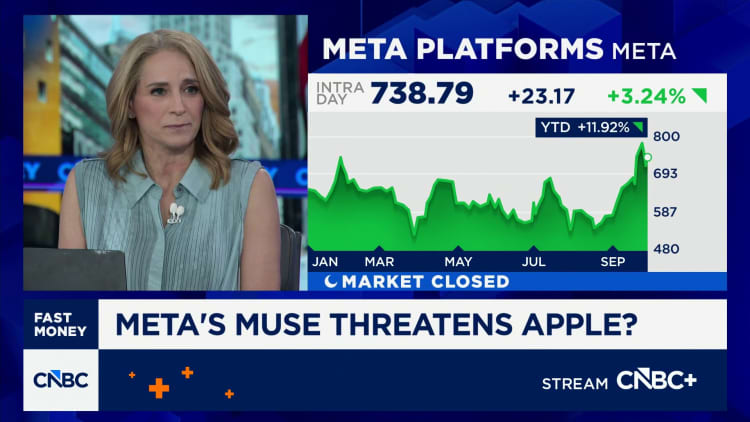
The buzz around Meta’s AI agent has excited investors. The stock is up about 20% since the app’s launch a month ago and recorded its best month in September since 2022.
While Meta is still currently the top free app on Apple’s iOS store, the bigger challenge for the Facebook parent is to get people to keep using Muse after the magic wears off. Meta needs its personal agent to be an anchor app for the company, which has been trailing competitors like OpenAI and Google in the red-hot AI market.
“Muse has an opportunity to be sticky with consumers because it’s a task-completer, rather than just a chatbot,” Meredith Whalen, chief research officer at IDC, said in an email.
Whalen said consumers are using current AI tools for a range of tasks, but it’s unclear if they’ll be willing to hand over the kind of personal data required to create an efficient digital assistant. That’s a particularly big obstacle for Meta, which just agreed to an almost $17 billion settlement with a group of states that alleged the company misrepresented the extent of child mental health harms caused by apps like Facebook and Instagram.
“The real question is trust,” Whalen said.
Meta is pitching Muse to both consumers and small businesses for tasks like organizing personal emails, searching for shopping deals or seeking out prospective customers. Although Meta lets users access Muse for free, it also sells monthly subscription plans for $20 or $100, depending on tokens, a metric the company uses to calculate the power AI agents need to accomplish tasks.
In offering Muse for free out of the gate, the company can get an understanding of how and why people are using it, said Whalen, who noted that, “Price comes later, once the habit is established.”

Coders have found AI agents helpful as software engineering tools, but the general public and even business leaders are still grappling with the potential for supercharged digital assistants, beyond acting as mere question-and-answering services.
“I would say that widely, enterprise-scale AI agent adoption is still page one, chapter one,” said Ketan Karkhanis, CEO of ThoughtSpot, which sells AI agent technologies to businesses.
Consumers are just getting started with AI agents.
Karkhanis said he hasn’t seen the kinds of “killer use cases” that would make apps like Muse more compelling than merely being a “next-gen Alexa” or Siri voice assistant that people might use to tell them the weather.
Andrew Geller, executive producer of 1stAveMachine, said his media firm develops its own internal agentic tools for certain production tasks. He views Muse and other consumer-focused AI agents as being “quite helpful” in introducing the technology to the masses, but says they’re hardly life-changing.
Geller said he was “early on the OpenClaw train,” referring to the so-called open-source harness for managing AI agents that took off earlier this year. He said he discovered that personal use of AI agents can be fun, but also “kind of a little banal,” particularly when contrasted with the more heavy-duty uses related to coding.
Bring on the Personal AI assistants
A number of other tech firms are trying to commercialize AI agents for the masses by first enticing users to join for free.
Former Yahoo CEO Marissa Mayer is taking a try-before-you-buy approach with her new photo-centric AI agent startup Dazzle, a tactic she said is important “for those occasional users or those users who are just trying to see what the service can do at the very beginning.”
Dazzle analyzes users’ personal photos to understand aspects of their lives, such as their family members or interests, and then can take actions like reminding someone that a pair of shoes they recently looked up is on sale online.
It’s a strategy she learned from her early tenure at Google, before the company built its market-leading online ad platform.
“What we’re really trying to do is see what use cases are really popping with users, what do they see as really helpful, and that will guide it,” Mayer said about Dazzle’s first week post-launch.
Mayer compared the pricing and adoption approach to Uber‘s evolution. The ride-hailing company began with black town cars before introducing lower-priced options for a wider swath of users.
“It’s a luxury to be able to have these wonderful recommendations and to have this level of convenience,” Mayer said.
Dazzle is considering transaction fees and subscriptions.
“We want to be running a service where people feel that they’re getting value on a relatively continuous basis over time,” Mayer said.
At Wajo AI, CEO Shivani Poddar is also contemplating business models for her new AI-powered digital assistant startup, which lets people research and book appointments or order gifts for family members.
Poddar, who has previously built voice-assistant technologies for Amazon Alexa and at Facebook, is letting people access the service for free for now. While Poddar believes businesses may be willing to pay subscription fees, she’s not yet convinced that “the everyday person” will want to sign up, and instead may be more willing to pay service fees based on outcomes, like how Airbnb makes money from bookings.
The stakes are highest for Meta, which went on a massive spending spree last year to acquire talent and build a business in AI that could compete with OpenAI and Anthropic. Zuckerberg is desperate to diversify away from online ads, which still account for almost all of the company’s revenue, and he’s got a long way to go to prove that Muse can be a key piece of that effort.
Zuckerberg, at least to an extent, has time on his side.
“Whoever can subsidize users and wait has the advantage,” IDC’s Whalen said. “And Meta’s ad business can pay for a lot of waiting.”
WATCH: Meta hits the mark.