

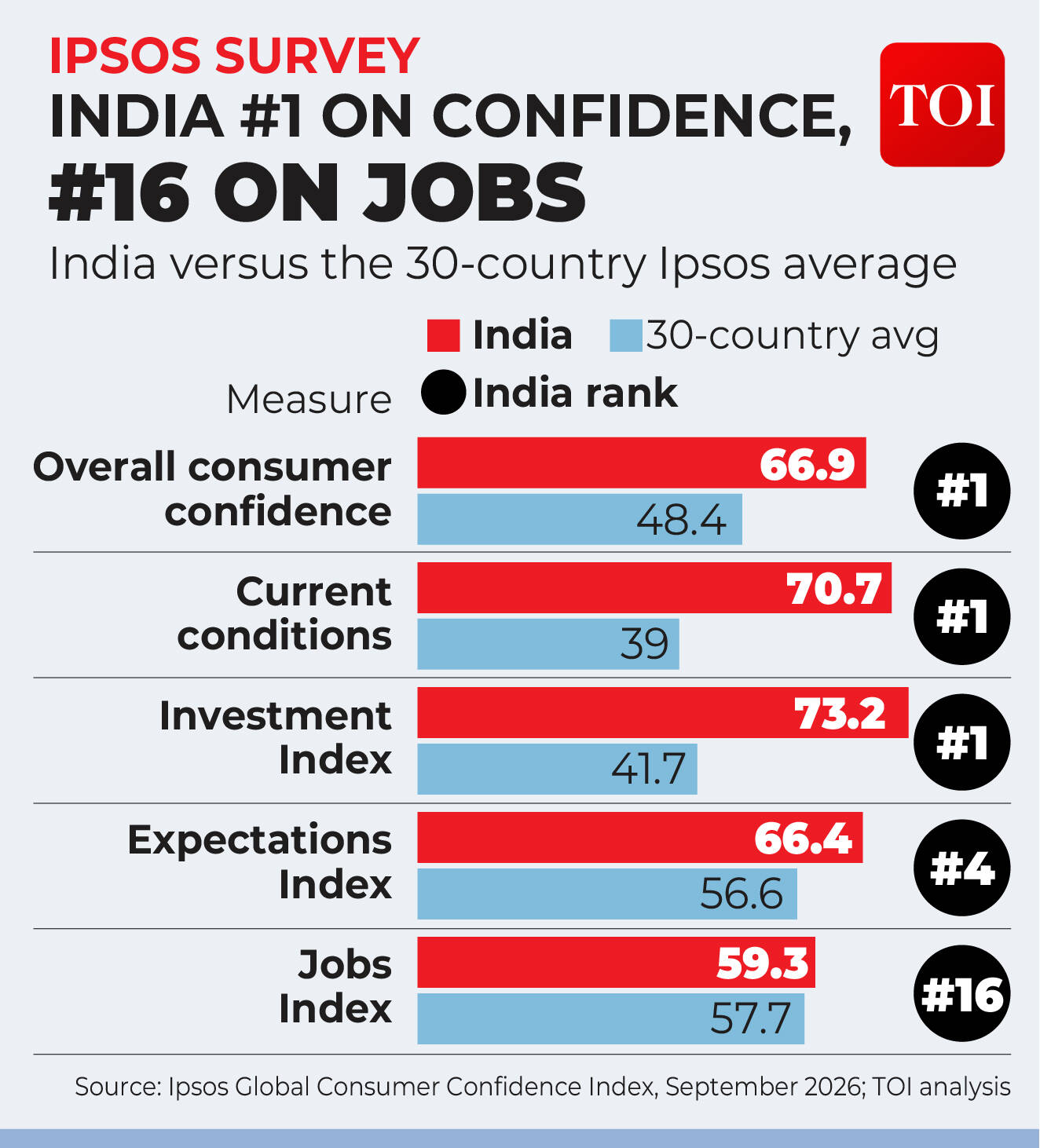
A sense of collective pride, and yet a feeling of individual disquiet. This is probably the most accurate description of the mood among India’s more connected, urban-skewed population. There is confidence in the larger macroeconomic story, even as there is lingering uncertainty about the jobs market and an apparent weakening of the old assumption that education is a sure-shot route to upward mobility. Ipsos’s September surveys capture that dilemma between hope and anxiety. India ranks first among 30 markets on consumer confidence but 16th on jobs, and unemployment is the issue Indian respondents worry about most.India’s consumers are upbeat about the economy. In Ipsos’s September 2026 Global Consumer Confidence Index, India scores 66.9, the highest among the 30 markets, compared with a global average of 48.4. Ipsos says its India sample is more urban, educated and/or affluent than the general population and hence the results should be read as reflecting the views of a more “connected” segment.
High on confidence about India, not so much about jobs
India’s Current Index, an indicator of how people rate present conditions, is 70.7, and its Investment Index is 73.2, both the highest among the 30 markets in the published survey. Its Expectations Index, at 66.4, ranks fourth, so respondents are also buoyant about the future.The contrast is particularly sharp against the world’s major advanced economies. Among the G7, the US has the highest overall consumer-confidence score at 50.5, followed by Great Britain at 48.2 and Canada at 47.3. Italy scores 43.0, Germany 41.4, France 40.6 and Japan 39.4. India, at 66.9, is therefore 16.4 points above the best-performing G7 economy.Across the countries surveyed, India is the most confident market, followed by Sweden at 60.0 and Malaysia at 54.8. At the other end, Türkiye is lowest at 35.3, followed by Argentina at 37.8 and Japan at 39.4. The gap between India and Türkiye is more than 31 points. Only one number breaks the pattern. India’s Jobs Index is 59.3, putting it in 16th spot. On current conditions and investment, India sits more than 30 points above the 30-country average. On jobs, its lead is just 1.6 points.
Jobs top the worry list
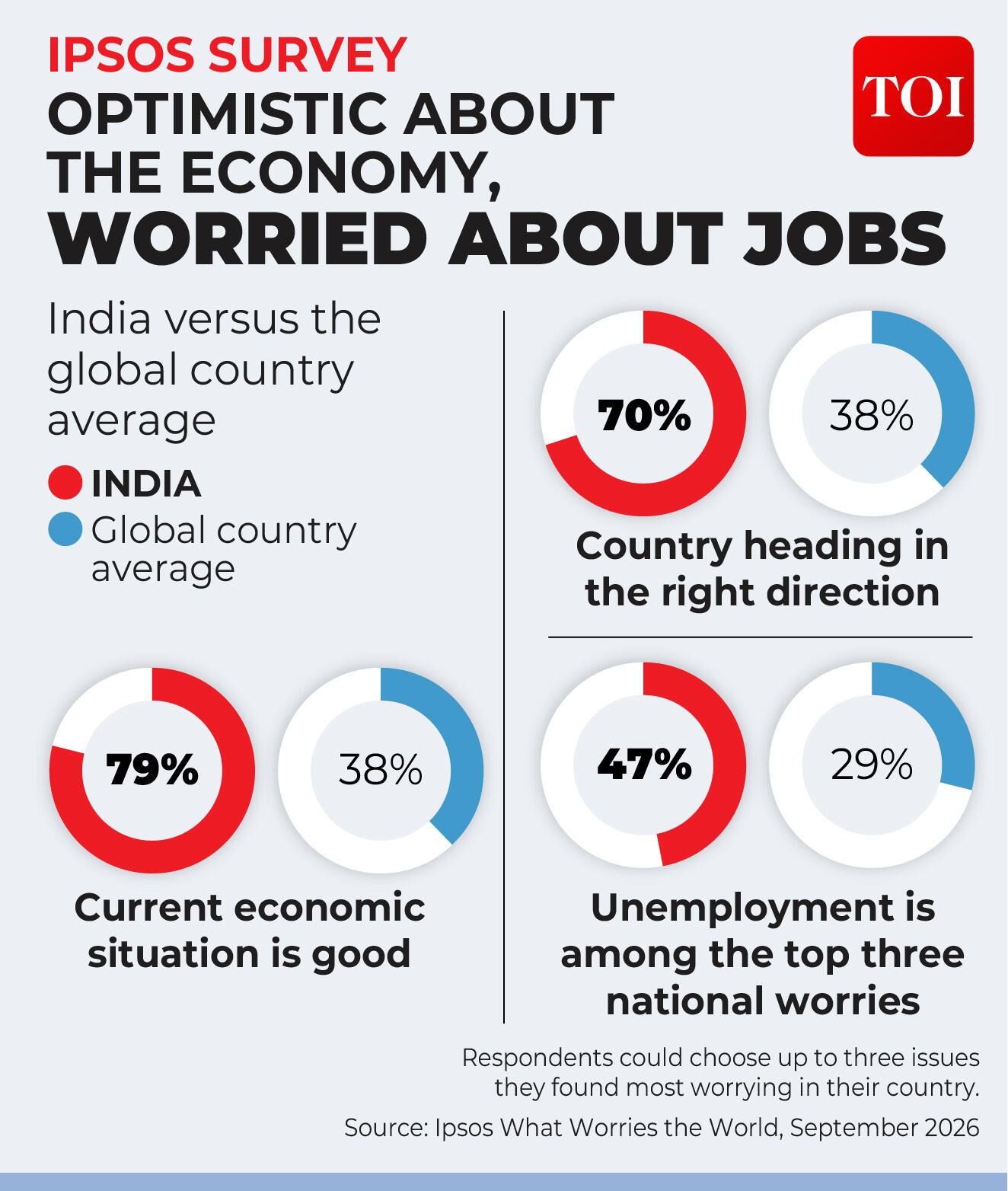
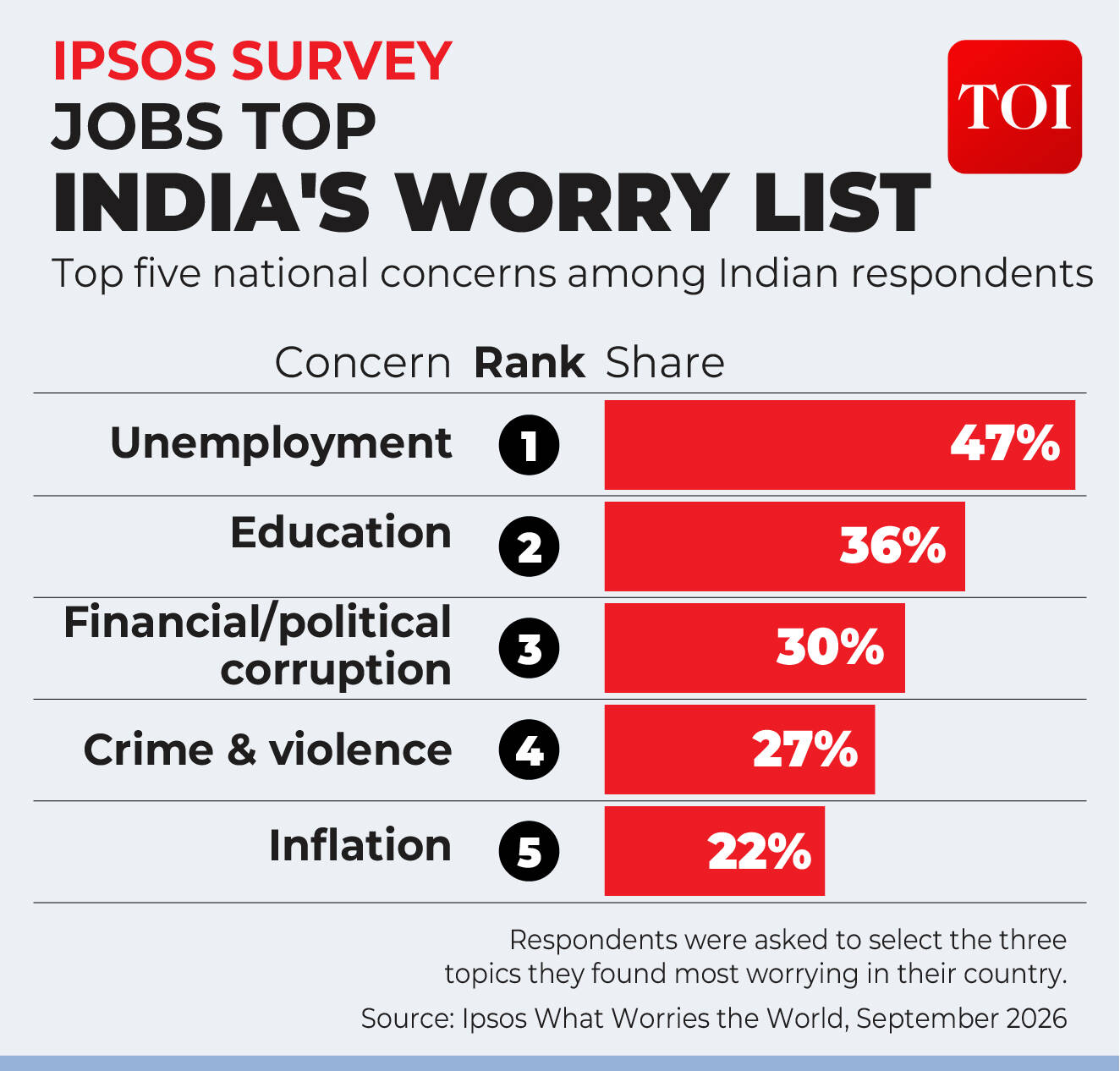
In the September edition of Ipsos’s What Worries the World survey, 47% of Indian respondents name unemployment among the three issues they find most worrying in the country, making it the most frequently cited concern in India. The global average is 29%. South Africa, Argentina, Singapore, Indonesia and Chile are the only countries with a higher share of respondents citing unemployment as a worry.Among the G7, unemployment is cited as a top concern by 28% in Canada and Italy, 20% in the US, 19% in Great Britain, 16% in France and 13% each in Germany and Japan, well below India’s 47%. Across the 30 countries surveyed, concern is highest in South Africa, at 69%, and lowest in the Netherlands, at 6%.The same survey also finds strong optimism among Indian respondents. Seventy per cent say the country is heading in the right direction, against a global average of 38%. Only Singapore, at 80%, records a higher figure. Meanwhile, 79% describe the current economic situation in India as good, again compared with a global average of 38%.
People most worried about unemployment
Here too India stands apart from the G7. The share saying their country is heading in the right direction is 44% in Canada, 36% in Japan, 28% in Great Britain, 27% in the US, 23% in Italy, 14% in Germany and 11% in France. Singapore does best on this measure at 80%, while France is at the bottom at 11%.The jobs concern, in other words, does not stem from general economic pessimism. The more connected Indians Ipsos surveys can be positive about the economy and still name unemployment as one of the country’s most worrying problems.
Education is second in the list of worries
Ipsos switched its India consumer-confidence sample from a mixed methodology to online-only in April 2026, a break that the September report flags. Long-term comparisons therefore need caution.
What the government data show
Do the official numbers help explain this contrasting mood?Real GDP grew 7.8% year-on-year in the April-June quarter of 2026-27, according to MoSPI estimates. Private final consumption expenditure, the broad measure of household consumption, increased 7.1%, while gross fixed capital formation rose 11.9% at constant prices. Those numbers are broadly consistent with Ipsos’s strong readings for current conditions and investment sentiment.The labour market data are more mixed. The government’s monthly Periodic Labour Force Survey put India’s unemployment rate for people aged 15 and above at 5.0% in August on the Current Weekly Status measure, marginally lower than 5.1% in July. But the improvement came from rural India. Rural unemployment fell from 4.5% to 4.1%, while the urban rate was almost unchanged, moving from 6.7% to 6.8%. The urban Worker Population Ratio was also 47.0%, unchanged from July and below 47.5% a year earlier.These figures are not directly comparable with Ipsos’s Jobs Index. PLFS measures actual labour-market status; Ipsos measures perceptions of job security and the employment environment. There is another limitation to headline unemployment numbers. NITI Aayog has also highlighted job quality, informality and underemployment as labour-market concerns, dimensions that an unemployment rate alone cannot fully capture.Taken together, the data help explain how the seemingly contradictory findings can coexist.
The classroom-to-career gap
Education is India’s second-most cited concern, at 36%. That is the highest among the 30 countries, against a global country average of 13%. India’s top two concerns, unemployment and education, are both closely tied to economic opportunity. The government’s labour survey tracks one measure that spans both. In the latest PLFS annual report, covering 2025, 25.0% of people aged 15-29 were not in employment, education or training, or NEET. Among those aged 15-24, the share was 21.0%.The same report put the unemployment rate at 9.9% for 15-29-year-olds, 13.6% for urban youth and 6.5% for people with at least secondary education. NEET is not an unemployment measure: it also includes young people who are neither working nor studying but may not be looking for work. So for Indians, confidence in the economy, current conditions and investment is higher than in any other market. The Jobs Index is the exception, and the official data point to where some of the strain lies: among urban youth and the educated.
Share your thoughts in the comments
Be respectful · TOI community guidelines
That is the lived reality the surveys capture. The pride is collective: it is about where the country is heading. The disquiet surfaces when the conversation turns to jobs and education. With technology rapidly changing the nature of work, continuous learning and reskilling are becoming an economic necessity. But many workers and young people still lack the support, guidance and pathways needed to navigate that transition.The surveys offer a snapshot of that churn.