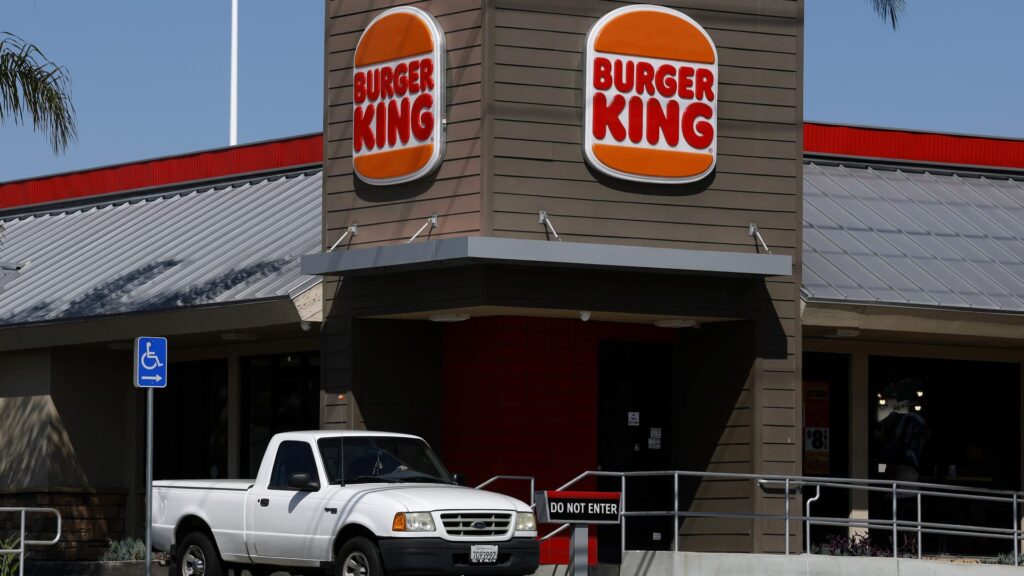
A car goes through the drive-thru at a Burger King restaurant on May 6, 2026 in Burbank, California.
Justin Sullivan | Getty Images
When Jeremy Kline was 15, he started as a crew member at Taco Bell. In the decades since then, he worked his way up the restaurant industry to director of franchising for Burger King North America.
These days, he is on the other side of the aisle as one of the burger chain’s newest franchisees, after buying 16 locations in the Salt Lake City area in February.
Kline is one of the new operators betting on Burger King as it embarks on a U.S. comeback. The burger chain is on track to sell about 200 company-operated restaurants to franchisees by the end of the year as part of a broader refranchising initiative, and buyers like Kline will be critical to the plan.
Since late 2022, Burger King has embarked on a turnaround strategy focused on revamping its marketing, improving food quality and renovating restaurants. The comeback has already started to pay off; Burger King recently overtook Wendy’s as the number two burger chain in the U.S., based on system sales.
To accelerate the modernization of Burger King restaurants, its parent company Restaurant Brands International bought the chain’s largest U.S. franchisee, Carrols Restaurant Group, in 2024 for roughly $1 billion. The Carrols deal added 1,023 company-owned locations to the 175 that Restaurant Brands already held at the time, largely acquired during franchisee bankruptcy sales as Burger King struggled before its turnaround.
Restaurant Brands always planned to sell most of those restaurants back to smaller, local franchisees. Ultimately, Burger King wants to end up with about 300 company-operated restaurants; franchisees will run the rest of its more than 6,000 locations in the U.S.
In other words, the future of Burger King rests on the shoulders of its franchisees at a time when slow traffic, elevated inflation and high interest rates make running a restaurant a challenging proposition.
“A franchising contract is 20 years. The average marriage in the U.S. is 8.2. So you got to get it right,” Burger King U.S. President Tom Curtis told CNBC.
Regal returns
Over the last year, shares of Restaurant Brands have risen about 6%, lifted by strong international growth and green shoots for Burger King’s U.S. comeback. For comparison, shares of rival McDonald’s have tumbled 23% over the same period, although its market cap is still more than six times larger than Restaurant Brands’. In its latest quarter, Burger King reported domestic same-store sales growth of 8.5%, while McDonald’s U.S. same-store sales rose just 0.8%.
Refranchising the Burger King restaurants could help send Restaurant Brands’ shares even higher.
Selling off locations generates cash for the company. It also results in an asset-light model that typically means higher earnings for the chain and its parent company. And most importantly, franchisee-operated locations usually report better results than those run by a company because franchisees are personally invested in their success.
“Getting these stores in the hands of better operators is a key part of the turnaround,” TD Cowen analyst Andrew Charles said.
Higher sales also mean more cash to spend on investments back into restaurants.
To be sure, it could be a while before investors see the fruits of refranchising. As the chain starts selling off company-owned locations, it is prioritizing smaller operators, a shift in strategy from the days when larger, private equity-backed franchisees like Carrols received preferential treatment.
At the time that the Carrols deal closed in 2024, Restaurant Brands said it would refranchise those restaurants over the next seven years.
Burger King initially targeted refranchising about 300 locations this year, but Curtis now expects to sell only about 200 restaurants in 2026.
One bottleneck slowing down the process is Burger King’s effort to make sure that a prospective franchisee is the right fit for the chain.
Community connections
Burger King crowns are seen in a restaurant on Aug. 17, 2026, in Miami, Florida.
Joe Raedle | Getty Images
When Kline was still a director of franchising for Burger King North America, his responsibilities included selling company-owned restaurants. That wasn’t always an easy task.
“I was trying to sell these restaurants here in Salt Lake City for two years, and I couldn’t really find anyone to buy them, but I saw the potential,” Kline said.
In February, he bought those same 16 locations, which were once owned by Meridian Restaurants Unlimited. Meridian was at one time one of Burger King’s biggest U.S. franchisees, with more than 120 locations across nine states before it filed for Chapter 11 bankruptcy protection in 2023.
Kline isn’t the only Burger King franchisee to originate from its own ranks. Even some corporate employees from sister chain Tim Hortons have signed term sheets, according to Curtis.
To run his new franchise, Kline relocated from Miami to Salt Lake City. Local operation is another part of Burger King’s refranchising strategy.
“We want franchisees who live and work in the communities that they serve,” Curtis said.
Proximity means that operators will visit their restaurants frequently. Plus, complaints are more likely to come from their neighbors and acquaintances, holding them accountable for any issues in their restaurants.
That franchise policy likely means that Burger King will have fewer operators with backing from private equity firms. For more than a decade, PE firms have been buying multi-location franchisees and adding more locations, typically by buying smaller operators’ restaurants and then selling the business at a higher valuation.
“I would tell you that we have less of it today than we’ve had in many years, and we will most likely have less of that going forward,” Curtis said. “… It really needs to be a great story of a company with a great operator who’s significant equity in the business, who has a long-term outlook, not a five-year plan.”
For other restaurant chains, private-equity franchisees are often attractive because of their access to capital, particularly in today’s high-interest rate environment. But Burger King is more focused on ensuring that its franchisees are skilled operators and that it can help set them up for financial success, Curtis said. For example, its Crown Your Career program helps restaurant leaders and managers acquire funding and financing to buy their own Burger King restaurants.
The Domino’s blueprint
Curtis would know what makes a good franchisee — he used to be one.
Years before he joined Burger King, he was a franchisee for about two decades with Domino’s Pizza. Then he joined the pizza chain’s management team, working alongside then-CEO Patrick Doyle to lead a comeback of Domino’s that is still held up as one of the greatest corporate turnarounds. Doyle has been executive chair of Restaurant Brands since late 2022.
Under Doyle’s leadership, Domino’s revamped its pizza recipe and released an ad campaign comparing its previous crust to cardboard. Under the radar, executives were also focusing on franchisee profitability.
Burger King has taken a similar tactic, centering operators’ earnings so franchisees feel comfortable reinvesting in their restaurants.
“Everything that we’re doing is based around franchisee profitability,” Kline said. “It’s not just to drive top-line sales, it’s not just to drive top-line traffic. It’s not just to be able to report a huge number to the Street.”
In this photo illustration, a Burger King Whopper and fries are seen in a restaurant on Aug. 17, 2026, in Hollywood, Florida.
Joe Raedle | Getty Images
Todd Jackson, Thomas Crowson and Colby Kaminer were impressed by Burger King’s management team and their vision for the chain. They acquired 20 Burger King locations in Florida in July 2025. As CKJ Management, they already had nearly two decades of experience as franchisees of Newk’s Eatery, a Southern fast-casual chain.
The business partners were even more enthused after the sale closed, when they discovered from their Newk’s employees how involved the franchisor’s due diligence was.
“We found out that Burger King came to our restaurants and interviewed our general managers and wanted to know ‘Are the owners in the restaurants? Do you know who they are, how involved they are?'” Crowson said.
Of course, not all of the refranchised locations are going to first-time Burger King franchisees.
Kevin Haas just celebrated his 40th anniversary as a Burger King franchisee in June. Several months later, Haas and his wife bought three more restaurants, formerly of Carrols, bringing K&JK Enterprises’ total footprint up to 15 locations. Haas said Burger King’s recent success gave him the financial means to make the acquisition.
From the ground up
Just as Burger King embarks on a turnaround for its U.S. business, the chain’s newest franchisees have also been trying to improve their restaurants’ own results.
First-time franchisee Brian Orlando, a former executive in the consumer packaged goods industry, said that he is focused on improving the culture within his recently acquired Delaware restaurants. For example, his younger employees are often reluctant to offer the chain’s signature paper crowns to diners, but Orlando is enforcing Burger King’s requirement to make the gesture and embrace “the performance of hospitality.”
Orlando is also part of a franchisee pilot to take all of customers’ complaint phone calls on his cell phone. (Earlier this year, Burger King promoted a phone number to text and call Curtis to share their feedback.)
For CKJ Management, a shift in culture meant rebuilding its restaurant teams, from the top down, and convincing employees to believe in the Burger King brand.
“We’ve been up 21% year over year for our market, which is really exciting,” Crowson said. “But I think the most exciting thing is we’re up 16% on traffic. That’s the thing for us — you can raise prices and try to grow your average check, but you can’t fake traffic.”
In Salt Lake City, Kline has been investing in the restaurant facilities and making sure that employees feel “like they’re part of something bigger and not just another fast-food job,” he said. Kline added that since he took over the restaurants eight months ago, customer complaints have fallen sharply.
Franchisees are expecting to see further improvements in sales when they remodel their locations. CKJ will need to remodel seven out of its 20 restaurants to fit Burger King’s modern design standards.
Orlando will soon break ground for his only remodel, although the rest of his restaurants have recently been outfitted with Burger King’s current logo.
Those renovation plans are just a small part of Burger King’s overall footprint. By the end of 2028, Restaurant Brands wants 85% to 90% of the chain’s domestic restaurants to look “modern.” The company has committed more than $1 billion to revamp its restaurants, primarily through remodels, but also with equipment, tech and building enhancements.