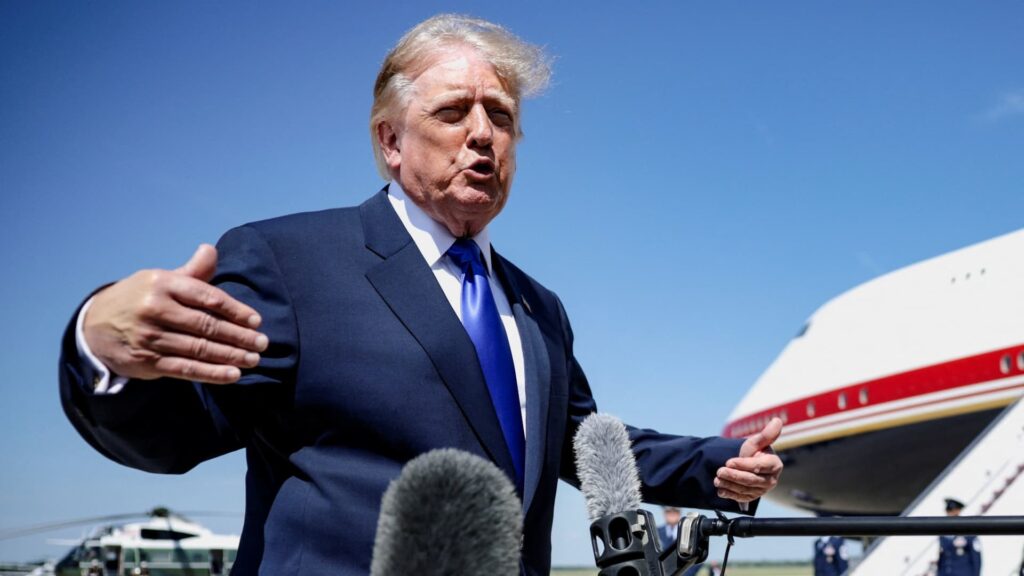
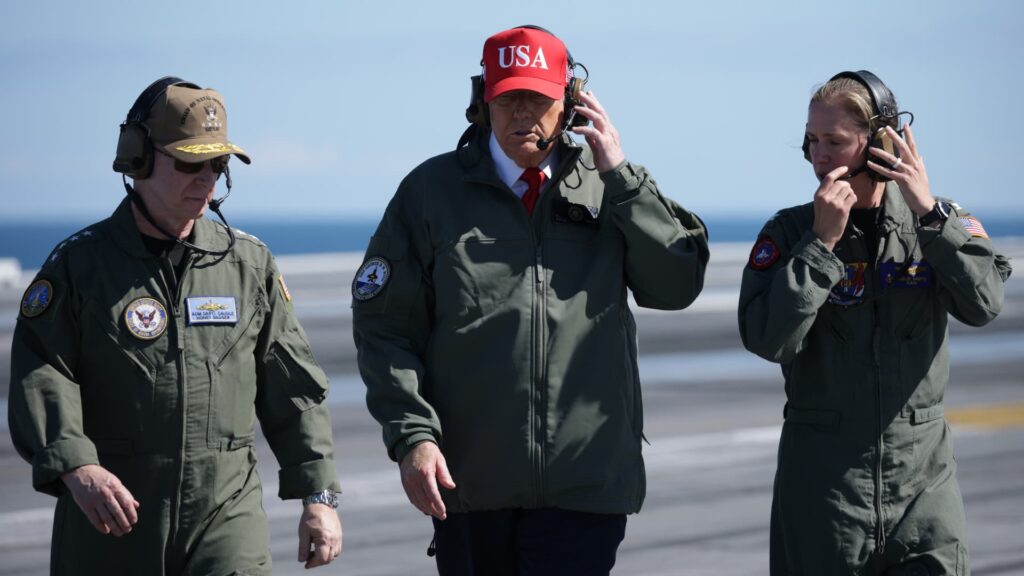
U.S. President Donald Trump observes naval flight demonstrations on the deck of the USS George H.W. Bush aircraft carrier on October 5, 2025.
Alex Wong | Getty Images News | Getty Images
President Donald Trump said Wednesday that U.S. military forces will remain deployed in and around Iran until Tehran fully complies with the “real agreement,” warning that any breach would trigger a military response larger than anything seen before.
“All US ships, aircraft, and military personnel…will remain in place in, and around, Iran, until such time as the REAL AGREEMENT reached is fully complied with,” Trump wrote on Truth Social.
“If for any reason it is not…the ‘Shootin’ Starts,’ bigger, and better, and stronger than anyone has ever seen before.”
Trump reiterated that it was agreed that Iran will not develop nuclear weapons, and the Strait of Hormuz will be open and safe for commercial shipping.
“In the meantime our great Military is Loading Up and Resting, looking forward, actually, to its next Conquest,” Trump added. He ended the post, which was published near midnight, with a declaration: “AMERICA IS BACK!”
The statement came a day after Washington and Tehran agreed to a two-week ceasefire brokered by Pakistan, which halted six weeks of fighting and sparked a brief relief rally in global markets amid growing optimism that energy flows may resume in the Strait of Hormuz.
Iran said safe passage through the strait would be possible but subject to coordination with its armed forces.
Read more U.S.-Iran war news
- Vance expects U.S. negotiations with Iran on war will be ‘positive’
- White House warned staff against making Iran war bets on prediction markets
- Trump says Iran ‘better stop’ if it’s charging oil tankers to transit Hormuz strait
- Hormuz strait oil traffic way down after ceasefire; Hassett says even one tanker is big
- Iran war has been an enormous financial windfall for Russia: former IEA oil head
- NATO’s Rutte told allies Trump wants Hormuz commitments within days, diplomats say
- Britain to call for toll-free Strait of Hormuz, Lebanon to be part of ceasefire
- Rep. Ritchie Torres calls for probe into trades ahead of March pause in Iran strike
- Trump Iran ceasefire updates: Strait of Hormuz toll confusion remains
- U.S. has violated ceasefire agreement, Iran parliamentary speaker says
- Trump threatens tariffs of 50% on nations supplying weapons to Iran
- Spanish PM says fire starters don’t deserve applause as he welcomes Iran ceasefire
- Trump, Iran agree to two-week ceasefire, plan to open Strait of Hormuz
- Trump faces calls for removal over threats to wipe out ‘whole civilization’ in Iran
- Pakistan seeks 2-week pause after Trump warns ‘whole civilization will die’ if no deal
- U.S.-Iran war ‘tax’ begins to hit American businesses and consumers
- India makes first Iranian oil purchase in seven years
- U.S. fighter jet shot down in Iran, one crew member rescued: MS NOW
- Defense startups eye Iran war windfall as U.S., Gulf states turn to tech
- Trump threatens to destroy Iranian infrastructure
- Trump speech paints grim picture for oil — over 600M barrels at risk
- Army chief of staff fired by Hegseth, sources say
- Iran and Oman drafting protocol to ‘monitor’ Hormuz Strait traffic: IRNA
- Iran demands guaranteed ceasefire to end war permanently: Reuters
- Analysis: Trump’s Iran speech ignores the risks of a return to the 1970s
- Iran’s war propaganda homes in on Trump with Lego memes
- Trump Iran speech: War is nearly over, vows ‘extremely hard’ hits coming
- Trump says Iran wants ceasefire, U.S. wants Hormuz Strait open first
- More from CNBC Politics
But much remained unclear in the ceasefire agreement, with the U.S. and Iran appearing far apart in demands. Tehran had rejected the 15-point proposal from Washington and reportedly presented a 10-point plan of its own to end the conflict, including a halt to Israeli strikes against Hezbollah in Lebanon and the lifting of all sanctions.
In a separate social media post earlier Wednesday, Trump described the 10-point plan reported by The New York Times and CNN as “totally fake.”
Israel supported Trump’s decision to suspend strikes against Iran but insisted that the ceasefire doesn’t extend to Lebanon, unleashing its harshest offensives on the country since the war broke out in February, killing at least 182 people on Wednesday.
The deadly attacks prompted a threat from Iran, which suggested that it would be “unreasonable” to proceed with talks to seek a permanent peace deal with the U.S., underscoring the fragility of the ceasefire. The U.S. and Iran are expected to meet for a round of negotiations in Islamabad on Friday.
Oil prices resumed their climb on Thursday as continued hostilities in the region hampered hopes for a swift ending to the war. International benchmark Brent crude futures for June delivery rose 2.46% to $97.08, while U.S. West Texas Intermediate crude futures for May climbed 3.4% to $97.55.
In an interview with CNBC on Wednesday, Amer Bisat, Lebanese minister of economy, said the country was “forced into this war” by external parties and reiterated its demand for a “sovereign-led ceasefire” and a negotiated settlement to the crisis.
“We are paying a devastating price for this war, war that was imposed on us,” Bisat added.