
China and the U.S. may be competing for dominance in artificial intelligence, but some Chinese manufacturers are eyeing the U.S. data center buildout as an opportunity.
“We can see very big potential in the U.S. market,” said S.K. Lee, a global vice president with Singapore-registered Brightray, an AI infrastructure company. “The China market is equally important, but we can see that there’s a stronger demand in the U.S.”
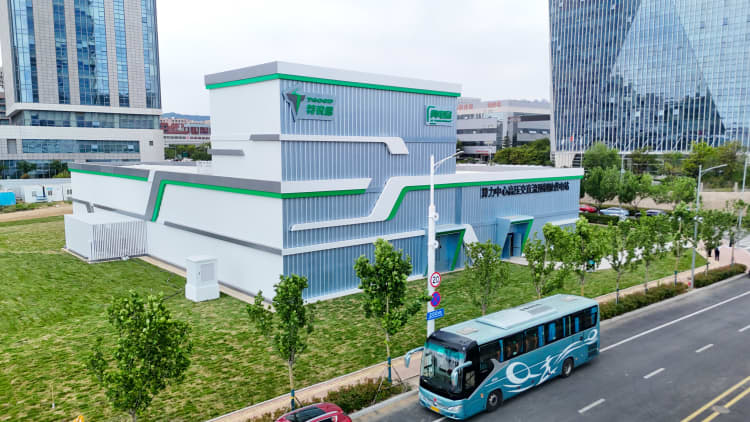
Brightray’s sole manufacturer is Chinese firm PrefabDC, which makes prefabricated data centers. Brightray manages the construction of the buildouts.
Even with public backlash over the AI data center buildout growing, the U.S. boasts more AI data centers than any other country, with 5,427 in 2025, according to data published by the Stanford Institute for Human-Centered Artificial Intelligence. China had 449, according to the same report.
U.S. tech giants like Alphabet, Microsoft, Meta and Amazon are estimated to spend around $765 billion combined this year on AI infrastructure. JPMorgan Chase CEO Jamie Dimon recently said that figure could hit $1 trillion next year.
Chinese companies like Alibaba have committed far less. But the Chinese government has outlined plans to invest $295 billion to build data centers over the next five years, though it’s still a far cry from U.S. private-sector investment.
“Chinese companies just are not generating as much revenues from their AI services,” said Jeffrey Ding, AI expert and assistant professor at The George Washington University. “And that’s one of the reasons why they’re not able to invest in these enormous data center buildouts that their competitors in the U.S. are doing.”
Ding said the deeper issue is “there is not as much demand for the AI services.”
China’s President Xi Jinping and U.S. President Donald Trump arrive for a military review in the Rose Garden of the White House in Washington, Sept. 24, 2026.
Saul Loeb | Afp | Getty Images
Chinese President Xi Jinping’s visit to Washington has brought renewed focus on the China-U.S. trade dynamic, and AI was a prominent part of talks between Xi and President Donald Trump.
But the relationship between the rivals remains fraught.
American policymakers and the security establishment fear cybersecurity risks and worry the U.S. could become reliant on China for critical infrastructure, potentially giving leverage to its main AI competitor. The Trump administration is considering bans on Chinese open-weight AI models as well as new types of Chinese data center components.
“It is a very challenging environment between the geopolitics recently between the tariffs we’ve been seeing and the recent bans,” said Benjamin Boucher, principal analyst on supply chains for Wood Mackenzie. “I think it is just going to depend on what we see at a political level over the coming years in terms of how it evolves.”
Boucher explained that the U.S., which is facing shortages in key components such as electrical equipment, doesn’t have a lot of what it needs domestically. And while the U.S. has some components, there are long lead times, and China “can offer those at a much more favorable timing.”
“China is definitely very important towards the U.S. supply chain for data centers at the moment,” Boucher said.
China, the world’s largest manufacturer, is already deep in the U.S. supply chain and has been for years. Chinese companies supply transformers, batteries and fiber-optic cables, among other products.
At a factory in the eastern Chinese trading city of Yangzhou, Brightray’s Lee explained how it benefits from China’s extensive supply chain.
“These materials, equipment are sourced from different parts of the world and a very big portion come from China because China’s supply chain is very integrated and comprehensive. That’s the reason why we have the factory here in China,” Lee said.
Prefabricated construction is used in the U.S., but mainly for the modules inside a building rather than modules that include the exterior of the building, as Brightray says it does. The method allows a company to build most of the data center inside a controlled environment to protect against weather and unexpected events at a site.
In the U.S., data centers take on average about two to three years to build, industry analysts told CNBC. Brightray said its prefabricated data centers with PrefabDC can cut construction time by at least half.