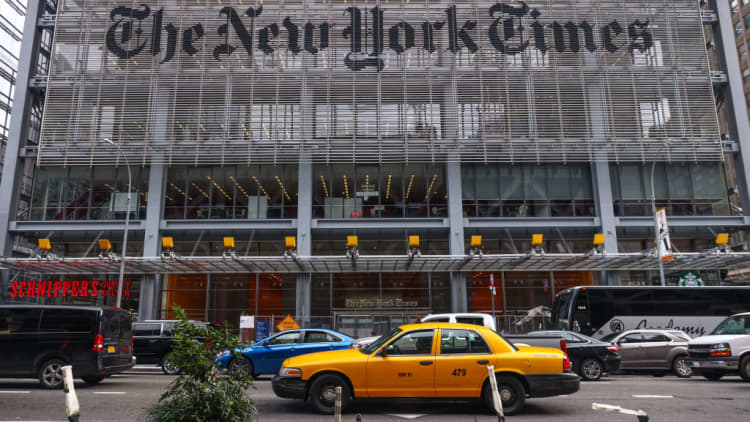

While President Donald Trump‘s war with the networks dominates the headlines, a far more consequential fight is unfolding in a Lower Manhattan courthouse. At stake? The economics of journalism itself, and the war is sparking options traders’ interest.
On Friday, newly unsealed statements from Microsoft and OpenAI executives threatened the “fair-use” defense in the New York Times lawsuit. The defense rests on showing that the accused product is neither a substitute for nor a direct competitor to the source work.
According to the unsealed material, an OpenAI executive allegedly acknowledged their chatbots were exactly that: an “existential threat” to journalism, delivering the information directly and sparing the reader the click-through, per the Wall Street Journal.
OpenAI allegedly copied millions of copyrighted articles for training, possibly exploiting hacks to retrieve them, and Microsoft’s own director of applied science, Brent Hecht, reportedly described the training as “the largest theft of labor in human history,” according to the Washington Post, while the companies’ own data showed Times’ click-through rates dropping precipitously.
OpenAI co-founder Greg Brockman, meanwhile, reportedly wrote in 2017 that he was “deeply motivated by the gazillions” he hoped to earn commercializing the technology, according to the Financial Times, and allegedly replied “ah nice” when told an employee had found a hack around the Times’ paywall.
These findings meaningfully raise the odds of either a massive settlement and licensing deal or, failing that, a Times victory at trial that would be catastrophic for the defendants and enormously remunerative for the plaintiff.
The one wrinkle for the Times was the September 1st statement of interest from the Department of Justice asking the court to hold that training AI models on copyrighted work is fair use, citing national security. If foreign adversaries will train on anything they can access by any means, the argument goes, restricting U.S. systems risks ceding an insurmountable lead.
Given the enormity of what’s at stake, you would think this would garner more investor attention, but New York Times shares have been flat year-to-date and barely moved on Friday.

The New York Times Company, YTD
But options activity has heated up. The meat of the flow was a purchase of roughly 4,400 October 72.5/77.5 call spreads for a $0.925 debit — risking just 1.3% of Friday’s close to win at least 4.6% by October expiration, and potentially 10% or more on a move to the $77.73 average analyst target. Concurrent volume in the October 62.5 and 65 puts suggests the trader may have trimmed the outlay further by selling downside puts, just below the August lows.
The October expiration implies an expectation that a summary judgment ruling, or a settlement, could potentially land within weeks, a likelihood the unsealed emails just increased.
But if the risk is a negative surprise driving new lows, and the near-term target coincides with the analyst consensus anyway, why not go in the money as a stock substitute with a defined risk and reward and lower capital use rather than trying to establish whether options premia are too hot, too cold, or “just right.” A 65/77.5 call spread offers more than $7 of upside against just over $5 of downside, with a de minimis outlay of extrinsic premium.
Put differently: less capital, defined risk, asymmetric payout.
Disclosures: Tidal owns/holds all the securities mentioned in the article.
All opinions expressed by CNBC Pro contributors are solely their opinions and do not reflect the opinions of CNBC, or its parent company or affiliates, and may have been previously disseminated by them on television, radio, internet or another medium. This content is provided as part of our editorial output for informational purposes only and does not constitute financial, investment, tax or legal advice or a recommendation to buy any security or other financial asset. The content is general in nature and does not reflect any individual’s unique personal circumstances. The above content might not be suitable for your particular circumstances. Before making any financial decisions, you should strongly consider seeking advice from your own financial or investment advisor.
THIS CONTENT IS PROVIDED FOR INFORMATIONAL PURPOSES ONLY AND DOES NOT CONSTITUTE FINANCIAL, INVESTMENT, TAX OR LEGAL ADVICE OR A RECOMMENDATION TO BUY ANY SECURITY OR OTHER FINANCIAL ASSET. THE CONTENT IS GENERAL IN NATURE AND DOES NOT REFLECT ANY INDIVIDUAL’S UNIQUE PERSONAL CIRCUMSTANCES. THE ABOVE CONTENT MIGHT NOT BE SUITABLE FOR YOUR PARTICULAR CIRCUMSTANCES. BEFORE MAKING ANY FINANCIAL DECISIONS, YOU SHOULD STRONGLY CONSIDER SEEKING ADVICE FROM YOUR OWN FINANCIAL OR INVESTMENT ADVISOR.
Click here for the full disclaimer.