Construction workers build a new data center in Stone Ridge, Virginia on August 12, 2026.
Brendan Smialowski | Afp | Getty Images
The AI data center buildout is expected to support employment and future job creation, but these facilities may create far fewer permanent roles than the industry suggests, according to data from an economic think tank.
The U.K. government and industry leaders have greenlit the construction of new data centers using widely cited figures from tech trade association techUK, Verdant said Wednesday. It added that those figures overstate the number of new, permanent jobs these sites will actually create.
Verdant, which advocated for tighter controls on data center development, estimates that existing U.K. data centers support about 4,400 direct jobs, compared with techUK’s estimate of 24,300. For planned developments, Verdant projects about 10,400 permanent operational jobs by 2035 — roughly a quarter of techUK’s forecast of 40,200 roles.
TechUK’s estimate is based on assumed staffing and capacity at a typical data center, producing a figure of 8.5 jobs per megawatt. Verdant said this estimate is too high because it is based on older, smaller data centers that need more staff.
It instead determined that the capacity-weighted average is closer to 1.2 operational jobs per megawatt. The think tank said it came to that calculation after examining 20 planned U.K. data centers, using planning applications and public staffing figures.
Newer, larger sites will be more automated and need fewer permanent workers, according to Verdant. It also said techUK’s wider estimate includes jobs outside the sites, such as contractors and supply-chain workers.
It also said that data centers create fewer jobs per unit of electricity than other major U.K. installations such as steelworks, car plants, hospitals, or schools, with some creating hundreds or thousands more jobs per megawatt.
In comments shared with CNBC, techUK said its estimates were based on published methodology using industry data and standard economic impact assessment techniques.

“The figures were built transparently from the best available industry data at the time, and we are confident they remain a reasonable estimate of the sector’s employment contribution,” techUK said.
“Verdant offers its own employment estimate using an unreliably small sample size. Furthermore, the report reduces the economic value of the sector to only the number of people physically working inside data centres, not the countless jobs that are supported by data centres and the services they provide,” techUK added.
A spokesperson for the U.K. government disputed Verdant’s claims. “This report relies on a deeply misleading jobs-per-megawatt metric, makes false comparisons with hospitals and schools, and appears to confuse electricity capacity with actual consumption,” the spokesperson said.
“More seriously, it discounts the wider economic value of compute and the national security and sovereignty case for building critical digital infrastructure in Britain,” they added.
AI boom
The U.K. government has made expanding AI infrastructure a policy priority. It has said that data centers are “critical to nearly all economic activity and public services.” It designated them as critical national infrastructure in 2024 in a bid to recognize their importance and vulnerability to cyberattacks.
U.K. AI Minister Kanishka Narayan said in June that future sites need to be more attractive and better integrated into local communities.
This comes amid a backdrop of big tech companies investing billions into developing specialized AI data centers, with Alphabet, Microsoft, Meta, and Amazon having committed nearly $700 billion in combined spend on the buildout this year.
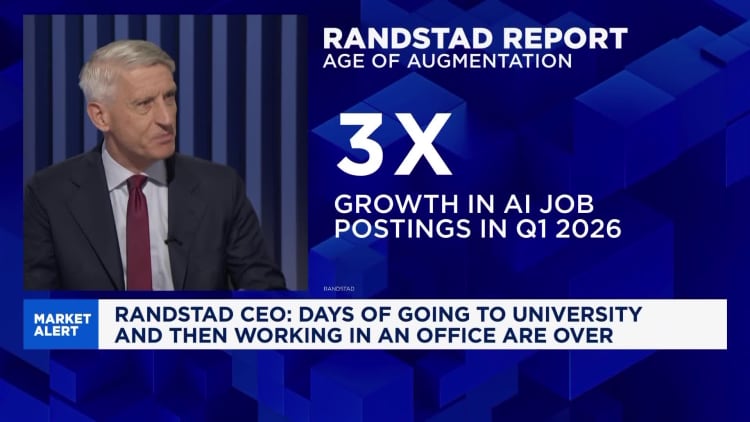
The data center boom has resulted in growing interest around the skilled trade career path, with Randstad‘s CEO Sander van’t Noordende telling CNBC in March that the days of going to college are “over,” and advising young people that trade work offers a good career trajectory.
A Randstad analysis of 50 million job postings found that demand for skilled trade jobs inside data centers, such as robotic technicians, increased 107% between 2022 and 2026. Meanwhile, vacancies for cooling or HVAC system engineers grew by 67%, and by 51% for industrial automation technicians.