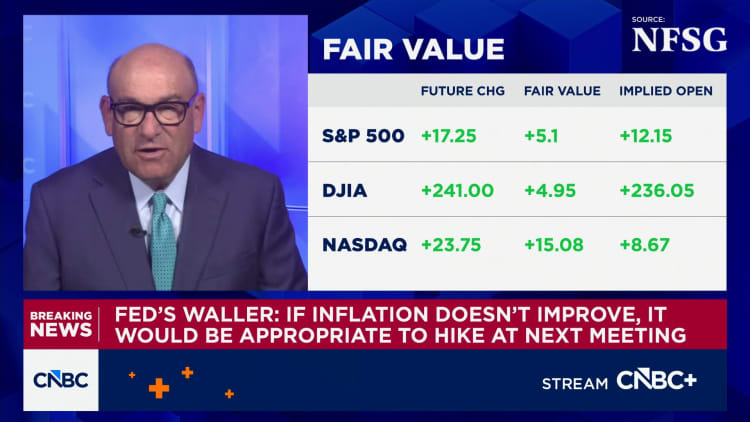

Federal Reserve Governor Christopher Waller said Thursday he is leaning toward keeping interest rates steady at the central bank’s September meeting provided there are no surprises from upcoming inflation data.
In remarks that seem to contrast with statements last week from Chairman Kevin Warsh, Waller expressed confidence in the current inflation trends, saying that tariff impacts likely have been muted and higher energy prices haven’t had a substantial impact in other parts of the economy.
While he conceded that inflation is “meaningfully above” the Fed’s 2% target, he noted that recent trends “suggest we are finally seeing some signs of disinflation.”
“If this continues in the data due over the next two weeks, I would be inclined to support holding the target for the federal funds rate at its current setting,” Waller said in remarks for a Reuters interview.
Market-implied odds for a rate hike at the Sept. 15-16 meeting dropped sharply following the remarks, with traders now pricing in just a 48.4% probability, down about 15 percentage points from Wednesday, according to the CME Group’s FedWatch.
“I’m going to paraphrase John Lennon here: Give disinflation a chance. We can wait one meeting,” Waller said. “What’s the cost of waiting one meeting? Hiking 25 basis points, one meeting right now, is not going to bring the CPI down to 2%.”
The policymaker did add caveats, noting that if there are any indications between now and the meeting, he could change course.
“I judge that policy is currently only slightly restricting aggregate demand, and it may not take much acceleration in inflation to nudge me into supporting tighter policy,” Waller said. “If there is evidence that progress toward 2% inflation reversed in August, a small adjustment in our stance would help ensure that it resumes.”
The only major inflation reports the Fed will get are the consumer and producer price indexes that the Bureau of Labor Statistics will release next week. Those two reports feed heavily into the Commerce Department’s personal consumption expenditures price index that the Fed uses as its main inflation barometer.
The remarks come less than a week after Warsh said, during a speech at the Fed’s annual symposium in Jackson Hole, Wyo., that recent softer monthly inflation readings “do not tell me that underlying trends have meaningfully improved.” If trends don’t cooperate, “we have work to do,” he added.
While the statements differed little from the chairman’s prior statements on inflation, markets took them as hawkish on rates and quickly priced in a strong possibility for a hike at the upcoming meeting.
Waller, though, offered a different take.
Though headline inflation was at 3.7% and core at 3.3% for July, he said the underlying trends are actually “better than the core numbers suggest” and the annual numbers “are not the best guide for where inflation is today.” He noted that the three-month inflation rate as measured by the Fed’s preferred gauge has slipped from 4.76% in February to 3.05% currently.
“That is a considerable improvement, and the speed of this downward trajectory is encouraging,” he said.
Waller said certain “nonmarket services prices” that are estimated rather than observed could be pushing the inflation numbers higher. Moreover, revisions to the way the Bureau of Economic Analysis computes the personal consumption expenditures price index are expected to take inflation readings issued earlier this year lower.