

Has the Donald Trump administration effectively killed the H-1B visa dream? Frequent policy changes, increasing restrictions and selective picking – the H-1B visa path for Indian professionals is becoming tougher to navigate – with unpredictability serving as the biggest obstruction.H-1B visas have long been the main road for Indian professionals who are seeking employment, long-term career opportunities, and eventually even the green card in the US. But over the past two years, several changes in the H-1B visa application and selection criterion have added a huge layer of uncertainty.Which is not to say that Indians still don’t make up the biggest chunk of individuals being granted the H-B visas. This is particularly true for engineering, technology, financial services, healthcare, and research-driven industries.Also Read | Indian IT sector job market is changing: What can get you hired & at a premiumBut, Indian professionals who are evaluating career prospects in the US must understand not only the immediate regulatory changes, but also the longer-term implications for career mobility, employer sponsorship and immigration planning. The H-1B visa route is becoming more selective, compliance-intensive, and less forgiving. Here’s what you should know:
H-1B visa changes : What you should know
Higher H-1B application fee (under litigation as of now), a new selection process, new rules for the 60-day grace period – the process has seen several changes recently.
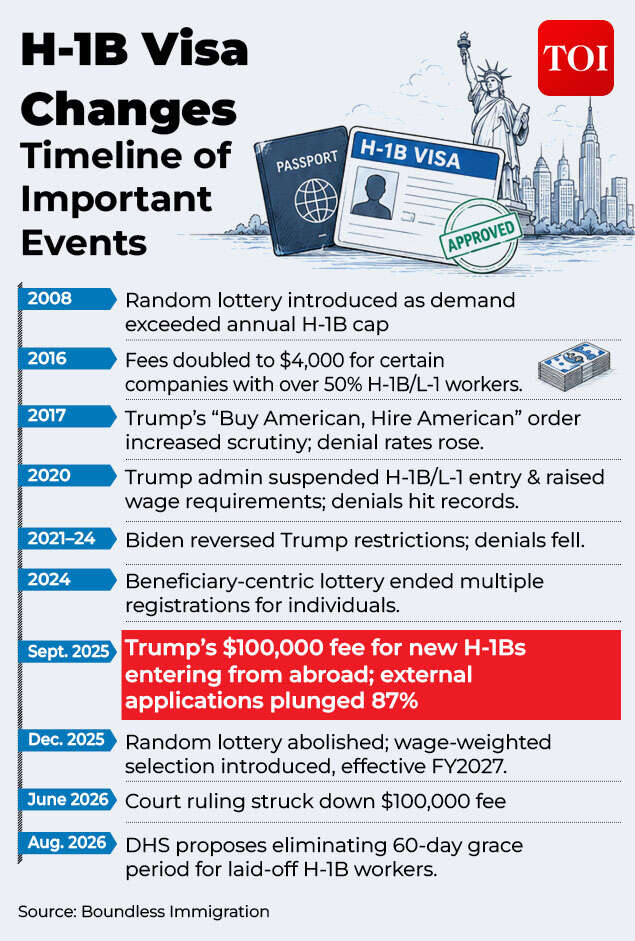
H-1B Visa Changes: Timeline of Important Events
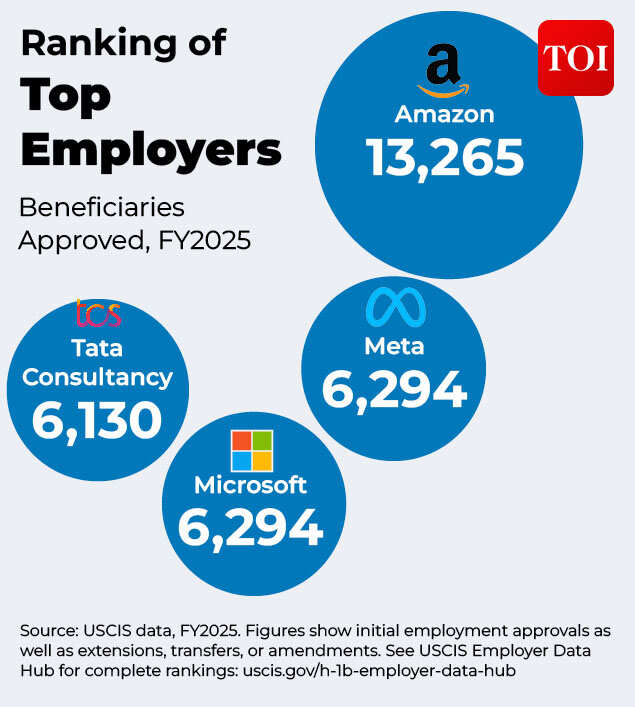
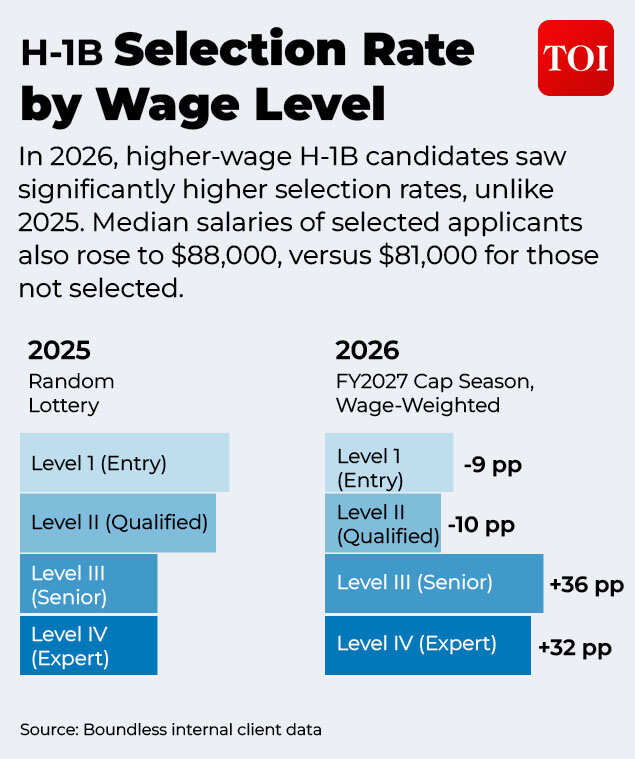
Xiao Wang, CEO of Boundless Immigration points out the three things that have changed in the last year, and how they are compounding the uncertainty:First, the $100,000 fee. Boundless’ CEO is of the view that the fee has dissuaded external applications from India in the first cap season under it, and that India-based IT consulting firms have absorbed the biggest hit, since their model depends on sending people to the US from India.“The National Foundation for American Policy documented the shift on the employer side: the top four H-1B employers in FY2025 are Amazon, Meta, Microsoft, and Google, not the Indian IT firms that historically held those slots,” Xiao Wang tells TOI.The fee has recently been struck down by a US court, but is likely to be appealed by the Trump administration.Second, the wage-weighted lottery. USCIS ran the March 2026 cap season under new rules that favor higher-paid workers. “In our Boundless client data, Level III (senior) candidates were selected at 68%, and Level I (entry level) candidates at 40%. For Indian professionals coming out of US master’s programs into their first job, that gap matters,” he says.
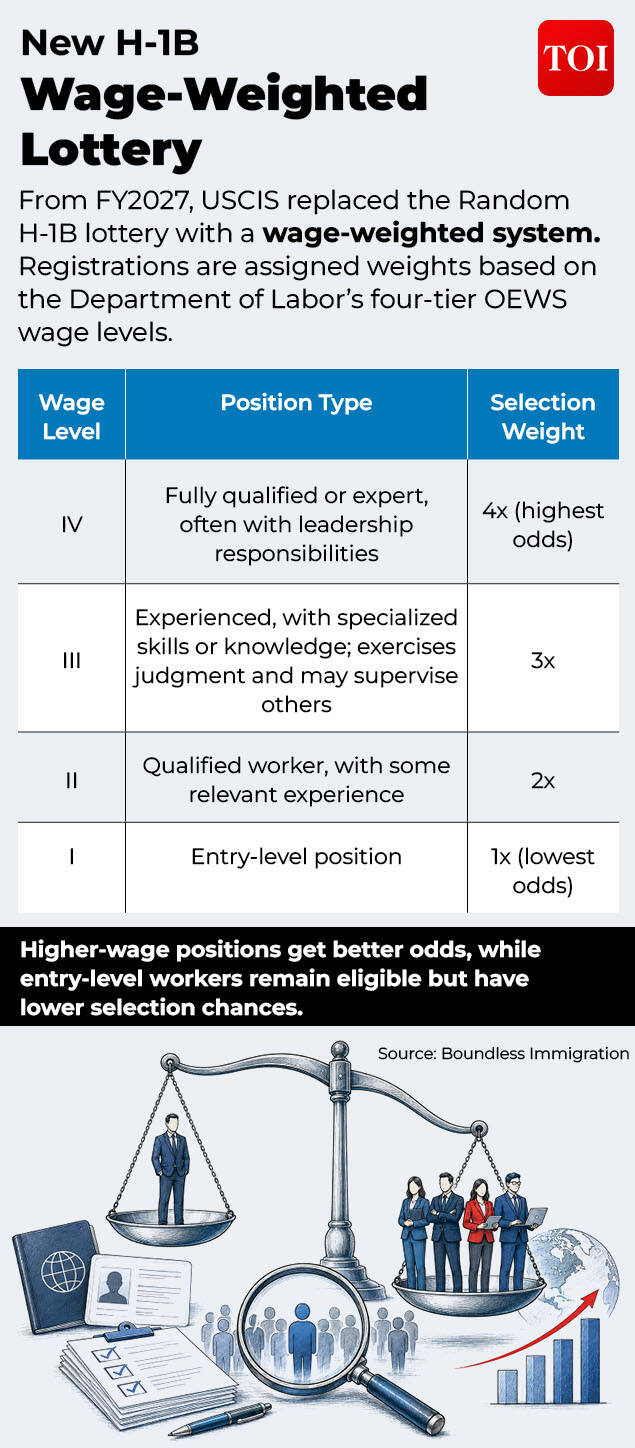
New H-1B wage-weighted lottery
Third, the sharp drop in EB-1A approvals. The USCIS I-140 report for Q2 FY2026 (Jan-Mar 2026) puts the EB-1A approval rate at 41.7%, down from 66.9% for FY2025 as a whole.In the same USCIS I-140 country data, Indian nationals filed 1,761 of the 6,647 EB-1A receipts worldwide in Q2 FY2026, 26.5% of the total.“Our read is that the drop in approvals lands disproportionately on Indian applicants because they are the single largest filer population in the category,” he says.So what does all of this mean for your H-1B prospects?According to K Edward Raleigh, Partner at Fragomen, a global immigration law firm, the new selection system gives greater weight to higher-paid and higher-skilled positions rather than relying on a purely random selection process.“That potentially creates advantages for some highly skilled professionals while making the process more challenging for others,” he tells TOI.
What about existing H-1B holders facing layoffs?
Once you have received an H-1B visa, the road is somewhat smoother. Experts say renewing the H-1B is still a routine process.According to Boundless, the NFAP November 2025 report puts the continuing employment denial rate at 1.9% for FY2025, which is essentially unchanged from 1.8% in FY2024.
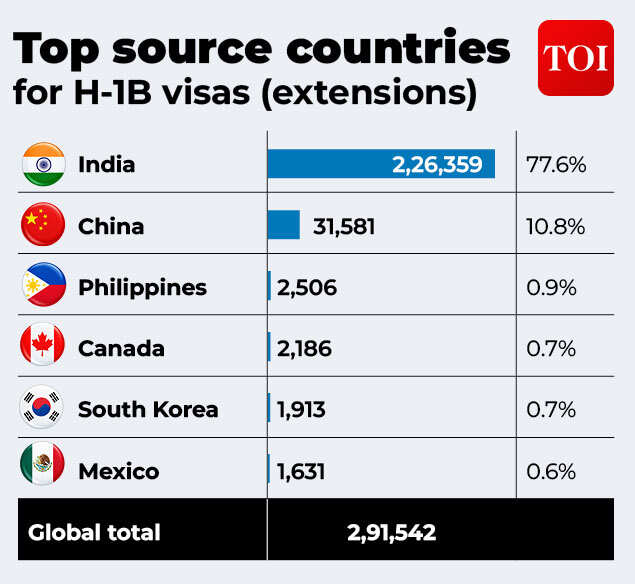
Top source countries for H-1B visas
But, there are risks associated with layoffs, which then initiates the 60-day grace period for visa holders to find an alternative job.“An H-1B worker who does not line up a new sponsoring employer or change status within 60 days falls out of status,” notes Xiao Wang, adding that two protections that used to make that window survivable are now weaker.
- USCIS archived the guidance that let terminated workers use B-2 for job search, and immigration attorneys are steering clients away from using B-2 as a bridge as a result.
- The May 2026 USCIS Adjustment of Status memo now treats in-country green card adjustment as extraordinary discretionary relief. Footnote 20 of the memo says holding H-1B status alone is not sufficient to justify adjustment.
There is also an added factor: The cost of keeping an existing H-1B worker could become more expensive. The Trump administration is considering extending the additional $4,000 H-1B fee and $4,500 L-1 fee to extensions for certain large employers.The proposal would particularly affect companies heavily dependent on foreign workers. About 71% of H-1B approvals in FY2025 were for continuing employment, and Indians accounted for nearly 78% of H-1B extensions.Meanwhile, the Department of Homeland Security is advancing a proposal to eliminate the 60-day grace period that currently allows H-1B workers who lose their jobs to find another sponsor, change status or prepare to leave.The proposal is not yet law, but if implemented, losing a job would create a much tighter immigration deadline and increase workers’ dependence on their sponsoring employer.Why the 60-day grace period changes are worrying is because of the labour market.“It’s a labor market affected by layoffs and AI-driven restructuring. An H-1B employee faces both the ordinary consequences of losing a job and an immigration consequence,” says K Edward Raleigh of Fragomen.“How difficult it is to find another sponsor within the available period depends heavily on the individual’s skills, seniority, industry and the willingness of prospective employers to undertake sponsorship,” he tells TOI, adding that employers continue to compete for exceptional talent, particularly in areas such as AI and machine learning.Also Read | Harsh reality for H-1B visa returnees: Changed Indian IT hiring landscape, lower salaries and fewer jobsBut even as Boundless’ Xiao Wang acknowledges the vulnerability, he tells TOI that the labour market picture is more mixed than the layoff headlines.“The US Bureau of Labor Statistics (BLS) unemployment rate for computer and mathematical occupations was 3.0% in August 2025, down from 3.4% a year earlier. USCIS approved 68,167 H-1B transfers in FY2025, and roughly 37% of H-1B workers who started at a new employer that year moved through the transfer route rather than through a new cap petition,” he explains.“We’re hearing more mid-career Indian H-1B workers ask about self-petition options (O-1, EB-2 NIW, EB-1A) as insurance policies before they need them,” he says.According to Boundless’ CEO, for an Indian applicant, the deeper issue is the green card queue.“USCIS I-140 data puts India’s EB-2 pending inventory at 351,142 petitions and EB-3 pending at 105,588. Cato Institute analysis by David Bier projects the EB-2 India wait for a new filing today at multiple decades under current visa issuance rates. Indian H-1B holders are therefore usually stuck on H-1B for many years, and losing a job during that window is a sharper cliff than for most other nationalities,” he cautions.
H-1B: Ranking of Top Employers
Demand stays strong, but alternative destinations in focus
Even as uncertainties mount, applications are still outpacing the allowed slots. Registrations still exceed slots by roughly five to one, says Xiao Wang. In the last posted H-1B registration cycle, USCIS had about 442,000 unique beneficiaries chasing 85,000 slots.Demand for the visa is not the constraint. What’s changing is where the next generation of Indian technologists choose to build a career.Britta Glennon’s Wharton research, cited in the NFAP report, finds that when US firms lose H-1B access they set up foreign affiliates and hire there at close to a one-for-one rate.“So global demand for the workers is not the constraint. Our read is that what has shifted is where the marginal Indian technologist bets, with Canada, the UK, Australia, and Germany picking up more of the flow,” Xiao Wang tells TOI.On the employer side, NFAP reports that the top seven India-based IT companies received 4,573 initial H-1B approvals in FY2025, a 37% drop from FY2024 and a 70% drop from FY2015. US tech companies now hold the top four employer slots for new H-1B approvals.
What Indian professionals should consider
So what do all these developments mean for Indian professionals? Experts are unanimous that caution is warranted and the environment continues to be volatile.Boundless Immigration CEO says that for Indian applicants, the H-1B is still a viable entry point, but applicants need to enter with realistic expectations.
H-1B Selection Rate By Wage Level
“H-1B is still a viable pathway if the applicant accepts that it may mean spending many years in temporary status rather than moving quickly to permanent residence,” Wang tells TOI. He shares some interesting data insights: The India numbers, from the USCIS I-140 report through Q2 FY2026
- India EB-2 pending: about 351,000.
- India EB-3 pending: about 105,000.
- India EB-1 filings jumped from 12,006 in FY2024 to 14,248 in FY2025, and denials on those filings ran at 22% (vs. 9% in FY2024). Indians are pouring into EB-1 as EB-2 stalls, and USCIS is denying more of it.
For an early-career Indian engineer today, Canada may offer permanent residence far sooner than the US, he adds.Experts note that specialised skills continue to be in demand, and that would be the way forward as well.Akhil Chandna, Partner and Global People Solutions Leader, Grant Thornton Bharat believes that success in getting H-1B visas and retaining jobs in the US is likely to depend on a combination of specialised skills, career progression, employer sponsorship strategies and proactive immigration planning.“Professionals who remain aligned with high-demand sectors and invest in continuous upskilling are likely to be better positioned for long-term success,” he tells TOI.“Despite increased scrutiny, layoffs, and immigration uncertainty, the H-1B remains one of the most established routes for Indian professionals seeking a long-term career in the US. The US has however become less attractive for early-career professionals. Alternative countries such as Germany, the United Kingdom and Australia remain attractive,” he adds.“Professionals should focus on building differentiated skills, maintaining strong documentation of specialized expertise and evaluating immigration options with broader career goals. Early planning can help manage uncertainty and improve resilience across career transitions,” he recommends.K Edward Raleigh at Fragomen sums it up: The H-1B environment has undoubtedly become more complex and less forgiving in recent years. We are seeing a greater emphasis on immigration compliance and vetting, along with structural changes to the H-1B program.According to Raleigh, for Indian professionals looking at the US over the longer term, the distinction between temporary H-1B status and permanent residence is important.The H-1B can provide a durable means of working in the US, including in certain circumstances through extensions beyond the normal six-year limit while a Green Card case is pending. At the same time, India-born professionals face significant employment-based Green Card backlogs, which can create considerable uncertainty around the timing of permanent residence.“Those realities make long-term immigration planning increasingly important for both employees and employers,” he says.