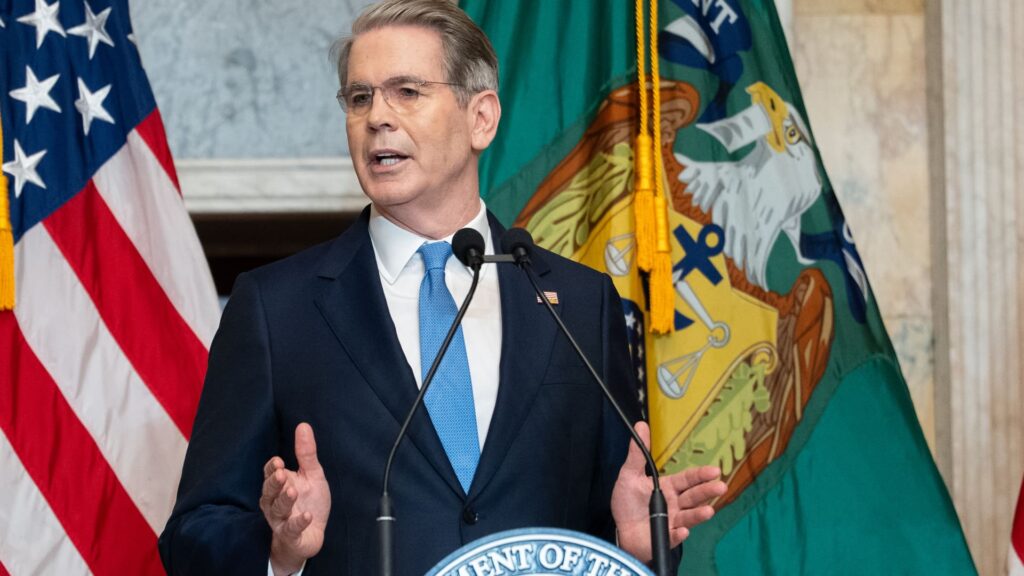
Scott Bessent, US treasury secretary, gives remarks during the launch of the “Fostering the Future Accounts” at the US Treasury Department in Washington, DC, US, on Thursday, June 11, 2026.
Aaron Schwartz | Bloomberg | Getty Images
Treasury Secretary Scott Bessent is in the midst of a historic effort to tamp down long-term Treasury yields. He may also be complicating the work of his counterpart at the Federal Reserve, Chairman Kevin Warsh.
The Treasury Department on Wednesday said it would increase its buybacks of long-term Treasury debt, raising the maximum it will buy from $2 billion to at least $4 billion. The intervention had the effect of stemming a sell-off in the Treasury market that has pushed up yields to uncomfortable levels in recent days. The selloff had dominated global headlines as investors worried that rising Treasury yields would worsen an affordability crisis for consumers, complicate businesses’ borrowing plans, threaten stock-market gains and make it more expensive for the government to finance its burgeoning debt.
While the buybacks aren’t large compared to the total amount of debt outstanding, many in the markets interpreted the Treasury’s new repurchase plan as a potent symbol of a long-standing effort by Bessent to bring down the yield on the 10-year Treasury and other maturities.
But doing so risks accelerating inflation while making the cost of financing the $32.2 trillion in debt held by the public more sensitive to potential interest-rate increases, bond traders and economists said. And it puts pressure on the independent Fed to back administration policies.
Read more CNBC politics and policy coverage
“We’re slowly moving to the point where the logic of populism is going to insist that the central bank support fiscal objectives,” said Joseph Brusuelas, principal and chief economist at RSM US.
President Donald Trump has demanded the Fed cut interest rates to lower the burden of financing the federal debt, while simultaneously adding to the debt. The federal budget deficit is on track to hit $2.1 trillion this year, according to the Congressional Budget Office.
“That will cause market distortions. And the sort of intervention that we saw this morning that will make life more difficult for Kevin Warsh,” Brusuelas said.
Stated purpose: market liquidity
Treasury buybacks are formally aimed at improving market liquidity for some less-traded instruments, in other words, ensuring that there are enough buyers and sellers in a given market to establish reliable prices. In this case, Treasury aimed to take longer-term maturities, of 10 to 30 years, off the market.
Markets have long asked the Treasury to increase its buybacks. Newly issued debt tends to trade with healthy liquidity, but buyers can later become scarce for maturities that are less than the term originally issued. For instance, a 30-year Treasury bond issued in May 2020 — with 24 years left to maturity — traded on Wednesday at roughly 45 cents on the dollar. Removing these so-called off-the-run securities from the market, frees up the balance sheets of institutions to buy the more liquid issues, which could put downward pressure on rates.
The Treasury is not retiring debt, or engaging in a quantitative easing program like the Fed.
“The Fed can print money and buy what they want,” said Brij Khurana, fixed-income portfolio manager at Wellington. “The Treasury doesn’t have that capability. They need to fund the buybacks by issuing more bills,” he said.
But that’s where Bessent’s actions become controversial. Instead of replacing long-term bonds with long-term bonds, Treasury is expected to replace them with short-term bills, manipulating the yield curve.
While that’s the expectations among market participants, the Treasury itself didn’t say in its announcement how it would fund the buybacks. The department didn’t respond to requests for comment.
The announced buybacks quickly reversed the bond selloff. Bond prices move inversely to yields.
Since the outbreak of the Iran war, the 10-year yield has risen by nearly 70 basis points, topping out recently at 4.74% and pushing up 30-year mortgage rates to around 6.75%. The 10-year yield fell as low as 4.63% after news broke of the Treasury buybacks and finished the day at 4.65%.
Bessent criticized Yellen
The buybacks follow two other recent steps that have also effectively stemmed the rise in long-term Treasury yields.
Bessent in July used Treasury funds to support Japan’s troubled currency, the yen, but chose to sell euros rather than dollars in the transaction. He also urged the Fed to expand a facility that would allow Japan to lend rather than sell its Treasury holdings for future interventions.
Then on Aug. 5, The Treasury Department said that it plans to continue with its recent practice of issuing relatively more short-term debt compared to the long-term trend.
That looks to be at odds with what his own Treasury Borrowing Advisory Committee has recommended. T-bills currently make up 22.2% of outstanding Treasury debt, higher than the rough 20% ceiling recommended by the TBAC, an apolitical group of market experts.
Bessent in 2024 criticized his predecessor, Treasury Secretary Janet Yellen, for adopting the same policy of issuing more T-bills. He described that as Yellen putting her thumb on the scale of markets to keep down the costs of overspending. Warsh similarly criticized the Fed for its bond purchases, saying by keeping yields down they opened the door for overspending by Congress and the administration.
TBAC has also cautioned the department not to politicize buybacks. In July 2025, TBAC said buybacks would be helpful if they were aimed at fixing market liquidity issues, but not if they changed the so-called debt profile, or changing the balance of debt between longer and shorter maturities, TBAC said.
“The Committee feels strongly that issuance is the primary tool for managing the debt profile,” its minutes recorded.
How it could backfire
How the Treasury manages the profile of the vast pool of Treasury debt can have significant consequences for taxpayers. The federal government has made $963 billion in net interest payments in the first 10 months of fiscal year 2026, according to the Congressional Budget Office. Debt payments account for about 15% of fiscal spending.
When the federal debt is tipped more toward shorter maturities, those payments become more sensitive to rises and falls in interest rates. If the Fed chooses to raise interest rates, it would rapidly increase the government’s interest expenses. Bessent’s decision to issue more short-term debt could backfire.
Also, keeping down long-term rates could boost economic activity and the threat of inflation. “You’re increasing the risk that inflation is sticky, and the Fed needs to keep rates higher,” said Khurana.
Bessent’s buyback prompted the dollar to fall by nearly 0.8% Wednesday against a basket of other currencies. That could increase inflation by making imports more expensive, Khurana said.
At the Fed, Warsh left investors uncertain about his future plans after his most recent press conference, on July 29. He said he was concerned about inflation that had remained above the Fed’s 2% target for more than five years, but didn’t raise interest rates and didn’t clearly articulate what might prompt him to change his mind. He also suggested he believed the market had done his work for him in raising long-term bond yields.
Brusuelas also noted that Warsh wants an unfiltered message from bond prices to help him set policy more closely tied to a market rate. But the moves Bessent to tamp down longer-term yields through his various methods of intervention, threaten to cloud those signals.
Warsh’s remarks accelerated the sell-off of long-term debt.
Warsh will have an opportunity to address these issues at an annual gathering of central banks in Jackson Hole, Wyo., next week.
But he will likely face long-term pressure to align Fed policy with the Treasury, Brusuelas said.
“I think that’s a path that will lead to large policy errors over time,” he said.