Amazon said Wednesday it plans to offer drone deliveries in nearly 500 U.S. cities and towns by the end of the year, a sign of momentum for a project that’s been slow to develop since founder Jeff Bezos first laid out his vision for the service almost 13 years ago.
The planned expansion for Prime Air would represent a sixfold increase from its current footprint, the company said in a blog post.
Amazon’s latest update comes five months after David Carbon, vice president of Prime Air, spoke confidently about the program and laid out ambitious growth plans in an internal all-hands meeting, according to a recording obtained by CNBC.
Carbon projected at the time that Prime Air will make 1 million deliveries this year, and said Amazon has the “highest demand drone delivery service in the industry.” The company said Wednesday it made hundreds of thousands of deliveries so far this year, and makes thousands daily.
Bezos, who stepped down as CEO five years ago, pledged in 2013 to build a network of drones to deliver small packages in 30 minutes or less. Since then, the program has faced regulatory delays and staff cuts, as well as technical challenges and pushback from some communities where it conducted early pilots.
Amazon in 2024 received a critical greenlight from regulators to conduct long-range drone deliveries, and over the past year has expanded beyond initial markets near Dallas and Phoenix to 11 metro areas, with six other locations coming online soon. Residents in some of those markets continue to raise concerns about drone noise and privacy and how those issues could hurt property values.
Amazon is hoping it can transform drone delivery from a futuristic concept to a critical piece of its speedy delivery playbook. After getting shoppers hooked on free two-day delivery, the company has moved to one-day and increasingly same-day deliveries, while testing out ultrafast models in more pockets of the U.S. through Amazon Now. Most Prime Air packages arrive in about 60 minutes, but the company says it has completed some drone deliveries in as little as a few minutes after checkout.
“Customers continue to demand faster delivery times,” Carbon told staffers in March. “Bottom line is we have yet to reach diminishing returns when it comes to how fast we deliver to our customers.”
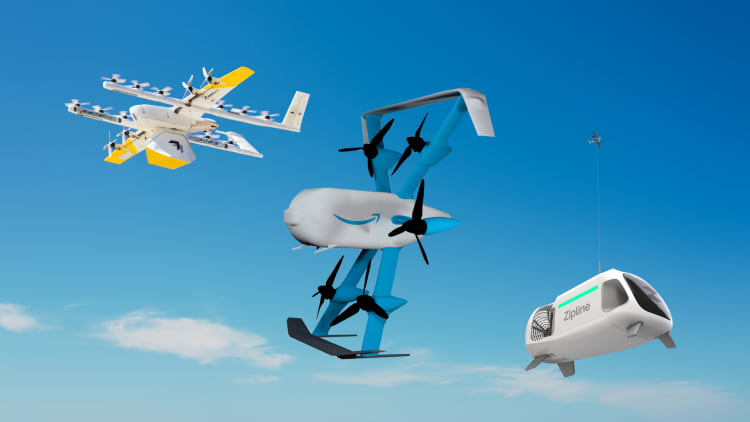
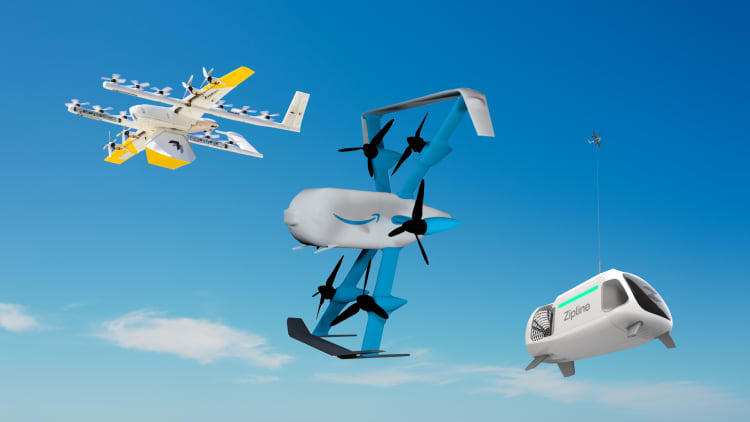
It’s a nascent space, but one where Amazon faces competition. Alphabet‘s Wing crossed 1 million commercial drone deliveries earlier this year, and it operates in 20 U.S. markets through partners like Walmart and DoorDash. Drone delivery startup Zipline operates on four continents and has made 2 million deliveries so far.
‘Gentle delivery option’
Amazon’s drones are capable of delivering packages that are up to 5 pounds and within a 7.5-mile radius of its facilities. The company has recently expanded the number of items eligible for drone delivery by integrating its drone operations into some robotic sort centers, which are larger and store more products than the same-day delivery hubs where drones have historically been housed.
Prime Air is currently testing a new drone delivery mechanism that could enable it to carry a wider assortment of products, like fragile cartons of eggs or other perishables, Carbon said.
It’s trialing a “gentle delivery option” with some customers that uses a retractable tether to lower packages to the ground, Carbon said. The current method involves releasing packages from a 13-foot drop. Wing and Zipline also use tethered delivery.
In the March meeting, Carbon also addressed an incident from October, where two Amazon drones collided with a crane in Tolleson, Arizona.
The crashes prompted an investigation, which remains in progress, from the National Transportation Safety Board, according to the agency’s website, and a probe by the Federal Aviation Administration.
“At the time, we were detecting these cranes above the industry standard,” Carbon said. “We trained our algorithms, we felt pretty good, but we found in the real world the performance just wasn’t good enough and let me tell you, that was a humbling experience.”
The company faces another FAA probe after one of its drones in November snapped an internet cable while ascending from a customer’s yard in Waco, Texas.
Its challenges aren’t limited to the U.S. The UK’s Air Accidents Investigation Branch opened a probe last month after a Prime Air drone crashed into a garden in Darlington, England. The company told the BBC it believed one of its drones came into contact with an object extending above the roof of a moving vehicle.
Amazon, which has been making drone deliveries in Darlington since February, said its drone operated as designed and made a safe landing. No injuries were reported.
WATCH: The rise of Phoenix as a major tech hub with chips, autonomous cars and drones