

NEW DELHI/BANGALORE: Atta, paneer, tea, juices, biscuits, ghee, honey, chocolates, energy drinks — the list of daily consumption items facing regulatory glare is growing, and so is the pressure on consumer goods companies. The scrutiny is not limited to packaged foods only as whisky and other alcoholic beverages too come under the regulatory lens.As food regulator FSSAI steps up action against product claims and labelling, companies are reviewing packaging, rewriting marketing communication and, in some cases, taking legal recourse against the orders. Some such as Dabur and Diageo have challenged the regulator’s action. Much of the regulatory action taken over the last few months is not the result of new regulations but the implementation of standards that were framed years ago. Improved testing infrastructure has strengthened enforcement, with companies increasingly feeling the pinch as regulators monitor compliance more rigorously.“When I joined FSSAI in 2016, only about 10-15% of the regulatory framework was in place. By the time I left four years later, nearly 90% of the regulations were in place. The gap between framing, notification and enforcement takes over a couple of years plus there was disruption caused by the Covid-19 pandemic.“We are now seeing those regulations being implemented as the country’s food regulatory ecosystem evolves,” said former FSSAI chief executive Pawan Agarwal.He said the law has for long contained provisions against misleading claims. “If regulators are questioning terms such as ‘energy’ or claims like ‘100% pure’, it is because they could create an impression that may not be fully substantiated, particularly for children in the case of energy drinks, for example. In a highly competitive market, brands often try to differentiate themselves through strong marketing claims, and that is where regulatory scrutiny is increasing.”The regulatory push is also being reinforced by changing consumer behaviour and a growing social media influence. “Consumers today are reading labels far more closely than they did a few years ago. Social media influencers, nutrition experts and consumer groups are actively scrutinising products and questioning claims. Independent product testing has also become more common. For companies, the consequences go well beyond the regulatory notice,” said an industry veteran.For businesses, the regulatory actions could mean disrupted sales, packaging changes, delayed product launches, reputational damage and, perhaps most significantly, a loss of consumer trust. Meanwhile, court documents show Blinkit told Dabur it would disable listings of affected products, including honey, coconut water, coconut milk and apple cider vinegar. Following the FSSAI directive to Red Bull, Sting Energy and Hell Energy to drop ‘energy’ from their labels, marketing and ads within 90 days, the Rs 13,000 crore beverage category is facing disruption.The issue is not about product safety, but clarity on on-pack labelling which is potentially misleading consumers. For energy drinks, the issue is not caffeine content as 70-80 mg of caffeine per 250 ml–is well within the limits permitted under Indian and international regulations, an industry player pointed out.He said the company is open to strengthening the warnings on cans to make it more explicit that the drinks are not recommended for children, pregnant or lactating women, and individuals sensitive to caffeine, if required by the regulator.Together with stricter action on misleading claims, companies are likely to face increasing pressure to make product labels simpler, more transparent and easier for consumers to understand.And this may just be the start of the journey. “As the regulatory landscape evolves, the industry will continue to adapt. We see this as an opportunity to further strengthen consumer confidence through responsible, fact-based and transparent communication and labelling. Any communication with consumers should be consistent with applicable regulations and supported by evidence,” a Nestlé India spokesperson said.
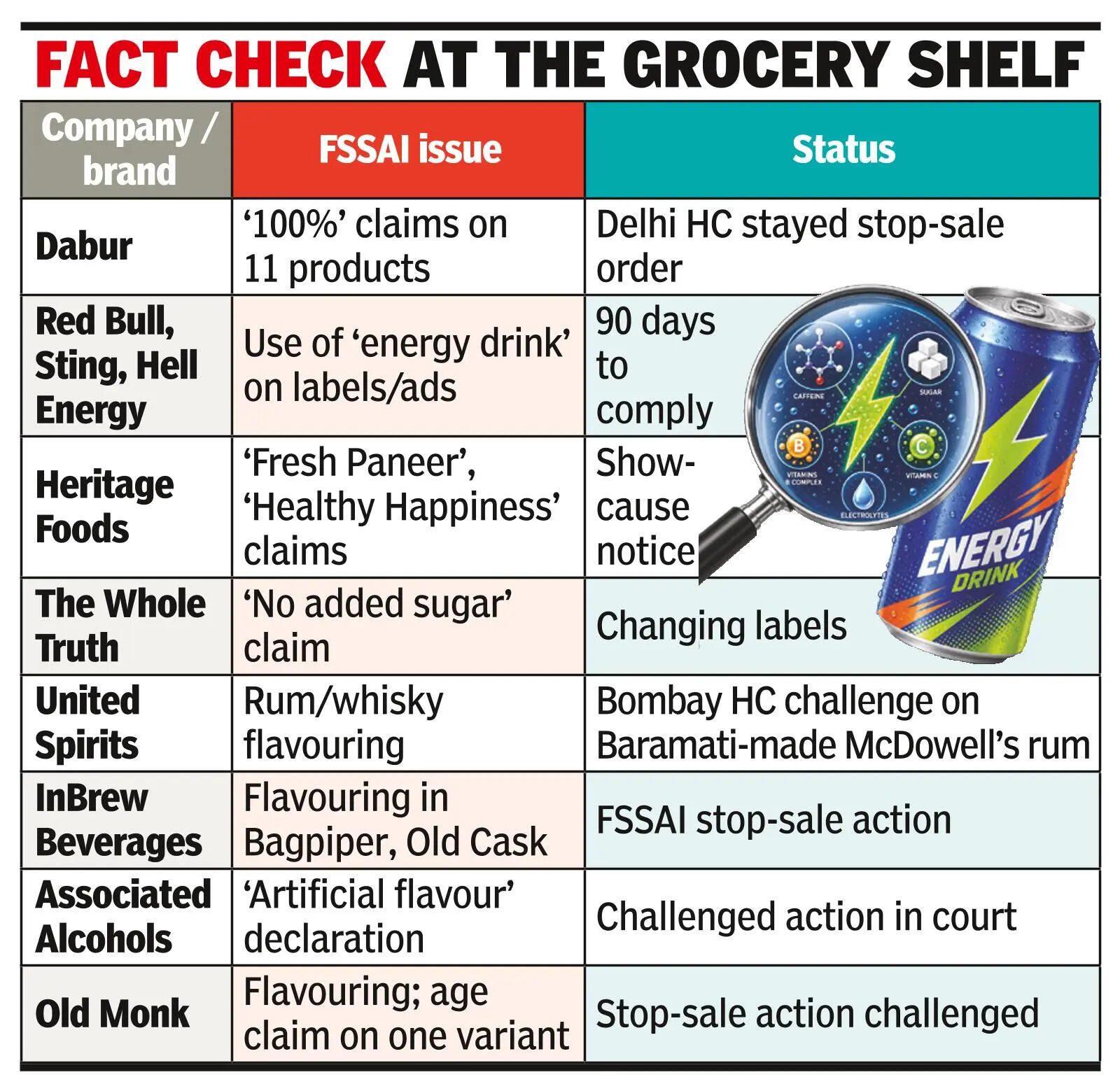
“The bigger issue remains unresolved. India still does not have clearly defined nutrient thresholds for foods high in sugar, salt or saturated fat (HFSS),” said Arun Gupta, paediatrician and convener of Nutrition Advocacy in Public Interest, a national think tank on nutrition.Over the past few years, public health experts, parliamentary committees and the Economic Survey have all argued for stronger front-of-pack information to help consumers make informed food choices. In Feb this year, Supreme Court also recommended the use of front-of-pack warning labels on packaged foods high in sugar, salt or saturated fat (HFSS), observing that such warnings should appear prominently, he added.For the food industry, the immediate question is how far companies will go in changing labels, claims and marketing practices before regulators force their hand.The liquor industry argues that these products have for years been sold under FSSAI licences and state excise label registrations. Its contention is that if the regulator now wants labels or product descriptions to change, companies should first get clear directions and enough time to change packaging and deal with stocks already in the market.InBrew Beverages’ Bagpiper Deluxe Whisky and Old Cask Deluxe XXX Rum, which have also come under FSSAI scrutiny, have maintained that the dispute is about how the regulator is now reading existing rules on flavouring, rather than any newly introduced standard.