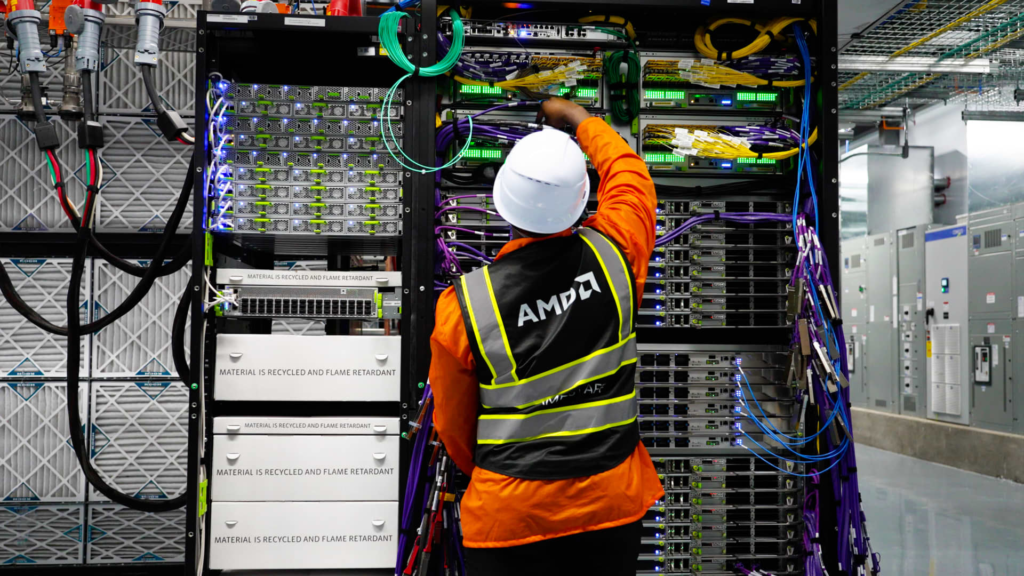
An AMD employee installs a the first Helios rack-scale AI system in a data center lab in Rockdale, Texas, on June 24, 2026. Helios comes in four customizable configurations, and this is the one Meta will deploy later this year.
Andrew Evers | CNBC
Advanced Micro Devices is counting on its graphics processing units to drive the bulk of its data center growth as cloud companies snap up all the advanced AI chips they can find.
But as the generative artificial intelligence boom approaches its fourth anniversary, it’s becoming clear that GPUs don’t do everything.
On Thursday, AMD said it’s entered into an agreement to acquire Taalas, a Toronto-based startup that makes chips for inference. Taalas’ accelerators are customized, or hard-wired for a single AI model, rather than being general purpose.
In exchange for that loss of flexibility, Taalas’ technology promises a less-expensive chip that it says can produce output for specific models thousands of times faster than a traditional GPU. An AMD representative declined to provide a purchase price for the transaction. Taalas has raised a total of $219 million in venture funding since its 2023 founding.
The deal comes a little over seven months after Nvidia spent $20 billion buying assets from Groq, a designer of high-performance AI chips. It was Nvidia’s largest transaction on record.
Taalas’ current chip runs a small version of Meta’s Llama 3.1 model, though the company is working on chips for bigger and more advanced models. It’s manufactured using an older TSMC process, and uses speedy SRAM memory on the chip itself.
Taalas CEO Ljubisa Bajic says on the startup’s website that the company “developed a platform for transforming any AI model into custom silicon.”
“From the moment a previously unseen model is received, it can be realized in hardware in only two months,” Bajic wrote.
Alternative chips like those from Taalas and Groq are particularly important for “low-latency” applications, where time to first response from an AI model is important.
“I’m a big believer that there’s no one-size-fits-all as it comes to chips,” AMD CEO Lisa Su said at a product launch in July. She added that AMD still expects GPUs to make up the majority of the AI chip market because they’re flexible enough to support newly developed AI models.
Demand for GPUs has turned Nvidia into the world’s most valuable company with a market cap of over $5 trillion.
The acquisition also reflects the rising importance for leading GPU makers to offer integrated systems with several different components and chips instead of just processors. AMD recently started to ship Helios, its first rack-scale rival to Nvidia’s integrated server racks, to customers including Meta and Microsoft.
AMD said it would integrate the Taalas chips and technology into its roadmap, including in systems with its central processors and Instinct GPUs. It’s not the only complimentary accelerator that AMD is supporting: In July, AMD announced a partnership with Cerebras to integrate its AI chips into its systems later this year.
AMD has been on a buying spree to fill out some of the components and technologies it needs to build its Helios racks. In 2024, it paid $665 million for Silo AI, which develops AI models, and purchased ZT Systems, which provided the technical basis of its rack-scale products, for $4.9 billion. Last year, AMD bought several smaller AI companies, including MK1, which made software for inference.