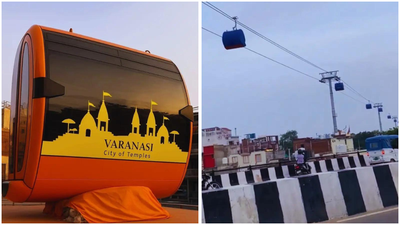
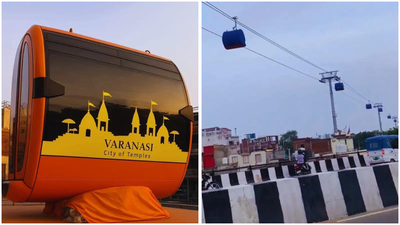
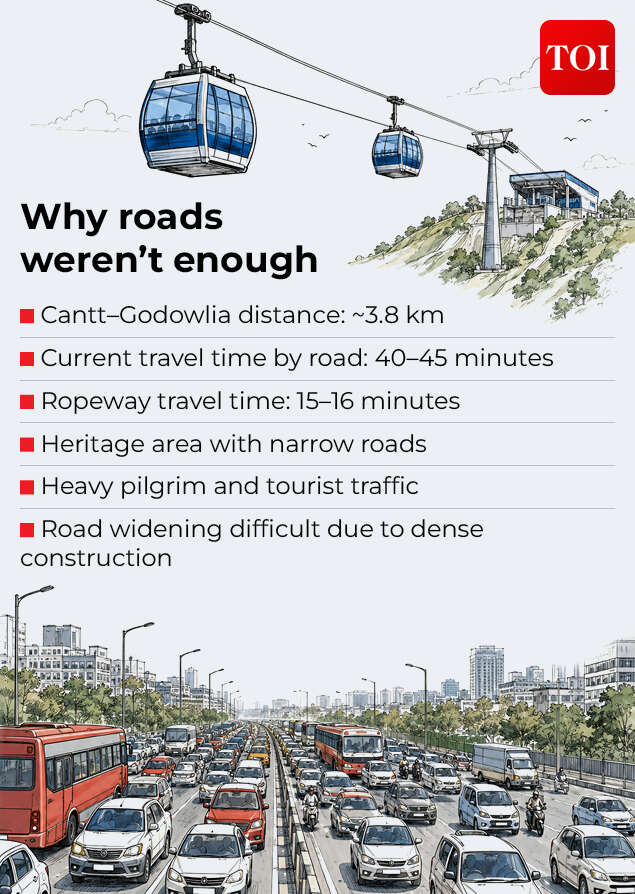
For centuries, getting around Varanasi has been part of the city’s experience.Its narrow lanes, bustling bazaars, temples and ghats are integral to the spiritual capital’s identity. But as one of India’s oldest continuously inhabited cities welcomed millions of pilgrims and tourists every year, those same streets also became one of its biggest infrastructure challenges.The stretch between Varanasi Cantonment railway station and Godowlia, the gateway to the Kashi Vishwanath Temple and Dashashwamedh Ghat, often witnessed bumper-to-bumper traffic.During festivals or the peak pilgrimage season, a journey of less than four kilometres could easily take 40 minutes or more.Building wider roads was never a practical solution. Much of the corridor passes through densely populated neighbourhoods and heritage areas, where large-scale demolition would not only be expensive but also risk altering the city’s centuries-old character.Instead, policymakers looked upwards.Later this year, Varanasi is expected to become home to India’s first urban public transport ropeway—a project that promises to ferry commuters and pilgrims above the city’s congested streets in gondola cabins suspended nearly 45-50 metres above the ground.Unlike the ropeways familiar to tourists in hill stations, this one is being built as part of the city’s everyday mass transit network.Officials say it will cut travel time between Cantt and Godowlia from around 40-45 minutes by road to roughly 15 minutes, while reducing pressure on one of the city’s busiest traffic corridors.The project is also a global rarity. Urban ropeways are still uncommon worldwide, with only a handful of cities integrating them into their public transport networks. Indian officials have frequently described the Varanasi project as among the first of its kind globally to use ropeway technology for mass urban commuting rather than tourism.Beyond offering a faster ride for pilgrims heading to the Kashi Vishwanath Temple, the project is being viewed as a test case for whether aerial mobility can solve transport problems in India’s densely populated and heritage-rich cities, where conventional infrastructure often faces severe space constraints.
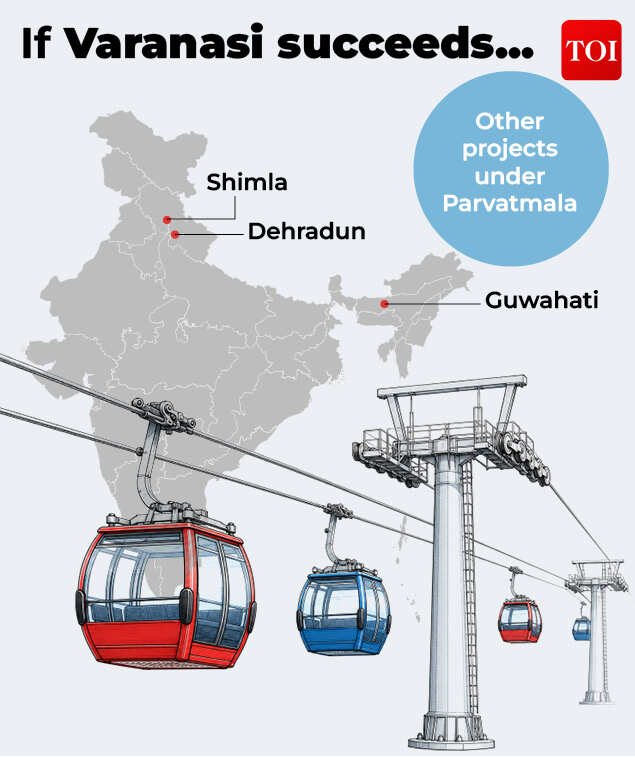
If successful, it could influence similar projects planned in cities ranging from Guwahati and Shimla to Dehradun and beyond under the Centre’s broader ropeway expansion programme.That makes Varanasi more than just another infrastructure project, as it could become the template for a new model of urban transport in India.So, what exactly is India’s first urban ropeway? Why has the government chosen cable cars over roads or metro lines? And can this technology genuinely become part of India’s future public transport network?
What exactly is the Varanasi Urban Ropeway?
The Varanasi Urban Ropeway is India’s first ropeway designed primarily as an urban mass transit system rather than a tourist attraction.
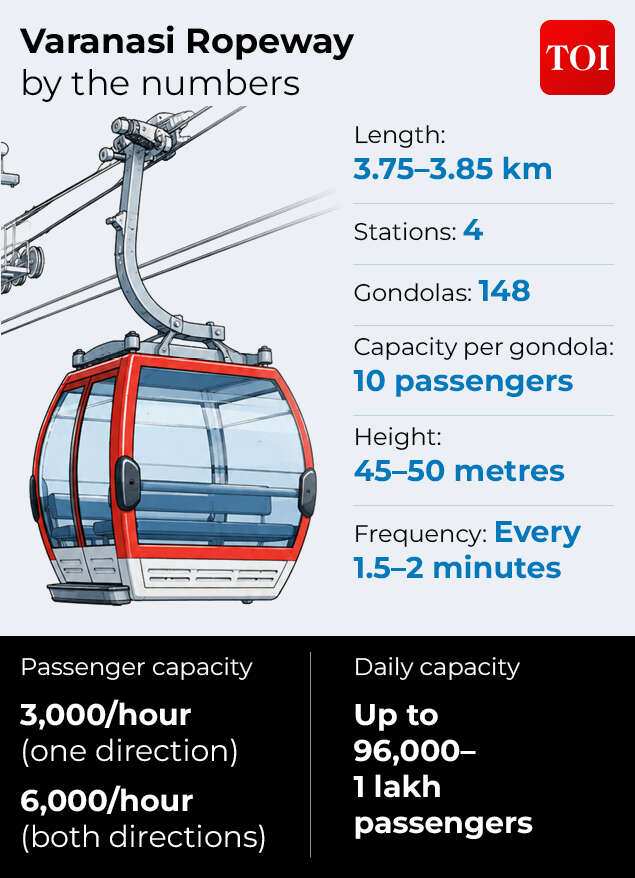
The project is being implemented by the National Highways Logistics Management Limited (NHLML), a wholly owned company of the National Highways Authority of India (NHAI), under the Ministry of Road Transport and Highways. Swiss ropeway manufacturer Bartholet Maschinenbau AG has supplied the cable transport technology for the project.Once operational, the ropeway will connect Varanasi Cantonment railway station with Godowlia Chowk, one of the busiest intersections in the city and the main access point for pilgrims visiting the Kashi Vishwanath Temple.Stretching approximately 3.75-3.85 kilometres, the corridor will include stations at Cantt, Vidyapeeth, Rath Yatra and Godowlia, linking the railway station with major commercial, residential and religious hubs.The project was conceived after authorities concluded that expanding roads through Varanasi’s congested core would be extremely difficult because of the city’s dense urban fabric and heritage structures.Instead of competing for road space, the ropeway will operate entirely above existing traffic, offering commuters a predictable travel time regardless of congestion below.
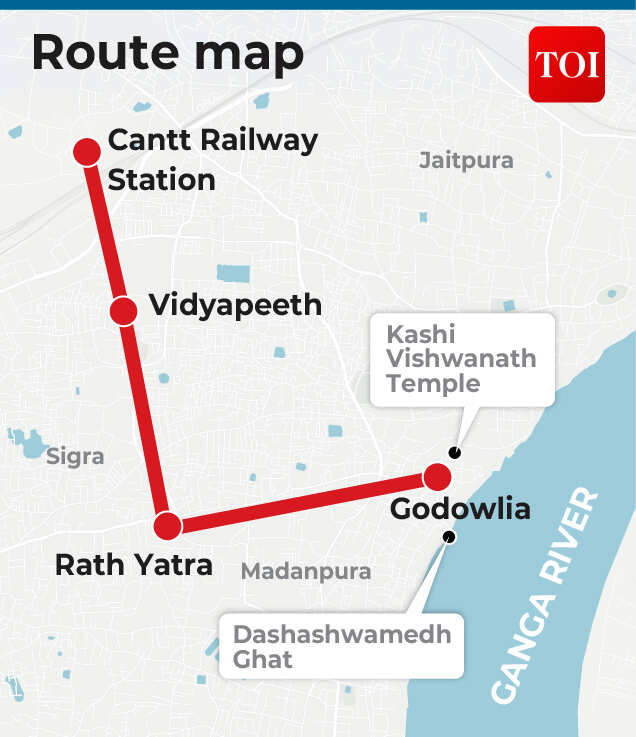
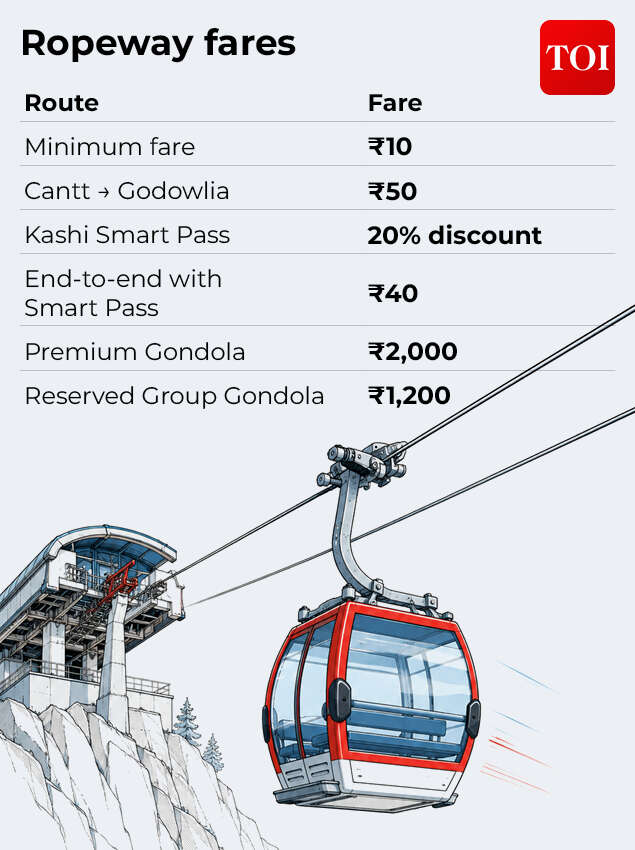
According to the government, the system will use 148 modern gondola cabins, each capable of carrying 10 passengers. Gondolas are expected to arrive every one-and-a-half to two minutes, allowing the system to transport nearly 3,000 passengers per hour in each direction, or about 6,000 passengers every hour in total.Official estimates suggest the network could eventually handle close to 96,000-1 lakh passengers daily, depending on operational schedules and demand.Passengers boarding at Cantt Railway Station will be able to reach Godowlia in about 15-16 minutes, less than half the time the journey often takes by road during busy hours.The Uttar Pradesh government has also finalised passenger fares. The minimum ticket has been fixed at Rs 10, while travelling the entire stretch from Cantt to Godowlia will cost Rs 50. Holders of the Kashi Smart Pass will receive a 20% discount, reducing the end-to-end fare to Rs 40. Premium gondolas have also been planned for tourists and group bookings.Modern passenger facilities, including lifts, escalators, CCTV surveillance, digital ticketing, fire safety systems and dedicated infrastructure for senior citizens and persons with disabilities, have been incorporated at stations to position the ropeway as a full-fledged public transport system rather than simply another tourist attraction.
The project, estimated to cost over Rs 800 crore including long-term operation and maintenance, has already completed trial runs and is expected to begin commercial operations after receiving the necessary regulatory clearances.
Why is the government betting on ropeways?
The Varanasi project is not an isolated experiment. It is part of the Centre’s much larger strategy to introduce ropeways as an alternative mode of transport in places where building conventional roads, metro lines or rail corridors is either too expensive, technically difficult or environmentally disruptive.This vision took shape in 2022 with the launch of the Parvatmala Pariyojana, the National Ropeways Development Programme announced in the Union Budget. The scheme aims to develop ropeways in hilly regions as well as congested urban areas through public-private partnerships.Traditionally, ropeways in India have been associated with tourist destinations such as Gulmarg, Auli, Mussoorie or pilgrimage centres. Under the new policy, however, the government wants them to become part of mainstream public transport.
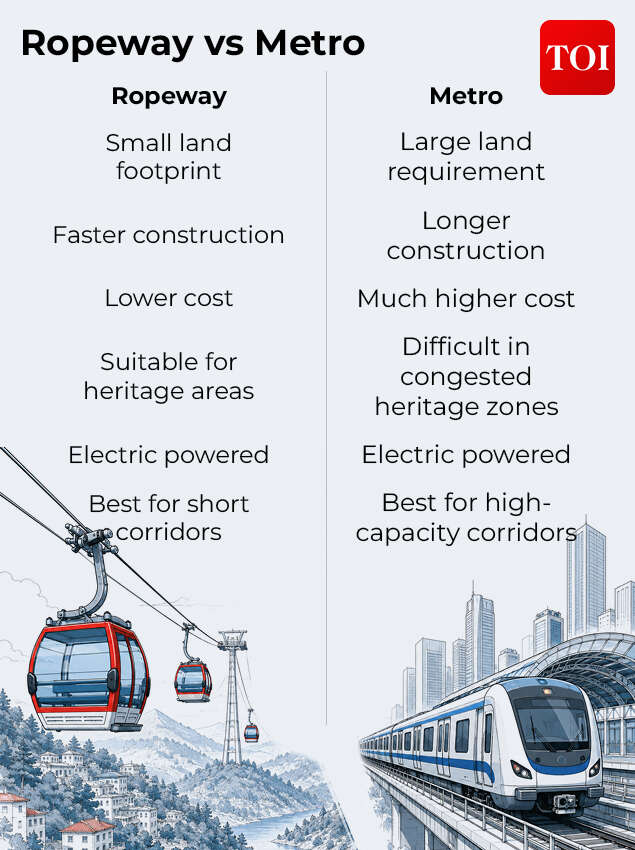
Officials argue that ropeways offer several advantages over conventional infrastructure. They require significantly less land acquisition than roads or metro systems because towers occupy relatively small footprints.Construction is also faster since there is little need for tunnelling, large flyovers or extensive utility shifting. Since the cabins are electrically operated, ropeways also produce lower emissions than conventional road traffic, making them an attractive option for cities trying to reduce congestion and pollution.The Varanasi project perfectly fits this philosophy.The city’s historic core leaves almost no room for widening roads without affecting heritage structures and densely populated neighbourhoods. A metro line would have involved far greater costs and engineering challenges.An aerial ropeway, planners argue, offers a way to increase mobility while preserving the city’s cultural fabric.Prime Minister Narendra Modi had also highlighted this balance between tradition and technology when the project was announced.Sharing details of the ropeway on social media in 2023, he described it as an “adbhut sangam” (remarkable confluence) of faith and technology and said it would not only make travel more convenient for devotees but also improve access to the Kashi Vishwanath Temple.The government now sees ropeways as a solution that can complement—not replace—existing transport systems.
Can ropeways really work as urban public transport?
The idea may appear futuristic in India, but urban ropeways have been operating successfully in several parts of the world for years.Perhaps the best-known example is La Paz, Bolivia, where the Mi Teleférico network has evolved into one of the world’s largest urban cable car systems. With multiple interconnected lines stretching across the city and neighbouring El Alto, it carries hundreds of thousands of passengers every day while navigating mountainous terrain that makes conventional transport difficult.Another frequently cited example is Mexico City, whose Cablebús system has transformed commuting for residents living in densely populated hillside settlements.What once took well over an hour by road can now be completed in a fraction of the time using aerial cabins integrated with the city’s wider public transport network.These examples have demonstrated that ropeways need not remain tourist attractions. They can function as reliable mass transit systems when integrated with buses, railways and pedestrian infrastructure.
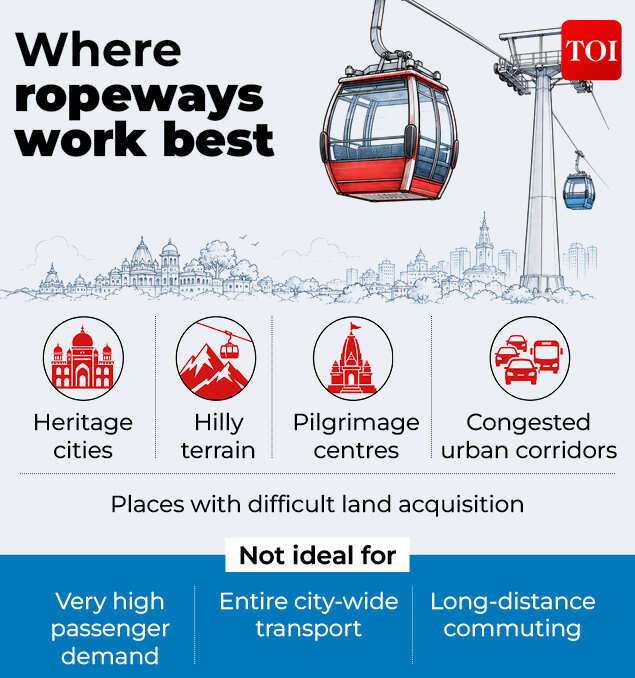
Varanasi is now attempting to replicate those successesUnlike metro systems that require passengers to travel underground or elevated through fixed corridors, ropeways can fly directly over existing development, reducing construction challenges and avoiding traffic altogether.Continuous movement of gondolas also means passengers spend less time waiting compared to conventional bus services.However, experts caution that ropeways are not a universal solution.Their passenger capacity is considerably lower than metro rail systems, making them suitable only for specific corridors rather than citywide transport. Weather conditions, periodic maintenance and evacuation protocols also require careful planning. Unlike buses, expanding routes later is neither simple nor inexpensive.Consequently, transport planners view ropeways as a niche solution—best suited for heritage cities, mountainous terrain or highly congested corridors where traditional transport networks are difficult to expand.
Could Varanasi become a model for other Indian cities?
That is perhaps the biggest question surrounding the project.If the ropeway succeeds in reducing congestion, attracting regular commuters and integrating smoothly with the city’s existing transport network, it could become a blueprint for similar projects elsewhere.The Centre has already identified several ropeway proposals across the country under the Parvatmala programme, particularly in Himalayan states and pilgrimage destinations. Cities facing severe geographical or heritage constraints are also studying whether aerial mobility could complement existing infrastructure.But the success of the Varanasi ropeway will ultimately depend on far more than engineering.Passengers must find it affordable enough to use regularly. The stations need seamless connections with railway stations, buses, auto-rickshaws and pedestrian routes. Safety standards, maintenance schedules and operational reliability will determine whether commuters choose the ropeway over conventional road transport.
Ridership will also be critical.Unlike tourist ropeways that witness seasonal demand, an urban transport system must attract consistent daily commuters—office-goers, students, residents and pilgrims—to remain financially viable over the long term.There is also the question of whether ropeways can genuinely ease congestion or merely shift it from roads to stations if passenger management is inadequate.These are precisely the issues transport planners and policymakers across India will be watching once commercial operations begin.
The bigger picture
India’s urban transport story has traditionally revolved around roads, flyovers, suburban railways and metro systems. Ropeways are rarely featured in discussions about everyday commuting.Varanasi could change that.By carrying passengers above one of the country’s oldest and most congested cities, the project represents an attempt to rethink how mobility solutions are designed for places where conventional infrastructure has reached its limits.Its significance therefore extends beyond the four-kilometre journey between Cantt and Godowlia.If successful, it could demonstrate that innovative transport systems can coexist with heritage conservation, allowing cities to modernise without fundamentally altering their historic character.At the same time, the project is also a reminder that no single technology can solve every urban mobility challenge. Ropeways are unlikely to replace metros or buses in India’s largest cities. Instead, they could become another tool in the transport planner’s toolkit—one best deployed where geography, density or heritage leave few alternatives.For Varanasi, the benefits could be immediate. Faster journeys for pilgrims, easier access to one of India’s holiest temples, reduced traffic on chronically congested roads and a cleaner mode of transport for residents and visitors alike.
Share your thoughts in the comments
Be respectful · TOI community guidelines
For India, however, the stakes are much larger.The country’s first urban public transport ropeway is not merely about moving people from one station to another.It is a test of whether the next generation of urban infrastructure can think beyond roads and rails and whether its oldest cities can embrace modern mobility without sacrificing the heritage that defines them.