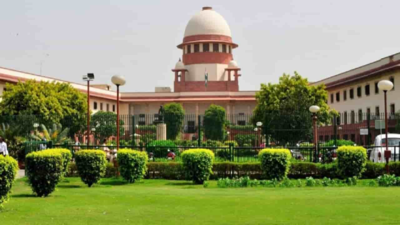
NEW DELHI: Drawing a distinction between using abuse language and the offence of obscenity, Supreme Court has said that use of mere swear words, profanities and vulgar expletives, however distasteful or uncivil they may be, cannot be equated with obscenity and is not an offence. It set aside conviction under Section 294 for a person who had used abusive slurs for mother and sister during an altercation.A bench of Justices Sanjay Karol and Vipul M Pancholi said obscenity which is an offence under IPC is not synonymous with “vulgarity”, “abuse” or “profanity”. “Words which are merely vulgar or abusive may evoke a feeling of disgust, revulsion or shock, but that by itself does not make them obscene in law. It is for this reason that this Court, through various judicial pronouncements, has held that the use of abusive, vulgar or profane language does not necessarily constitute obscenity.
Abusive words lacked lascivious element: SC
This Court in Samaresh Bose v. Amal Mitra case, while considering a Bengali novel, held that the use of slang, unconventional words or vulgar language may create a feeling of disgust or revulsion, but that does not necessarily amount to obscenity,” the bench said.It said the test to determine whether the words complained of are obscene or not is to see whether the words fulfil three ingredients – (i) it should be lascivious; (ii) appeals to prurient interests of people; and (iii) has a tendency to deprave and corrupt persons who are likely to see, hear or read it. “Further, it must also be shown that the use of such words has caused annoyance to others. Unless presence of essential ingredients is established, the offence of obscenity cannot be said to be made out,” the court said while examining the ambit of Section 294Section 294 says Whoever, to the annoyance of others, (a) does any obscene act in any public place, or (b) sings, recites or utters any obscene song, ballad or words, in or near any public place, shall be punished with imprisonment of either description for a term which may extend to three months. The court said that in order to constitute an offence under the Section, the words uttered must contain some lascivious element capable of arousing sexual thoughts or feelings and must further be shown to have caused annoyance to others.“In the present case, during an altercation, the appellant allegedly uttered: ‘Hey Mother…r! You son of a w….e! Are you coming in support of your elder sister’s son? Just f…k off, you ‘K….a’ F…r’…’. It is this which is sought to be invoked under Section 294(b) of the IPC. Going by the version of Prosecution witnesses-1 himself, the words and verbal slang used by the appellant were, at best, abusive or vulgar in nature. The Collins English Dictionary defines the word “abusive” as a language which ‘is extremely rude and insulting’ Whereas the word ‘vulgar’ is defined by the Cambridge Dictionary as “rude and likely to upset or anger people, especially by referring to sex and the body in an unpleasant way” These definitions clearly show that words may be insulting, offensive or unpleasant without necessarily being obscene in law,” the bench said.“For an utterance to be considered obscene, it must be shown that it was lascivious, appealed to prurient interests and had the tendency to deprave and corrupt the minds of those who are exposed to it. Tested on this anvil, even if all the allegations levelled in the complaint are taken at their face value and accepted to be true in entirety, the same cannot be held to be obscene. Such words, howsoever abusive, unpalatable or uncivil, do not satisfy the requirement of Section 294(b) IPC for there being nothing on record to show that they had any one or all three elements referred to hereinabove. Further, it is nobody’s case that use of such words causes annoyance to others in a public place, which is a mandatory ingredient of the Section, much less to the complainant . In absence thereof, we find that the offence under Section 294(b) IPC is not made out,” the bench said.