
Currency dealers monitor exchange rates as an electronic screen (top) shows South Korea’s benchmark stock index (KOSPI) in a foreign exchange dealing room at the Hana Bank headquarters in Seoul on June 23, 2026.
Jade Gao | AFP | Getty Images
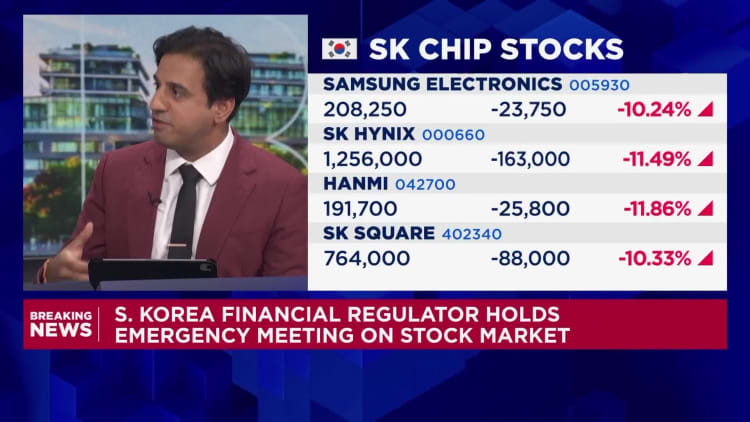
South Korea’s stock benchmark, Kospi, has gone from being the world’s hottest equity market to entering bear territory within a few weeks, highlighting how investors have soured on artificial intelligence plays and underscoring concentration risks.
The Kospi fell more than 5% on Wednesday, which brought it 20% below its June 19 record high, according to LSEG data. It closed slightly higher on Thursday in choppy trading.
“South Korea’s recent drawdown has been driven by heightened AI skepticism on the part of global investors, coupled with extreme market concentration,” said Manishi Raychaudhuri, CEO of Emmer Capital.
The speed of the reversal brings to light a central feature of this year’s rally: South Korea’s outsized dependence on the AI trade. Chipmakers Samsung Electronics and SK Hynix accounted for more than half of the Kospi’s weighting as of June, data provided by Emmer Capital showed. That extreme reliance has both lifted and sunk the index.

Kospi performance year-to-date
“The correction has been driven more by positioning than by a deterioration in fundamentals,” said Jung In Yun, founder of Fibonacci Asset Management Global. Korean equities had become “one of the most crowded AI trades globally after a very strong rally, so it did not take much to trigger profit taking,” he added.
Rising global uncertainty and concerns that earnings upgrades could moderate have also made investors more cautious, although he described the drop in Kospi as “a healthy reset rather than a fundamental change in the outlook.”
Peter Kim, head of research at KB Securities, argued that the move also reflects a broader shift in how modern markets behave.
“The gamification of finance has led to such gyrations driven less by fundamentals but by news flows and fads,” he said, adding that retail fund flows, leveraged exchange-traded funds and AI-driven concentration have made swings of 5% to 10% increasingly common. The Kospi volatility index has surged over 200% since the start of the year.
Valuation adjustment
Kospi has been hammered lately despite strong earnings from the companies at the center of the sell-off. Samsung on Tuesday reported blockbuster profit, while memory pricing continues to strengthen. The chip giant’s shares, however, tanked on concerns about AI spending.
“The market is questioning the pace of earnings growth rather than the sustainability of AI demand itself,” Fibonacci’s Jung said. “This distinction is important because it suggests we are seeing a valuation adjustment rather than the end of the AI cycle.”
Underscoring strong demand, Rolf Bulk, head of semiconductors and infrastructure at Futurum Group said that memory prices rose between 50% and 80% sequentially in the second quarter, with further increases expected later this year.

Fundamentals for memory makers remain intact, Bulk added, citing a multi-year supply shortage and long-term contracts with hyperscale customers. KB Securities’ Kim echoed that “fundamentals and visibility of earnings makes the current correction an opportunity for those who can withstand the short-term volatility.”
The Kospi is still up more than 70% this year, having gained over 75% last year.
“While volatility may persist in the near term, I believe the medium-term outlook remains constructive,” said Fibonacci’s Jung. “Once global risk sentiment stabilizes, foreign investors are likely to revisit Korea given its central role in the global AI supply chain.”
The timing of any sustained recovery in South Korea’s stock market, however, remains difficult to predict and will depend in part on broader global market conditions, experts said.
The U.S. listing of SK Hynix on Friday could provide a near-term boost for memory stocks, according to Bulk. Constructive management commentary on the durability of the memory cycle through the second half of 2026 could help lift both chipmakers and the broader Kospi, he added.
“2Q26 earnings disclosures from SK Hynix and Samsung Electronics later this month can be a further positive driver: constructive commentary from both companies on the sustainability of the cycle in the second half of 2026 could support the stocks and the broader Korean market.”