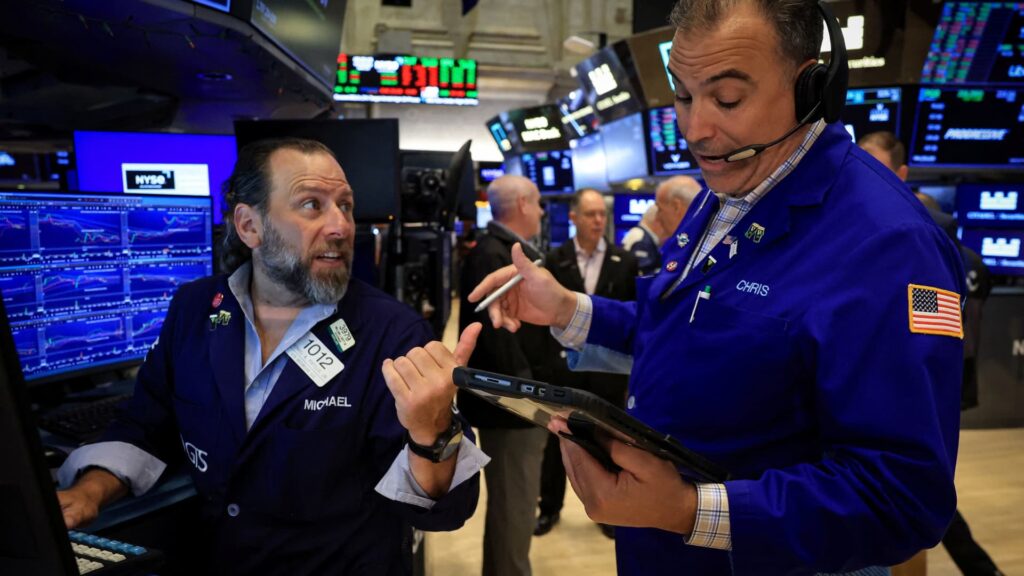
The view at the halfway point of the year on Wall Street is more rosy than could’ve been expected at just about any point over the past six months now that a U.S.-Iran resolution is in sight. This week, JPMorgan hiked its 2026 S & P 500 target to 7,800 from 7,200 , suggesting another 5% rise from current levels is possible thanks to a “Blue Sky” scenario. Others are becoming more sanguine on the market outlook. Thursday’s PCE report, for example, showed inflation at its highest in roughly three years, but it also confirmed that consumer spending remains robust — suggesting the U.S. economy can absorb what many hope is a one-time spike in energy prices. “I think there’s a very good chance that equities can continue to rally from here in a pretty significant way through the end of the year,” said David Miller, investment chief at Catalyst Funds. That doesn’t mean investors expect stocks will go up in a straight line. In the week ahead, they anticipate lower trading volumes in a holiday-shortened week — heading into the Fourth of July weekend celebrating the U.S.’ 250th anniversary — which could mean wilder swings in the market. At the same time, managers rebalancing their portfolios into the end of the month and quarter could also result in greater volatility. .SPX 5D mountain S & P 500 this week The seasonal picture beyond the holiday weekend is also mixed. July is the best month of the third quarter for the Dow and the S & P 500. But it’s also the start of the worst four months for the Nasdaq, which loses 0.8% on average for the month during midterm election years, according to the Stock Trader’s Almanac. And, Bank of America’s technical strategist Paul Ciana warned clients this week that risks of a correction are moving higher , and urged investors to take on some protection heading into the third quarter. Investors, taking stock of where they are, could trim some gains in their biggest winners as they head into a second half of the year that’s sure to involve some volatility around the midterm elections, and during which many are hoping the rally will broaden out beyond tech. Some are reducing their exposure to the hyperscalers, until there’s more confidence that they can continue to deliver on the extraordinary earnings growth they’ve delivered so far this year. Software companies, which are most vulnerable to AI disruption, are being picked through for clear winners. Semiconductors, namely memory, remain the biggest beneficiary of the AI trade — though here, too, many investors fear they may have run up too far, too fast in recent weeks, and are now waiting for better positions for entry. “If I’m an investor looking to invest the next marginal dollar into equities, I would just say to them, ‘be a little patient,'” said Darrell Cronk, chief investment officer for Wealth & Investment Management, a division of Wells Fargo. “We think you might get some volatility buying opportunities as we move through the summer.” Cronk said he prefers U.S. over international, large- and mid-cap over small cap, and said he thinks the best value may lie in financials and industrials. Small caps, which have been on a tear recently, are one area he would avoid, he said, especially with the Russell 2000 undergoing a reconstitution on Friday. Investors will also keep an eye on next week’s jobs report, though, outside of a major surprise, they expect it may have little impact on a stock market that’s become more preoccupied with inflation. Fed funds futures are now pricing in a hike coming as soon as September, after Federal Reserve Chair Kevin Warsh signaled a greater focus on inflation that investors were anticipating at the last FOMC meeting. Any encouraging signs of inflation coming down can ease those concerns. Inflation fears have also been showing up in the bond market, with the spread between the 2-year and 10-year Treasury yield shrinking further this week. Investors will watch whether that trend continues, given that an inverted yield curve, if it occurs, could raise fears of a recession. A strengthening dollar, falling oil prices, and weakening commodities, could also upend how investors position their portfolios heading into the second half of the year. For now, however, investors are likely breathing a collective sigh of relief, after muscling through an anxious first half that included major geopolitical conflicts, and tremors around the potential for AI disruption. Earnings remain strong, as does the consumer, and traders have not stopped buying the dip. Week ahead calendar All times ET. Tuesday, June 30 9:00 a.m. FHFA Home Price Index (April) 9:45 a.m. Chicago PMI (June) 10:00 a.m. Consumer Confidence (June) 10:00 a.m. JOLTS Job Openings (May) Earnings: Nike , Constellation Brands Wednesday, July 1 8:15 a.m. ADP Employment Survey (June) 9:45 a.m. S & P Global PMI Manufacturing final (June) 10:00 a.m. Construction Spending (May) 10:00 a.m. ISM Manufacturing (June) Earnings: General Mills Thursday, July 2 8:30 a.m. Hourly Earnings preliminary (June) 8:30 a.m. Average Workweek preliminary (June) 8:30 a.m. Initial Claims (06/27) 8:30 a.m. Manufacturing Payrolls (June) 8:30 a.m. Nonfarm Payrolls (June) 8:30 a.m. Private Nonfarm Payrolls (June) 8:30 a.m. Unemployment Rate (June) 10:00 a.m. Durable Orders final (May) 10:00 a.m. Factory Orders (May) Friday, July 3 NYSE closed in observance of Independence Day.