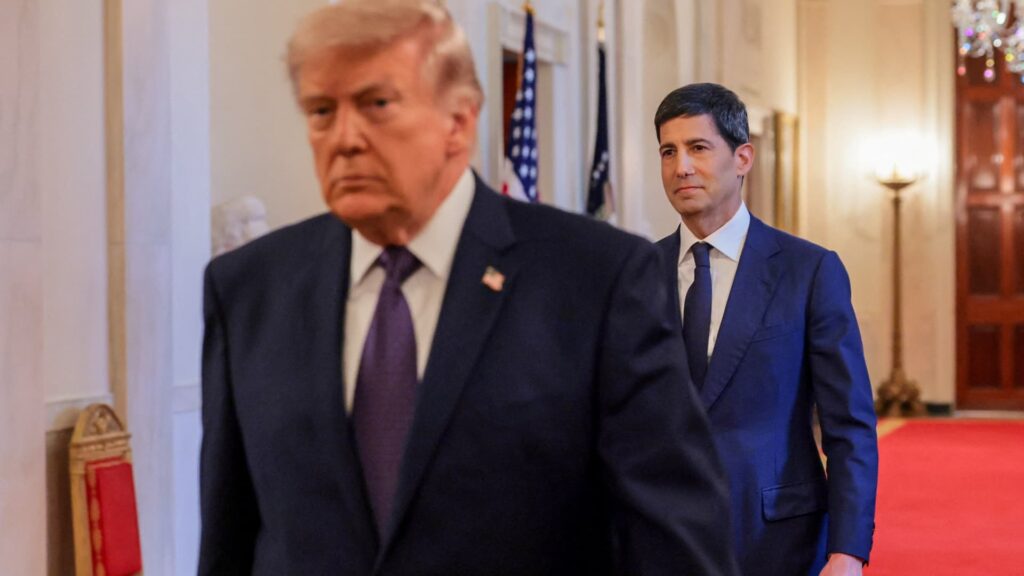
U.S. President Donald Trump arrives with incoming Federal Reserve Chair Kevin Warsh for Warsh’s swearing-in ceremony at the White House in Washington, D.C., U.S., May 22, 2026.
Jonathan Ernst | Reuters
With inflation topping 4%, the Trump administration is easing off its long-standing calls for the Federal Reserve to immediately cut interest rates. That is giving new Fed Chairman Kevin Warsh an extended political grace period as he deals with a challenging economic environment, but underscores the depth of the pushback he could face if the mercurial president changes his mind.
President Donald Trump said as recently as Wednesday that he wants the Fed to cut rates. Meanwhile several of the president’s top economic advisers have in recent interviews and writing stopped short of calling for near-term rate cuts, as they had before the Iran war sent some prices surging and Trump installed Warsh as the new Fed chair.
What might look like division is really an indication that the Trump-Warsh relationship has shifted the political gravity of the Trump administration, a White House official said, speaking on condition of anonymity to describe behind-the-scenes conversations.
“I wouldn’t say it’s necessarily a shift in policy, or how we’re seeing the data,” the official said. Rather, ”personnel is big for this president,” the official said. Trump has “confidence and faith” in Warsh and so will let him make decisions that he didn’t entrust to Jerome Powell, the prior chair.
Read more CNBC politics coverage
“Since Epic Fury and since Warsh getting in there, I think the president’s position is a lot more nuanced than ‘there need to be rate cuts,'” the official said, adding that there is “no daylight” between the president and his advisers.
Inflation rose by 4.1% in the year ending in May, according to Bureau of Economic Analysis data released Thursday. The Fed wants that measure, personal consumption expenditures, to be at 2%.
Elevated energy prices stemming from the war contributed significantly to the elevated reading. Taking them out along with volatile food prices, so-called core inflation rose 3.4%.
Warsh said last week the Fed was keeping a close eye on data like that. “The Fed will deliver price stability,” he said. He and the Fed’s committee of interest rates voters opted to keep interest rates steady and end a long-standing plan that biased the Fed toward interest-rate cuts.
Nearly half of the Fed’s policymakers said in projections released last week that they expected interest rates to go up this year. Markets now see a 79% chance of a rate increase by the end of December, according to CME FedWatch Friday morning, and have no expectation of a cut.
White House trade adviser Peter Navarro wrote in an opinion essay Thursday that the new inflation data makes a “hold-steady case” for the Fed.
Navarro had previously called for rate cuts. In an email to CNBC, he said his view that the Fed should now hold rates was consistent with his past arguments and the president’s current position. His point in the essay was that it was “foolish” now to consider rate increases, he said.
“Rates should be lower and they would’ve been lower if the Fed had done the right thing over the past year,” Navarro said in the email.
Treasury Secretary Scott Bessent on Tuesday said at an event in New York that Warsh will “be independent and do what he wants.” In an interview the next morning on CNBC, Bessent declined to say whether the Fed should cut. But people should “keep an open mind,” he said.
“Let’s see what inflation looks like on the other side of” the Iran conflict, Bessent said.
Some in the markets heard Bessent as indicating he has come around to rate increases under Warsh.
“On the Fed, I heard a green-light to hike,” Neil Dutta, head of economics at Renaissance Macro Research, wrote in a note to his clients Tuesday evening.
The Treasury Department declined to comment on how Bessent’s views line up with Trump’s.
Kevin Hassett, director of the White House National Economic Council, has also suggested that he supports a pause from the Fed under Warsh. “The first meeting, you want to kind of get your feet on the ground and hold steady,” Hassett said on CNBC on Tuesday.
Trump has said he wants Warsh to “do whatever he wants” and “be totally independent.”
But on Wednesday the president returned to his calls for interest-rate cuts. “We need low interest rates. Low interest rates will solve everything, will solve that now,” Trump said at an Oval Office event.
Energy prices have fallen in the wake of a deal to reopen the Strait of Hormuz, the international waterway that has become a chokepoint for global oil supplies. The average price of a gallon of gas in the U.S. was $3.90 on Friday, down 58 cents from a month ago according to AAA.
But with the Middle East still unstable, it isn’t clear how durable price declines will be or what exactly the inflation picture will look like when the Fed meets next in late July. Iranian forces attacked a cargo ship in the strait on Thursday.
All that means extended patience will be required of Warsh. The White House said that is just what’s being provided.
“President Trump and administration officials have all consistently said the same thing: everyone has confidence in Chairman Kevin Warsh and, despite temporary disruptions to energy markets, the Trump administration’s supply-side policies are cooling inflation to pave the way for interest rate cuts,” White House spokesman Kush Desai told CNBC.