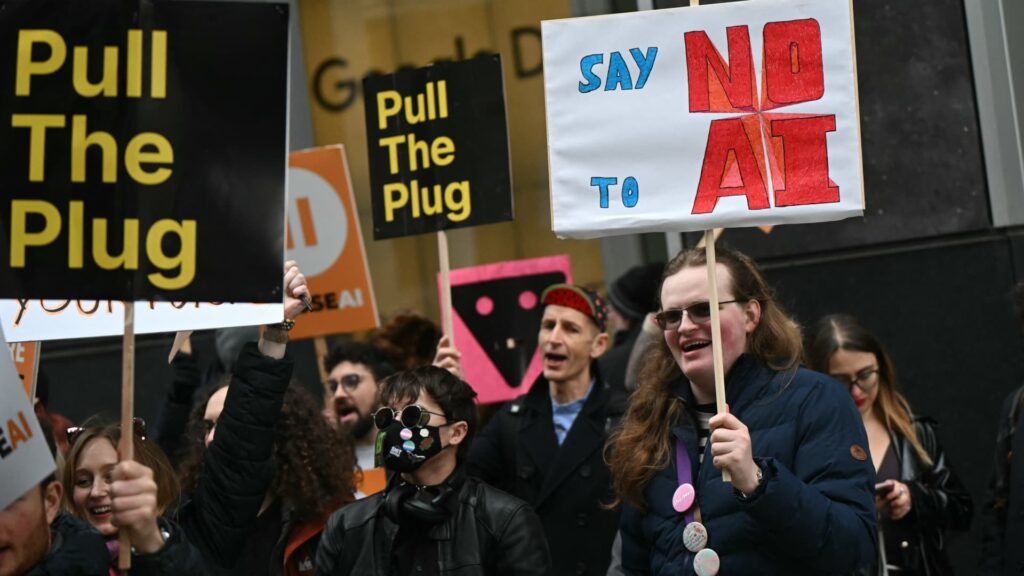
Protesters gather with banners and placards outside the offices of Google Deepmind at a protest organized by PauseAI UK and other groups concerned in controlling the development of advanced Artificial Intelligence systems, in London on February 28, 2026. (Photo by JUSTIN TALLIS / AFP via Getty Images)
Justin Tallis | Afp | Getty Images
With college graduates jeering mentions of artificial intelligence at commencement speeches, and voices as disparate as the Pope and technology giant Anthropic warning of the risks of unmitigated AI development, public sentiment toward the technology has sobered considerably since its early euphoria.
Yet despite mounting public backlash, global AI usage has surged to record highs. OpenAI’s ChatGPT reached one billion monthly app users, or MAUs, in May, according to recent estimates from market intelligence firm Sensor Tower. Other AI apps including Anthropic’s Claude made triple-digit year-over-year percentage gains in users, the data company said.
With its billion-MAU figure — achieved roughly 3.5 years after its November 2022 launch — ChatGPT became the fastest app ever to reach the milestone, surpassing the previous record set by Google Maps, which took around five years after launch to reach the same volume of usage, Sensor Tower said.
OpenAI, which did not respond to CNBC’s requests for comment, said in February that ChatGPT saw more than 900 million weekly active users across web and mobile platforms and claimed it had more than six times the monthly web visits and mobile sessions of the next largest AI platform.
According to Sensor Tower, OpenAI’s market-leading large language model was trailed by offerings from its competitors, including Google’s Gemini, ByteDance’s Doubao and its overseas variant Dola, as well as Claude from rival developer Anthropic.
But while ChatGPT enjoys a significant lead in monthly users, rival models are quickly catching up. Monthly usage of Claude and Meta AI respectively rose by 640% and 973% year-on-year, compared to ChatGPT’s 62%, per Sensor Tower estimates.
Despite its “early mover advantage,” usage of ChatGPT’s competition has grown on tangible model improvements, as well as more positive market sentiment, Abe Yousef, Sensor Tower’s senior insights analyst, told CNBC.
Yousef cited OpenAI’s February deal with the U.S. Department of Defense to deploy its models on classified Pentagon networks as an instance where public unease drove usership.
ChatGPT uninstalls surged around 295% day-on-day on Feb. 28 — the day after OpenAI announced its Pentagon agreement, according to Sensor Tower data.
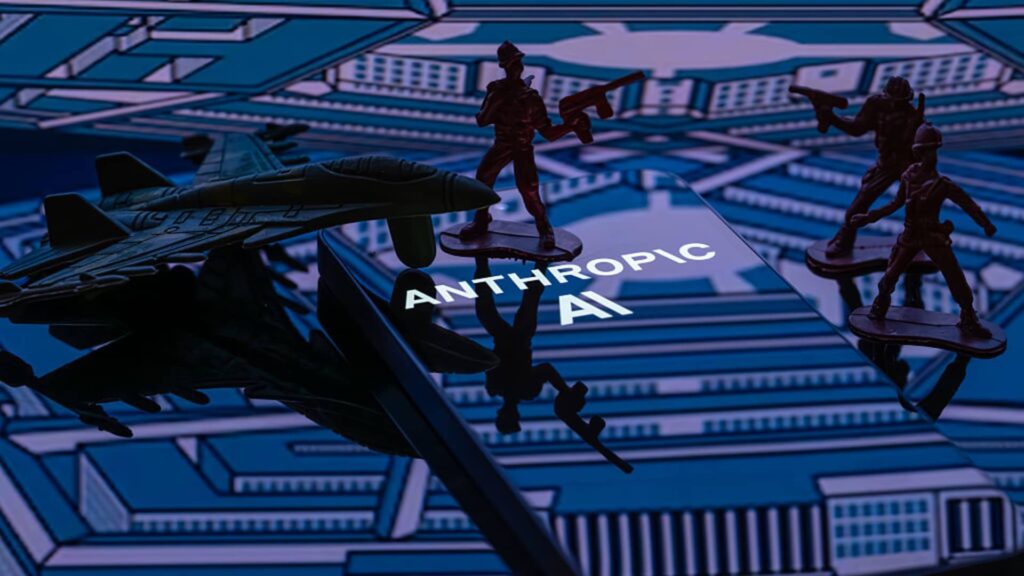
Anthropic gained a boost from sentiment toward ChatGPT, as Claude soared to the App Store’s top spot that same weekend, outpacing ChatGPT by U.S. downloads for the first time, after it refused involvement in Pentagon operations.
Both Anthropic and OpenAI have recently begun proceedings for widely anticipated public listings, with Sam Altman’s OpenAI submitting its IPO filing Monday afternoon stateside, hot on the heels of Anthropic, which filed its IPO prospectus with the U.S. Securities and Exchange Commission a week earlier.
Sentiment-driven usage
While ethical user considerations may have driven usage in cases like Anthropic’s feud with the Defense Department, analysts say the broader trajectory of AI usage is less likely to be derailed by sentiment.
“The strong trajectory of AI adoption shows no sign of slowing,” said Hanno Stegmann, managing director and partner at the Boston Consulting Group’s AI and technology team, BCG X.
Stegmann’s comments come amid a growing sense of unease over AI. Tech giant Anthropic called on Friday for a pause in global AI development, warning that unmitigated development could fast get out of control.
“If systems are capable of fully building their own successors, the ways we secure them, monitor them, and shape their behavior all grow much more important,” the company wrote in a blog post.
Anthropic’s statements echoed earlier claims from Pope Leo in a letter published May 25, warning of widening inequality and public safety concerns driven by the world’s insatiable AI demand.
Many of such concerns were also laid bare during recent college commencement ceremonies in the U.S., where new graduates across the country jeered at mentions of AI on concerns that the technology would displace early-career roles, among other ethical and environmental anxieties.
Meanwhile, a CNBC survey published in May showed that workers have avoided using AI for moral, environmental or privacy reasons.
“I understand why a generation entering the workforce and into this much change feels uncertain. That is a rational response to a genuine transition,” Stegmann said, adding that ambiguity over outcomes is often what undermines sentiment.
But as AI plays an increasingly central role across daily life, any souring public sentiment will likely make few dents in overall usership.
A BCG poll of around 12,000 frontline workers released June 3 showed that 74% regularly use AI, up 23 percentage points year-on-year, and more than 40% of regular users reported saving the equivalent of a full workday each week. Meanwhile, the United Nations estimated that the burgeoning AI market could reach more than $4.8 trillion by 2033.
“While negative sentiment towards AI… is undeniably growing, consumers are increasingly using and relying on these platforms,” said Sensor Tower’s Yousef.