
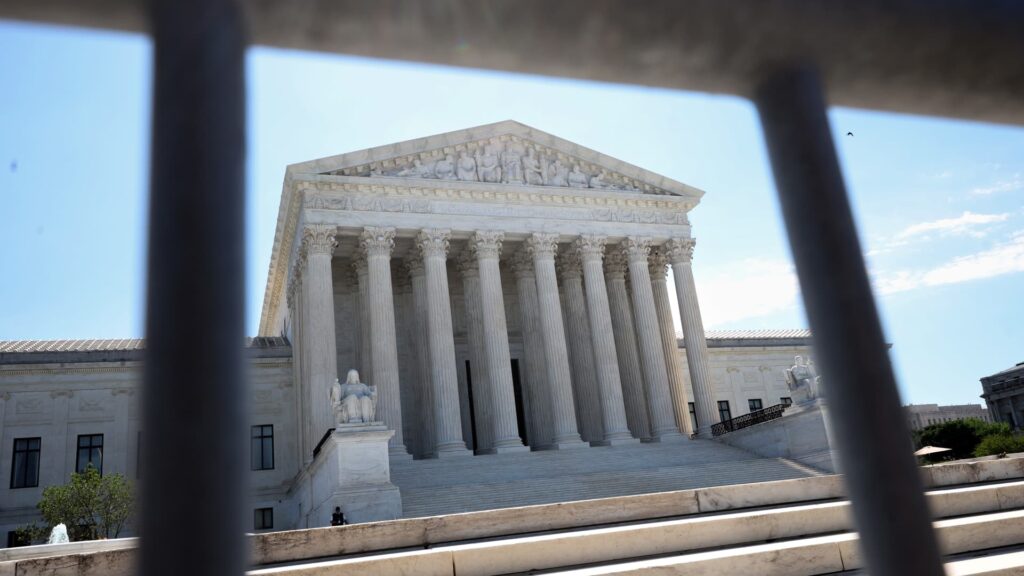
The U.S. Supreme Court is seen on May 28, 2026 in Washington, DC.
Kevin Dietsch | Getty Images
The Supreme Court on Tuesday night allowed Alabama to use a new map for congressional districts that a lower federal court ruled was discriminatory to Black voters.
The 6-3 ruling by the Supreme Court, which will eliminate one of the two majority Black districts in Alabama, is expected to result in Republicans gaining one seat from the state in the House of Representatives in November’s midterm elections.
Republicans hold a razor-thin majority in the House. Since last year, they have forced redistricting in a number of states in an effort to retain that majority in the upcoming elections, which in turn led to identical efforts by Democrats in other states.
The ruling by the Supreme Court’s six-member conservative majority was unsigned. Justice Sonia Sotomayor wrote a dissent that was joined by her fellow liberal justices, Elena Kagan and Ketanji Brown Jackson.
The majority said that a lower court ruling that had blocked the map failed to heed a legal precedent requiring a “presumption of … good faith” on the part of Alabama’s legislature, which adopted the map, “because it interpreted the State’s legal disagreement with the court’s earlier remedial order as proof of discriminatory animus.”
Sotomayor, in her dissent, wrote, “Before the Court are two paths.”
“Down one lies an orderly election, held under a tried-and-tested congressional map
that protects Black Alabamians’ right to vote and with which all voters, elections officials, and candidates alike are familiar,” Sotomayor wrote.
“Down the other lies a chaotic election, held under a never-before-used congressional map that intentionally discriminates against Black Alabamians, that Alabama adopted in unashamed defiance of a prior court order directly affirmed by this Court, and that will require officials to change the voter registrations of hundreds of thousands of voters in just days at best, a task that Alabama previously represented would take months,” she wrote.
“The majority chooses the second path and disregards both democratic values and the rule of law. I respectfully dissent.”
Tuesday’s decision overturns a ruling issued May 26 by a panel of three judges in U.S. District Court in Birmingham, Ala., which found that the state’s map proposed in 2023 “intentionally discriminated based on race.”
That panel had been compelled to revisit a prior decision barring the map from being used in state elections in light of a recent Supreme Court ruling in the case known as Louisiana v. Callais.
The Supreme Court in that case found that Louisiana’s drawing of its own congressional maps was a racial gerrymander.
The majority decision on the Alabama case on Tuesday evening said, “At this preliminary stage, the State has shown that it is entitled to interim relief from the District Court’s injunction” against use of the 2023 map.
“The State is likely to succeed on the merits as to both claims” in a suit challenging the use of the map, the majority said.